So far, 27 years of COP meetings have been a complete failure; you can't argue with physics. Anyone saying otherwise has fossil fuels or books to sell. #EmergencyMode
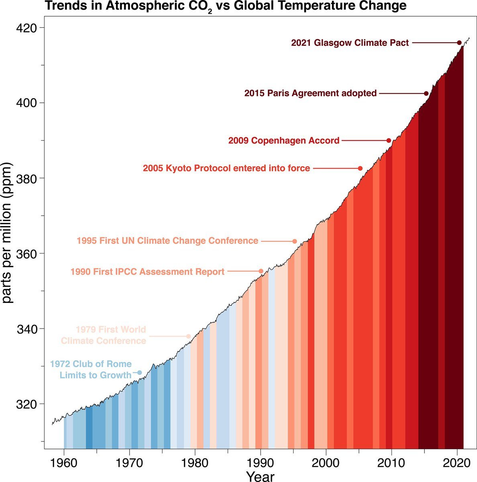
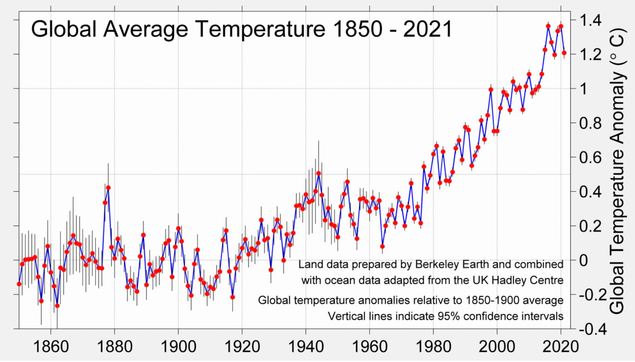
The colors provide an approximate indicator of global mean surface temperature anomaly over the time period. Deepest reds correspond to where we are today (about 1.3°C above pre-industrial). For the actual temp. anomaly plot, here's Berkeley Earth
https://berkeleyearth.org/global-temperature-report-for-2021/#:~:text=Annual%20Temperature%20Anomaly,baseline%20for%20global%20temperature%20targets.
Global Temperature Report for 2021 - Berkeley Earth

2020 was nominally the second warmest year on Earth since 1850. It was slightly colder than 2016 but warmer than every other measured year.

Berkeley Earth
@ClimateHuman this information needs pushed to Congress and to the media at every turn. Every avenue we have at our disposal.
@Thoughts_by_Johnny @ClimateHuman
Agreed, but I fear they have some naive arrogance that humans and innovation can overcome any hurdle because some humans beat other groups of humans before.
@ClimateHuman And that's just relative to the 1850-1900 average. There was likely up to a further 0.2C rise in the previous century, i.e. from pre-industrial times. So we could already be at 1.5C, just waiting for the 10 year average to catch up.
@ClimateHuman decades of warning and... 🦗🦗🦗!
@ClimateHuman It's disappointing to see that #2020 seemed to have no effect on #CO2 levels. Bare in mind there were a lot of #fires I seem to remember 😧

@ClimateHuman

The meetings have largely been hijacked by fossil fuel companies.

@ClimateHuman The scary thing is: it's exponential and we haven't even reached the tipping point where the _rate_ of increase of CO2 decreases.
It's difficult to prepare young people for a future that is so utterly different from our past or present. We can only do the best we can. #EnvironmentalEducation is critical for both mitigation & adaptation.
@ClimateHuman Do you have the raw data of this? I’d like to try fitting an exponential to the curve before 1990. It looks suspicious.
@ArneBab What do you mean? btw I fitted an exponential to the CO2 fraction curve in my book ("Being the Change"):
@ArneBab The raw CO2 fraction data is easy to find online. I posted a link to the global mean surface temperature data (above)

@ClimateHuman I now checked that myself with the mauna loa data. Took a while to get gnuplot to behave …

The result is this:

@ClimateHuman I wanted to check this, because the narrative "these climate conferences do not achieve anything" is a dangerous one — if it is false.

As you can see, if we had continued as we did before 1989, we’d now be at a much worse place.

@ClimateHuman (though this does not prove that it was the conferences that achieved that)
@ClimateHuman What it took for gnuplot to behave (see the image description for the code):
@ClimateHuman That’s an exponential fitted to the whole curve. Do you see how this does not actually capture the time between 1960 and 1990 very well? It appears like between 1960 and 1990 there was a more rapidly rising exponential and it somewhat levelled out after 1990.
Arne Babenhauserheide (@[email protected])

Angehängt: 1 Bild @[email protected] I now checked that myself with the mauna loa data. Took a while to get gnuplot to behave … The result is this:

Die Heimat für Rollenspieler
@ClimateHuman Because it's all lip service at the conference with little in the way of policy to back it up.
@ClimateHuman It seems to me that the problem is consumption as well as production. And consumption by the wealthy regardless of which country they live in. I read that £100k annual income puts someone in the top 1% of global earners - is that a verified statistic?
@ClimateHuman I agree totally, however I think that exponential curve is flattening. And since it is cumulative it’ll take a long time to go back down again.
@peterbrown @ClimateHuman hard to tell and in 100 years either it is flattening and we have a chance or not. My own measure, the state of the mountains, suggests the archeologists are right - no human culture/civilisation has survived climate change and this one with all the aces up its sleeve may be no different

@DaveFernig @peterbrown @ClimateHuman Um, archaeologist who studied climate change impacts here -- and that is absolutely NOT what we say.

Yes, individual polities have been decimated by climatic events, and many historical crises have an environmental component. (I myself have made that exact case regarding the role of megadrought in the rapid decline of the Neo-Assyrian Empire.)

But as nearly any archaeologist who is versed in the subject will tell you, "collapse" is kind of a meaningless and badly-defined term. There are literally dozens of articles and books out there which explicitly lay out WHY "collapse" is a bad term, because it creates the false impression of a total destruction that almost never happens. (Karl Butzer's PNAS piece is a great introduction to that literature: https://www.pnas.org/doi/abs/10.1073/pnas.1114845109)

Case in point, for example: obviously the *polity* of the Roman Empire is dead and gone. But is Roman culture really "dead" when the Latin language, Roman philosophical and legal ideas, Roman iconographies of power, Roman religion (at least from the later Empire), Roman architectural style, and so on, are very much still with us? Even the word "empire" is itself a Roman term still in use today (just like the titles "kaiser" and "tsar" were in fact direct continuations of "Caesar"). So is Roman culture and/or Roman "civilization" (whatever that means) actually "dead," or not? Well, that kinda depends on who you ask, and how you define "dead".

Anyway, my point is this: polities come and go, sure. But "cultures" rarely die unless they are actively killed by other human cultures (as in the case of Spain's brutal colonial conquest of the so-called "New World", for example). And even in those cases, at least some cultural habits or preferences tend to stubbornly cling to life in the new sociopolitical order.

@DaveFernig @peterbrown @ClimateHuman

Hey @FlintDibble have you got anything you'd like to add to this? (Or is there anything I just said above that you'd like to take issue with, for that matter? 😅)

@s3nnacherib @DaveFernig @peterbrown @ClimateHuman

Hi Adam, complicated topic! I think I agree with most of what you said.

Defining collapse is tough. One of the things I find ironic, is most of the "collapses" we see archaeologically are a collapse in elite material culture, yet elites think they might escape modern climate change

I need to time in my life, because Id love to write more on that!

@s3nnacherib @DaveFernig @peterbrown @ClimateHuman

i personally think archaeology and history is very relevant to our own moment, but at the same time (as usual) our own moment is unique. So, it won't provide direct answers, but perhaps a larger context with which to understand our world and the potential impact of the decisions we make

i certainly think it goes to show that we won't "science" ourselves out of this. It's a cultural shift we need, if we will get out of this intact

@FlintDibble In case it wasn't obvious, I absolutely agree we have relevance to how interpreting the present crisis, Flint!

For me the issue is that we have to be really vigilant in not misinterpreting the past for the sake of creating a more dramatic narrative. The evidence for impacts is bad enough as it is; there's no need to embellish it further by failing to acknowledge its complexity.

By the same token, one of the things that drives me up the wall about the sort of "everyone died" narrative about historical climate impacts is that it completely obscures the often-remarkable degree of resilience many past societies showed in the face of climatic disruption. Archaeology and history can inform about adaptation as much as risk, but it's rare to see the former get as much attention in popular discourse as the latter. Both sides of that story really need to be told if we're going to give people a real sense of not only the challenges we face, but that past peoples could and did successfully adapt to climatic challenges in the past.

@ArdentArchivist @FlintDibble @DaveFernig @peterbrown @ClimateHuman Do you mean a paradigm shift about how we think about historical climate change impacts, specifically? (Or relatedly, how the past informs our thinking about the modern climate crisis?)
@ClimateHuman @peterbrown @s3nnacherib @FlintDibble @DaveFernig
How the past informs our thinking is of vital importance, you’re right, but my thinking was much more basic: too many people are too ignorant of the problems (and solutions), and of those who aren’t, too many are burying their heads in the sand. Humanity wants to continue the status quo, but Mother Nature has other ideas. We must accept that & act.
@peterbrown @s3nnacherib @ClimateHuman @FlintDibble @DaveFernig
So yes, it’s a culture thing. And the cultural perception has to change from “We don’t want to deal with this, it’s too expensive and it’s too late anyway,” to “Holy shit, why did we waste half a century? We need to get cracking on this NOW, and no expense is too great vs annihilation.”
Or something like that.

@FlintDibble @DaveFernig @peterbrown @ClimateHuman Hah, yeah... it's funny how that works, isn't it? Almost like they don't realize how dependent they are on the rest of the rest of the world... 😏

And yeah, collapse is SUPER complicated. But it's *definitely* not the sort of straightforward, monocausal nonsense Jared Diamond depicts in his book (which is sadly way more influential than it should be because it's... not great).

@s3nnacherib @FlintDibble @peterbrown @ClimateHuman

I will write more when I have time, but this is absolutely right - collapse is not a simple one way process.
@ClimateHuman So true, we needmore action.
@ClimateHuman and as always, it’s the poor that suffer the most. in 2009 wealthy countries promised $100 billion per year to help vulnerable states. where is it 🤷🏻‍♀️ https://bit.ly/3GdyY44
Flood-hit Pakistan seeks loss and damage 'compensation' at COP27 | Context

Officials and climate experts are calling on rich nations to set up a fund to help the people hit hardest by climate change

just maybe it’s time for women to take over and make some real changes? 💡 @ClimateHuman
@ClimateHuman true, but talking and highlighting the problem — even if the actions taken are insufficient — is better than doing nothing or, worse, denying there is a problem. At least humanity as a whole is post-denial and some attempt at mitigation is underway. Action will ramp up
@ClimateHuman Great Image that highlights just how little Governments have done over the last 50 years.
@ClimateHuman I’m reading in the UK Guardian about the Russian oil and gas lobbyists at COP. What a sham!
@ClimateHuman We have to do it ourselves at every level, from closest local to farthest global. Policy discussions can't substitute for practical action. I start from simplest solar, others do depaving or community gardens, solar & weatherization barnraisings... Mutual aid for emergency preparedness can become a way to transition to a more ecological society.
@ClimateHuman can you link the source for the global co2 levels please? :)
@ClimateHuman why won't it be a failure? The rich who own all the oil and polluting companies don't feel the impact we do. They don't see the need to take massive losses short term to reduce the climates health.
Any government aggressively trying to make changes gets kick out of office.
#COP meetings are just a fanfare for the rich and corrupt governments.
Sadly Africans still attend these meetings begging for money, rather than boycotting and using our resources for ourselves
@ClimateHuman you can’t have it both ways, global warming first, now climate change. Goldman Sachs says over 1 trillion dollars spent and less than 1% change in co2.
@ClimateHuman
Counterfactuals are hard. We can't know what carbon emissions would have looked like without COP meetings. Maybe the increase curve would have been even steeper?
@ClimateHuman How quickly would concentrations react to the reductions of CO2-equivalents emissions? I though about 30years.