 Peter Kalmus
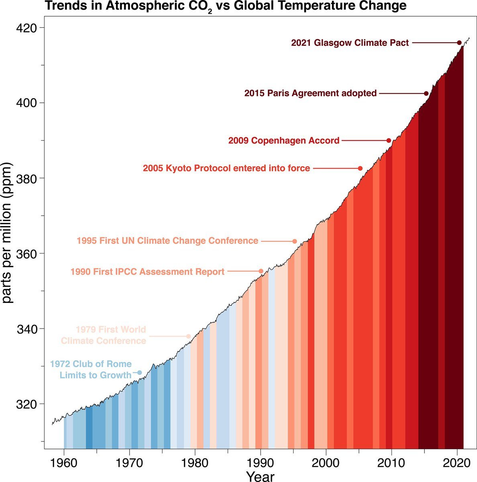
So far, 27 years of COP meetings have been a complete failure; you can't argue with physics. Anyone saying otherwise has fossil fuels or books to sell. #EmergencyMode
@DaveFernig @peterbrown @ClimateHuman Um, archaeologist who studied climate change impacts here -- and that is absolutely NOT what we say.
Yes, individual polities have been decimated by climatic events, and many historical crises have an environmental component. (I myself have made that exact case regarding the role of megadrought in the rapid decline of the Neo-Assyrian Empire.)
But as nearly any archaeologist who is versed in the subject will tell you, "collapse" is kind of a meaningless and badly-defined term. There are literally dozens of articles and books out there which explicitly lay out WHY "collapse" is a bad term, because it creates the false impression of a total destruction that almost never happens. (Karl Butzer's PNAS piece is a great introduction to that literature: https://www.pnas.org/doi/abs/10.1073/pnas.1114845109)
Case in point, for example: obviously the *polity* of the Roman Empire is dead and gone. But is Roman culture really "dead" when the Latin language, Roman philosophical and legal ideas, Roman iconographies of power, Roman religion (at least from the later Empire), Roman architectural style, and so on, are very much still with us? Even the word "empire" is itself a Roman term still in use today (just like the titles "kaiser" and "tsar" were in fact direct continuations of "Caesar"). So is Roman culture and/or Roman "civilization" (whatever that means) actually "dead," or not? Well, that kinda depends on who you ask, and how you define "dead".
Anyway, my point is this: polities come and go, sure. But "cultures" rarely die unless they are actively killed by other human cultures (as in the case of Spain's brutal colonial conquest of the so-called "New World", for example). And even in those cases, at least some cultural habits or preferences tend to stubbornly cling to life in the new sociopolitical order.
@DaveFernig @peterbrown @ClimateHuman
Hey @FlintDibble have you got anything you'd like to add to this? (Or is there anything I just said above that you'd like to take issue with, for that matter? 😅)
@s3nnacherib @DaveFernig @peterbrown @ClimateHuman
Hi Adam, complicated topic! I think I agree with most of what you said.
Defining collapse is tough. One of the things I find ironic, is most of the "collapses" we see archaeologically are a collapse in elite material culture, yet elites think they might escape modern climate change
I need to time in my life, because Id love to write more on that!
@s3nnacherib @DaveFernig @peterbrown @ClimateHuman
i personally think archaeology and history is very relevant to our own moment, but at the same time (as usual) our own moment is unique. So, it won't provide direct answers, but perhaps a larger context with which to understand our world and the potential impact of the decisions we make
i certainly think it goes to show that we won't "science" ourselves out of this. It's a cultural shift we need, if we will get out of this intact
 Peter Brown
 Dave Fernig
 Totally Assyrious
 Flint Dibble
 ArdentArchivist