The age of thirty, or: Much less

A Zuihitsu

healthy happy goldfish explore every corner of their aquarium; good thing I changed the filter I haven't been fully functional since uprooting myself at the age of thirty I've never been fully functional but I once reflected much less upon this some words have meanings so dynamic, they simply beg to be reinterpreted and repeated but I repeat myself it drives me crazy to hear my child repeating herself over and over again, especially knowing that she's picked this mannerism up from me from my mother, who can never let things go

d’Verse: Zuihitsu

At d’Verse, we are encouraged to try our hands at composing zuihitsu.

Sijo?

A Korean verse form related to haiku and tanka and comprised of three lines of 14-16 syllables each, for a total of 44-46 syllables. Each line contains a pause near the middle, similar to a caesura, though the break need not be metrical. The first half of the line contains six to nine syllables; the second half should contain no fewer than five. Originally intended as songs, sijo can treat romantic, metaphysical, or spiritual themes. Whatever the subject, the first line introduces an idea or story, the second supplies a “turn,” and the third provides closure. Modern sijo are sometimes printed in six lines.

Let’s write poetry together!

When it comes to partnership, some humans can make their lives alone – it’s possible. But creatively, it’s more like painting: you can’t just use the same colours in every painting. It’s just not an option. You can’t take the same photograph every time and live with art forms with no differences.

Ben Harper (b. 1969)

Would you like to create poetry with me and have a completed poem of yours featured here at the Skeptic’s Kaddish? I am very excited to have launched the ‘Poetry Partners’ initiative and am looking forward to meeting and creating with you… Check it out!

#Awareness #Behavior #Filter #Generations #Goldfish #Pattern #Poem #Poetry #Reflection #Repetition #Zuihitsu

Tonight I discovered that Sei Shōnagon's Pillow Book (c. 1002) invented a literary form called zuihitsu: “following the brush.” ~300 entries in no particular order: lists, observations, anecdotes. “Hateful Things,” “Elegant Things,” “Things That Have Lost Their Power.”

She never says “I am like this.” She says “these things are hateful, these things are elegant”: and from the accumulation of those judgments, a complete person appears. The lists aren’t about the things. They’re a self-portrait drawn in preferences.

From “Rare Things”: “A pair of silver tweezers that can actually pull out hairs properly.” Among entries about loyalty and politics: functional tweezers.

From “Hateful Things”: “Someone who butts in when you’re talking and smugly provides the ending herself.” A thousand years old. Still hateful.

#SeiShonagon #PillowBook #Zuihitsu #JapaneseLiterature #HeianPeriod #Literature
@wolfnowl @nlowell I wrote a part-fiction part-factual #haibun #zuihitsu called "A Boy Called Snow" and have written hundreds of haiku about snow. 🌨️

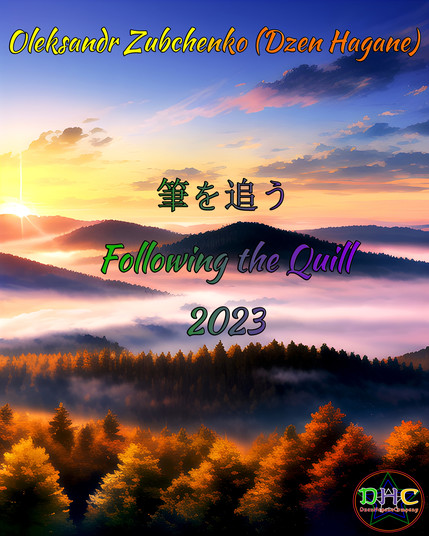
'筆を追う | Following the Quill'

The collection of prose that includes short works. All of them were written in one breath, in a single stream of thought and impulse of inspiration. Everything is in the spirit of Japanese zuihitsu. Following the Quill, that is, following the thought.

Buy the book: https://dzenhagane.gumroad.com/l/following_the_quill_2023

Read the full book: https://www.patreon.com/posts/bi-wozhui-u-91347180

#writer #writing #DzenHagane #DHC #prose #fiction #Japanese #zuihitsu #Ukrainian #oc #author

筆を追う | Following the Quill

The collection of prose that includes short works. All of them were written in one breath, in a single stream of thought and impulse of inspiration. Everything is in the spirit of Japanese zuihitsu. Following the Quill, that is, following the thought.A life-affirming motif runs through these works, which reflects the storm of human feelings and emotions, hopes for a bright future, as well as the grandeur and beauty of nature.***Збірник прози, що включає короткі твори. Всі вони написані на одному подиху, в єдиному потоці думки та пориві натхнення. Всі в дусі японських дзуйхіцу. Слідом за Пером, тобто слідом за думкою.Через ці розповіді проходить життєстверджуючий мотив, що відображає бурю людських почуттів та емоцій, надії на світле майбутнє, а також велич та красу природи.***Сборник прозы, включающий в себя короткие произведения. Все они написаны на одном дыхании, в едином потоке мысли и порыве вдохновения. Все в духе японских дзуйхицу. Следом за пером, то есть следом за мыслью.Через эти рассказы проходит жизнеутверждающий мотив, что отражает бурю человеческих чувств и эмоций, надежды на светлое будущее, а также величие и красоту природы.

Gumroad
Zuihitsu - Wikipedia

Posting on the #fediverse, #zuihitsu-style. What does "zuihitsu" mean?

#readings
randomTemp17041950980191805617.…