My 25 years of palaeoart chronology...

Here are some photos of the Xiphactinus half of my large Western Interior Seaway mural (2021) for Children's Museum of Indianapolis, USA. And, for Fossil Friday, also pictured are a bunch of marine reptile, fish & ammonite fossils. The yellow blurs are animated Caproberyx, using my ZBrush model.

#PaleoArt #SciArt #DigitalArt #Illustration #Dinosaurs #Reptiles #Palaeontology #Paleontology #Xiphactinus #Mosasaurus #JurassicPark #JurassicWorld #FossilFriday

My 25 years of palaeoart chronology...

Here's a closer look at the school of Caproberyx around a Tylosaurus skeleton, from the fish half of my large Western Interior Seaway mural (2021) for Children's Museum of Indianapolis, USA. Also featured are a Xiphactinus, Apsopelix, and a variety of ammonites.

#Painting #PaleoArt #SciArt #SciComm #DigitalArt #Illustration #Dinosaurs #Birds #Reptiles #Palaeontology #Paleontology #Xiphactinus #Tylosaurus #Mosasaurus #Ammonites #JurassicPark #JurassicWorld

My 25 years of palaeoart chronology...

Here's the fish half of my large Western Interior Seaway mural (2021) for Children's Museum of Indianapolis, USA. Featured are a Xiphactinus, Apsopelix, a school of Caproberyx around a Tylosaurus skeleton, and a variety of ammonites.

#Art #Painting #PaleoArt #PalaeoArt #SciArt #SciComm #DigitalArt #Illustration #Dinosaurs #Birds #Reptiles #Palaeontology #Paleontology #Xiphactinus #Tylosaurus #Mosasaur #Mosasaurus #Ammonites #JurassicPark #JurassicWorld

Today's random portfolio artwork is the Xiphactinus section from one of my Mesozoic Monsters murals, in The Children's Museum of Indianapolis. Also features Inoceramus and a school of Caproberyx.

#Art #Painting #PaleoArt #PalaeoArt #SciArt #SciComm #DigitalArt #Illustration #Dinosaurs #Birds #Reptiles #Palaeontology #Paleontology #Xiphactinus

Tuesday’s #megafauna is xiphactinus, a #fish that lived between 112 and 65 million years ago. At up to 20 feet long, it is one of the largest bony fish to ever have lived. Its long, slender body would have allowed it to travel at high speeds, reaching 37 miles per hour. Its fanlike pectoral fins and large tail fin made it a powerful swimmer, capable of leaping from the water (like modern-day dolphins.) This has led to speculation that #xiphactinus could prey on pterosaurs by snatching them from the sky.

Whether or not the behemoth fish ate pterosaurs, it was definitely a voracious predator. Its sharp teeth and large size would have allowed it to feed on many smaller animals in the ocean, including fish, turtles, and even young mosasaurs. In one of the images below, a 13-foot-long xiphactinus skeleton contains the 6-foot long skeleton of a smaller fish–its last meal. However, another image shows a xiphactinus skeleton within the remains of a large shark--also xiphactinus's last meal, in a sense. Despite its appetite, xiphactinus was not an apex predator of the inland sea, and did sometimes fall prey to other, more vicious megafauna.
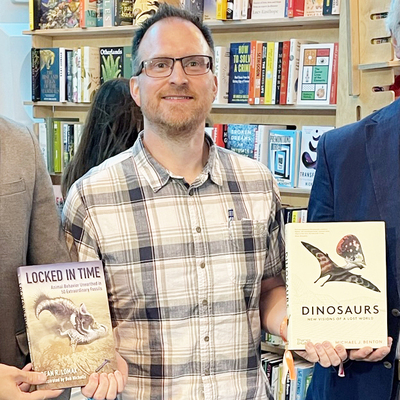
Exasperated #Xiphactinus for #fossilfriday (Senckenberg Museum, Frankfurt). Have a nice weekend, #paleobubble !
And there it is printed!
#Xiphactinus

#Xiphactinus is ready to print, I saw a fossil of one of these in Pittsburgh and it was very impressive. I'd like to do more extinct #fish, there's only so many mackerels I can make.

#fishart #linocut #printmaking #paleoart