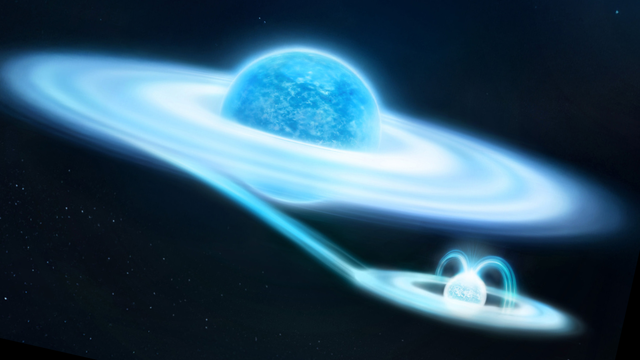
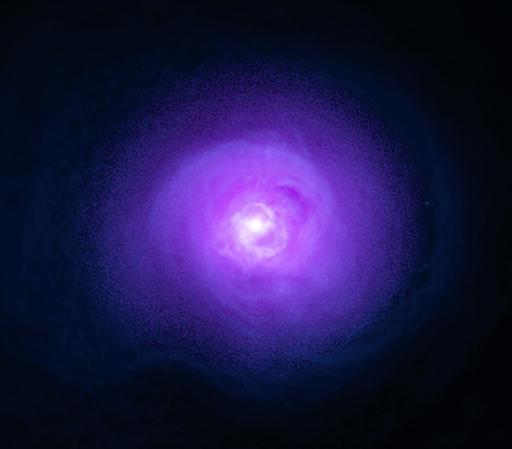
Mystère résolu pour Gamma Cassiopeiae : ses émissions X extrêmes viendraient d’un compagnon naine blanche aspirant la matière de l’étoile www.techno-science.net/actualite/my... #Space #Science #Innovation #Astrophysics #Cosmology #GammaCassiopeiae #XrayAstronomy #BinaryStars

🌟 Le mystère des émissions de ...
🌟 Le mystère des émissions de l'étoile Gamma-Cassiopeiae résolu

Depuis plus d'un siècle, l'étoile nommée Gamma-Cassiopeiae (ou "Gamma-Cas") perturbe les astronomes. Visible à...

Techno-Science.net
Mystère résolu pour Gamma Cassiopeiae : ses émissions X extrêmes viendraient d’un compagnon naine blanche aspirant la matière de l’étoile
https://www.techno-science.net/actualite/mystere-emissions-etoile-gamma-cassiopeiae-resolu-N28577.html #Space #Science #Innovation #Astrophysics #Cosmology #GammaCassiopeiae #XrayAstronomy #BinaryStars
🌟 Le mystère des émissions de l'étoile Gamma-Cassiopeiae résolu

Depuis plus d'un siècle, l'étoile nommée Gamma-Cassiopeiae (ou "Gamma-Cas") perturbe les astronomes. Visible à...

Techno-Science.net

Weekly Update from the Open Journal of Astrophysics – 28/03/2026

Once again it’s time for the usual Saturday morning update of activity at the Open Journal of Astrophysics. Since the last update we have published a further eight papers, bringing the number in Volume 9 (2026) to 67 and the total so far published by OJAp up to 515.

I will continue to include the posts made on our Mastodon account (on Fediscience) to encourage you to visit it. Mastodon is a really excellent service, and a more than adequate replacement for X/Twitter (which nobody should be using); these announcements also show the DOI for each paper.

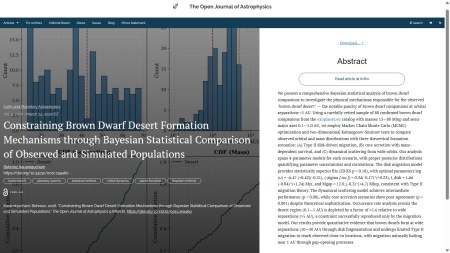
The first paper to report this week is”Constraining Brown Dwarf Desert Formation Mechanisms through Bayesian Statistical Comparison of Observed and Simulated Populations” by Behrooz Karamiqucham (College of Charleston, USA). This paper was published on Tuesday March 24th in the folder Earth and Planetary Astrophysics. It presents a Bayesian statistical analysis exploring why brown dwarf companions are rarely found at orbital separations <5 AU. The results suggest that brown dwarfs form at wider separations then migrate.

The overlay is here:

You can find the officially accepted version on arXiv here and the announcement on Fediverse here:

https://fediscience.org/@OJ_Astro/116282898593823676

The second paper for this week, also published on Tuesday March 24th, but in the folder Astrophysics of Galaxies, is “JWST observes the assembly of a massive galaxy at z ~ 4” by Aayush Saxena (University of Oxford, UK) and 20 others (based in the UK, Europe, USA, Brazil, Japan and China). The paper presents observations of radio galaxy TGSSJ1530+1049, revealing it as part of a dense structure of emitting objects likely to merge to form a massive galaxy within a few Gyr.

The overlay for this one is here:

The official version of the paper can be found on arXiv here and the Fediverse announcement here:

https://fediscience.org/@OJ_Astro/116282956216523629

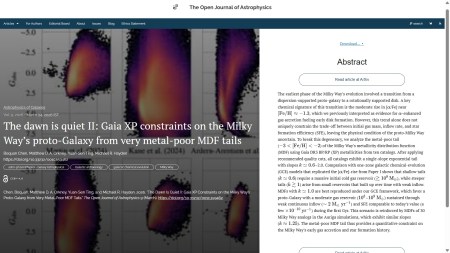
Next one up, the third paper of the week, also published on Tuesday March 24th in the folder Astrophysics of Galaxies, is “The dawn is quiet II: Gaia XP constraints on the Milky Way’s proto-Galaxy from very metal-poor MDF tails” by Boquan Chen (Ohio State U., USA), Matthew D. A. Orkney (Universitat de Barcelona, Spain), Yuan-Sen Ting (Ohio State U.) & Michael R. Hayden (U. Oklahoma, USA). The paper aegues that the Milky Way’s metallicity distribution suggests that its early evolution involved a moderate gas reservoir, sustained by weak continuous inflow, and star formation efficiency similar to the present value.

The overlay for this one is here:

The final, accepted version can be found on arXiv here and the Mastodon announcement is here:

https://fediscience.org/@OJ_Astro/116283020198162509

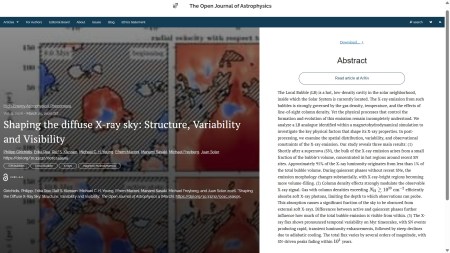
The fourth paper this week, published on Wednesday 25th March 2026 in the folder High-Energy Astrophysical Phenomena is “Shaping the diffuse X-ray sky: Structure, Variability and Visibility” by Philipp Girichidis (Heidelberg U., Germany) and 7 others based in Germany, USA, Austria and Italy. The paper argues that the X-ray properties of the Local Bubble (LB), a low-density cavity in the solar neighborhood reveal that supernova events significantly influence X-ray emissions, which show pronounced temporal variability

The overlay is here:

The finally accepted version of this paper can be found here and the Mastodon announcement is here:

https://fediscience.org/@OJ_Astro/116288916505020843

The fifth paper this week, also published on Wednesday 25th March 2026, is “Graph-Based Light-Curve Features for Robust Transient Classification” by Jesús D. Petro-Ramos David J. Ruiz-Morales, David Sierra Porta (Universidad Tecnológica de Bolívar, Colombia). This paper, which is in the folder Instrumentation and Methods for Astrophysics, uses graph-based representations of astronomical light curves for transient classification, achieving competitive multiclass performance, highlighting the potential of visibility graphs as a survey-agnostic tool for classifying time series.

This is the overlay:

The officially accepted version can be found on arXiv here and the Mastodon announcement follows:

https://fediscience.org/@OJ_Astro/116288982927449308

The sixth paper this week is “Redshift-Frame Systematics and Their Impact on the Hubble Constant from Pantheon+ Supernovae” by Said Laaroua (Santa Rosa Junior College, USA)This was published on Thursday 26th March in the folder Cosmology and Nongalactic Astrophysics. The study analyzes redshift-frame transformations in the Pantheon+ Type Ia supernova sample, finding a negligible shift in the Hubble constant, thus limiting redshift-frame systematics.

The overlay is here:

The officially accepted version of this paper can be found on arXiv here, and the Mastodon announcement is here:

https://fediscience.org/@OJ_Astro/116294271036561714

The penultimate, that is to say the seventh, paper for this week is “Why Machine Learning Models Systematically Underestimate Extreme Values II: How to Fix It with LatentNN” by Yuan-Sen Ting (Ohio State University, USA). The paper introduces LatentNN, a method that reduces attenuation bias in neural networks by optimizing network parameters and latent input values, improving inference in low signal-to-noise astronomical data; the code is available here. This article was published on Thursday 26th March 2026 in the folder Instrumentation and Methods for Astrophysics

The overlay for this one is here:

The official version of this paper can be found here. This is the Mastodon announcement:

https://fediscience.org/@OJ_Astro/116294325612775166

And finally for this week, published yesterday (Friday 27th March 2026) in the folder Astrophysics of Galaxies, we have “Catalog of Mock Stellar Streams in Milky Way-Like Galaxies” by Colin Holm-Hansen, Yingtian Chen and Oleg Y. Gnedin (University of Michigan, USA).

Here is the overlay for this one:

The officially accepted version can be found on arXiv here and the Mastodon announcement is here:

https://fediscience.org/@OJ_Astro/116300257535421390

And that concludes the update for this week.

You will have observed that this week’s papers cover five of the six main categories on astro-ph. We haven’t yet managed to cover all six in a week – we only missed Solar and Stellar Astrophysics this time!

#arXiv250908737v2 #arXiv251009604v2 #arXiv251017721v2 #arXiv251106755v4 #arXiv251113650v3 #arXiv251118901v2 #arXiv251223138v2 #arXiv260322392v1 #AstrophysicsOfGalaxies #BayesianMethods #BrownDwarfs #CosmologyAndNonGalacticAstrophysics #DiamondOpenAccess #DiamondOpenAccessPublishing #EarthAndPlanetaryAstrophysics #GAIA #galaxyFormation #InstrumentationAndMethodsForAstrophysics #JWST #lightCurves #LocalBubble #MassiveBlackHoleSeeds #metallicity #MilkyWay #OpenAccess #OpenAccessPublishing #Pantheon #radioGalaxy #supernassiveBlackHoles #supernovae #TransientAstronomy #XRayAstronomy
NASA IXPE’s Longest Observation Solves Black Hole Jets Mystery - NASA

An international team of astronomers using NASA’s IXPE (Imaging X-ray Polarimetry Explorer) has identified the origin of X-rays in a supermassive black hole’s

NASA
NASA-JAXA XRISM Finds Elemental Bounty in Supernova Remnant

For the first time, scientists have made a clear X-ray detection of chlorine and potassium in the wreckage of a star using data from the Japan-led XRISM

NASA Science

Weekly Update from the Open Journal of Astrophysics – 01/11/2025

It’s time once again for the usual Saturday update of the week’s new papers at the Open Journal of Astrophysics (although a bit later in the day than usual). Since the last update we have published another two papers, which brings the number in Volume 8 (2025) up to 163, and the total so far published by OJAp up to 398.

The first paper this week is “Instability and vertical eccentricity variation in global hydrodynamic disk simulations” by Janosz W Dewberry (U. Mass. Amherst, USA), Henrik N. Latter and Gordon I. Ogilvie (U. Cambridge, UK) and Sebastien Fromang (U. Paris Saclay, France). This article was published in the folder Solar and Stellar Astrophysics on Tuesday 28th October 2025; it discusses the instabilities and eccentricity variations generated in numerical hydrodynamic simulations of accretion disks.

The overlay is here:

You can find the officially accepted version on arXiv here.

The Fediverse announcement is here:

Open Journal of Astrophysics

@[email protected]

New Publication at the Open Journal of Astrophysics: "Instability and vertical eccentricity variation in global hydrodynamic disk simulations" by Janosz W Dewberry (U. Mass. Amherst, USA), Henrik N Latter and Gordon I Ogilvie (U. Cambridge, UK) & Sebastien Fromang (U. Paris Saclay, France)

https://doi.org/10.33232/001c.146332

October 28, 2025, 9:43 am 2 boosts 0 favorites

The second (and last) paper of the week is “Fast X-ray Transient Detection with AXIS: application to Magnetar Giant Flares” by Michela Negro (Louisiana State University, USA) and 8 others based in the USA and Canada. This one was also published on Tuesday 28th October, but in the folder High-Energy Astrophysical Phenomena. It presents a feasibility study of detecting Magnetar Giant Flares with the Advanced X-ray Imaging Satellite (AXIS). The overlay is here:

You can find the official version of this one on arXiv here. The announcement on Mastodon is here:

Open Journal of Astrophysics

@[email protected]

New Publication at the Open Journal of Astrophysics: "Fast X-ray Transient Detection with AXIS: application to Magnetar Giant Flares" by Michela Negro (Louisiana State University, USA) and 8 others based in the USA and Canada

https://doi.org/10.33232/001c.146360

October 28, 2025, 10:02 am 1 boosts 1 favorites

It being a relatively slow week we didn’t reach the 400 mark as I thought we might, but we will probably get there next week. After 10 months of the year 2025, in which we have published 163 papers, a rough projection for the 2025 total is 195. We do have some extra papers up our sleeve, however, so we might well reach 200 for the year. We will find out soon enough!

#accretionDisks #AdvancedXRayImagingSatelliteAXIS_ #arXiv250903763v2 #arXiv251022381v1 #DiamondOpenAccessPublishing #HighEnergyAstrophysicalPhenomena #Magnetars #OpenAccessPublishing #OpenJournalOfAstrophysics #SolarAndStellarAstrophysics #TheOpenJournalOfAstrophysics #XRayAstronomy

Weekly Update from the Open Journal of Astrophysics – 11/10/2025

It’s time once again for the usual Saturday update of the week’s new papers at the Open Journal of Astrophysics. Since the last update we have published six  more papers, which brings the number in Volume 8 (2025) up to 152, and the total so far published by OJAp up to 387. Not only have we passed the 150 mark for the year, but this week saw another record for the Journal, in that it was the first week in which we published at least one paper on every day.

Anyway, here are this week’s papers:

The first paper is “Mapping the Nearest Ancient Sloshing Cold Front in the Sky with XMM-Newton” by Sheng-Chieh Lin (University of Kentucky) and 10 others based in the USA, Spain and Germany. This article, published on Monday 6th October 2025, in the section High-Energy Astrophysical Phenomena discusses cold fronts in the Virgo Cluster, their importance in shaping the thermal dynamics of the intracluster medium beyond the cluster core, and their implications for cluster cosmology.

The overlay is here:


The officially accepted version of this paper can be found on the arXiv here.

The second paper this week, also published on Monday 6th October, is “Testing gravitational physics by combining DESI DR1 and weak lensing datasets using the E_G estimator” by S.J. Rauhut (Swinburne University of Technology, Australia) and an international cast of 63 others. This one is in the folder Cosmology and NonGalactic Astrophysics, and it presents a comparison of  Baryon Acoustic Oscillation (BAO) measurements from BOSS, DESI with weak lensing from KiDS, DES and HSC showing that the results are altogether consistent with the standard cosmological model.

The overlay is here:

You can find the officially accepted version of this paper on arXiv here.

Next one up is “Analysis of Galaxies at the Extremes: Failed Galaxy Progenitors in the MAGNETICUM Simulations” by Jonah S. Gannon (Swinburne University, Australia), Lucas C. Kimmig (Ludwig-Maximilians-Universität, Germany; LMU), Duncan A. Forbes (Swinburne), Jean P. Brodie (Swinburne), Lucas M. Valenzuela (LMU), Rhea-Silvia Remus (LMU), Joel L. Pfeffer (Swinburne) and Klaus Dolag (LMU). This paper, published on Tuesday 7th October 2025, in the folder Astrophysics of Galaxies, discusses the business of identifying the possible high-redshift progenitors of low-redshift ultra-diffuse galaxies in cosmological simulations.

The corresponding overlay is here:

You can find the officially accepted version on arXiv here.

The fourth paper this week, published on Wednesday 8th October 2025 in the folder Astrophysics of Galaxies,  is
What Sets the Metallicity of Ultra-Faint Dwarfs?” by Vance Wheeler, Andrey Kravtsov, Anirudh Chiti & Harley Katz (U. Chicago) and Vadim A. Semenov (CfA Harvard), all based in the USA.

The overlay is here:

You can find the officially-accepted version on arXiv here.

Next, and fifth, we have our 150th publication of 2025, “Synthesizer: a Software Package for Synthetic Astronomical Observables” by Christopher C. Lovell (Cambridge, UK), William J. Roper, Aswin P. Vijayan & Stephen M. Wilkins (Sussex, UK), Sophie Newman (Portsmouth, UK) and Louise Seeyave (Sussex). This paper presents a suite of software tools for creating synthetic astrophysical observables for use in mock galaxy catalogues. It was published on Thursday 9th October 2025 in the folder Instrumentation and Methods for Astrophysics.

The overlay is here:

You can find the officially accepted version on arXiv here.

And finally for this week we have “Introducing the THESAN-ZOOM project: radiation-hydrodynamic simulations of high-redshift galaxies with a multi-phase interstellar medium” by Rahul Kannan (York University, Canada) and 13 others based in the USA, Germany, Japan, Italy and the UK. This one was published on Friday 10th October (i.e. yesterday) in the folder Astrophysics of Galaxies. It describes a comprehensive suite of high-resolution zoom-in simulations of high-redshift galaxies, encompassing a diverse range of halo masses, selected from the THESAN simulation volume.

The corresponding overlay is here:

You can find the officially accepted version of this one on arXiv here.

That concludes the papers for this week. I will, however, add a short postscript. This week saw the announcement of this year’s list of MacArthur Fellows. among them Kareem El-Badry who has published quite a few papers with the Open Journal of Astrophysics. His biography on the MacArthur Foundation page includes this:

He has published articles in Monthly Notices of the Royal Astronomical SocietyThe Astrophysical Journal, and The Open Journal of Astrophysics, among other leading scientific journals.

I’m pleased to see us listed with the established names. I mention this just in case there are still people out there who think it might damage their career if they publish with a non-mainstream journal. I guess we are mainstream now…

#arXiv250220437v3 #arXiv250703182v2 #arXiv250716098v3 #arXiv250803888v3 #arXiv251003150v1 #arXiv251004416v2 #AstrophysicsOfGalaxies #coldFronts #cosmologicalSimulations #CosmologyAndNonGalacticAstrophysics #galaxyFormation #HighRedshiftGalaxies #HighEnergyAstrophysicalPhenomena #InstrumentationAndMethodsForAstrophysics #KareemElBadry #MAGNETICUM #mockGalaxyCatalogues #THESANSimulations #ultraFaintDwarfGalaxy #ultradiffuseGalaxies #VirgoCluster #XRayAstronomy

NASA, JAXA XRISM Satellite X-rays Milky Way’s Sulfur

An international team of scientists have provided an unprecedented tally of elemental sulfur spread between the stars using data from the Japan-led XRISM

NASA Science