 In the Dark
Weekly Update from the Open Journal of Astrophysics – 28/03/2026
Once again it’s time for the usual Saturday morning update of activity at the Open Journal of Astrophysics. Since the last update we have published a further eight papers, bringing the number in Volume 9 (2026) to 67 and the total so far published by OJAp up to 515.
I will continue to include the posts made on our Mastodon account (on Fediscience) to encourage you to visit it. Mastodon is a really excellent service, and a more than adequate replacement for X/Twitter (which nobody should be using); these announcements also show the DOI for each paper.
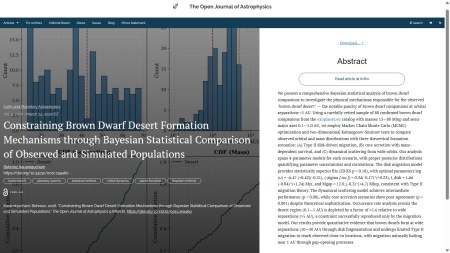
The first paper to report this week is”Constraining Brown Dwarf Desert Formation Mechanisms through Bayesian Statistical Comparison of Observed and Simulated Populations” by Behrooz Karamiqucham (College of Charleston, USA). This paper was published on Tuesday March 24th in the folder Earth and Planetary Astrophysics. It presents a Bayesian statistical analysis exploring why brown dwarf companions are rarely found at orbital separations <5 AU. The results suggest that brown dwarfs form at wider separations then migrate.
The overlay is here:
You can find the officially accepted version on arXiv here and the announcement on Fediverse here:
https://fediscience.org/@OJ_Astro/116282898593823676
The second paper for this week, also published on Tuesday March 24th, but in the folder Astrophysics of Galaxies, is “JWST observes the assembly of a massive galaxy at z ~ 4” by Aayush Saxena (University of Oxford, UK) and 20 others (based in the UK, Europe, USA, Brazil, Japan and China). The paper presents observations of radio galaxy TGSSJ1530+1049, revealing it as part of a dense structure of emitting objects likely to merge to form a massive galaxy within a few Gyr.
The overlay for this one is here:
The official version of the paper can be found on arXiv here and the Fediverse announcement here:
https://fediscience.org/@OJ_Astro/116282956216523629
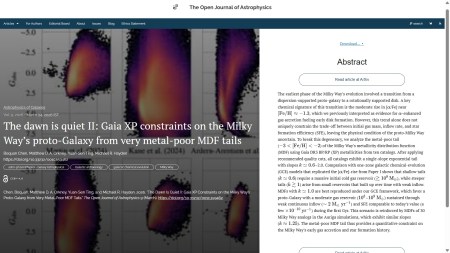
Next one up, the third paper of the week, also published on Tuesday March 24th in the folder Astrophysics of Galaxies, is “The dawn is quiet II: Gaia XP constraints on the Milky Way’s proto-Galaxy from very metal-poor MDF tails” by Boquan Chen (Ohio State U., USA), Matthew D. A. Orkney (Universitat de Barcelona, Spain), Yuan-Sen Ting (Ohio State U.) & Michael R. Hayden (U. Oklahoma, USA). The paper aegues that the Milky Way’s metallicity distribution suggests that its early evolution involved a moderate gas reservoir, sustained by weak continuous inflow, and star formation efficiency similar to the present value.
The overlay for this one is here:
The final, accepted version can be found on arXiv here and the Mastodon announcement is here:
https://fediscience.org/@OJ_Astro/116283020198162509
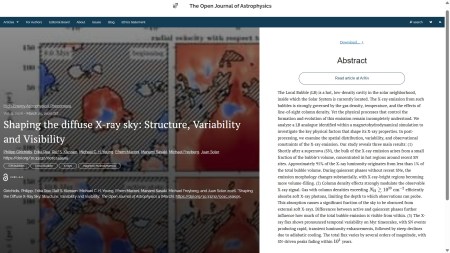
The fourth paper this week, published on Wednesday 25th March 2026 in the folder High-Energy Astrophysical Phenomena is “Shaping the diffuse X-ray sky: Structure, Variability and Visibility” by Philipp Girichidis (Heidelberg U., Germany) and 7 others based in Germany, USA, Austria and Italy. The paper argues that the X-ray properties of the Local Bubble (LB), a low-density cavity in the solar neighborhood reveal that supernova events significantly influence X-ray emissions, which show pronounced temporal variability
The overlay is here:
The finally accepted version of this paper can be found here and the Mastodon announcement is here:
https://fediscience.org/@OJ_Astro/116288916505020843
The fifth paper this week, also published on Wednesday 25th March 2026, is “Graph-Based Light-Curve Features for Robust Transient Classification” by Jesús D. Petro-Ramos David J. Ruiz-Morales, David Sierra Porta (Universidad Tecnológica de Bolívar, Colombia). This paper, which is in the folder Instrumentation and Methods for Astrophysics, uses graph-based representations of astronomical light curves for transient classification, achieving competitive multiclass performance, highlighting the potential of visibility graphs as a survey-agnostic tool for classifying time series.
This is the overlay:
The officially accepted version can be found on arXiv here and the Mastodon announcement follows:
https://fediscience.org/@OJ_Astro/116288982927449308
The sixth paper this week is “Redshift-Frame Systematics and Their Impact on the Hubble Constant from Pantheon+ Supernovae” by Said Laaroua (Santa Rosa Junior College, USA)This was published on Thursday 26th March in the folder Cosmology and Nongalactic Astrophysics. The study analyzes redshift-frame transformations in the Pantheon+ Type Ia supernova sample, finding a negligible shift in the Hubble constant, thus limiting redshift-frame systematics.
The overlay is here:
The officially accepted version of this paper can be found on arXiv here, and the Mastodon announcement is here:
https://fediscience.org/@OJ_Astro/116294271036561714
The penultimate, that is to say the seventh, paper for this week is “Why Machine Learning Models Systematically Underestimate Extreme Values II: How to Fix It with LatentNN” by Yuan-Sen Ting (Ohio State University, USA). The paper introduces LatentNN, a method that reduces attenuation bias in neural networks by optimizing network parameters and latent input values, improving inference in low signal-to-noise astronomical data; the code is available here. This article was published on Thursday 26th March 2026 in the folder Instrumentation and Methods for Astrophysics
The overlay for this one is here:
The official version of this paper can be found here. This is the Mastodon announcement:
https://fediscience.org/@OJ_Astro/116294325612775166
And finally for this week, published yesterday (Friday 27th March 2026) in the folder Astrophysics of Galaxies, we have “Catalog of Mock Stellar Streams in Milky Way-Like Galaxies” by Colin Holm-Hansen, Yingtian Chen and Oleg Y. Gnedin (University of Michigan, USA).
Here is the overlay for this one:
The officially accepted version can be found on arXiv here and the Mastodon announcement is here:
https://fediscience.org/@OJ_Astro/116300257535421390
And that concludes the update for this week.
You will have observed that this week’s papers cover five of the six main categories on astro-ph. We haven’t yet managed to cover all six in a week – we only missed Solar and Stellar Astrophysics this time!
#arXiv250908737v2 #arXiv251009604v2 #arXiv251017721v2 #arXiv251106755v4 #arXiv251113650v3 #arXiv251118901v2 #arXiv251223138v2 #arXiv260322392v1 #AstrophysicsOfGalaxies #BayesianMethods #BrownDwarfs #CosmologyAndNonGalacticAstrophysics #DiamondOpenAccess #DiamondOpenAccessPublishing #EarthAndPlanetaryAstrophysics #GAIA #galaxyFormation #InstrumentationAndMethodsForAstrophysics #JWST #lightCurves #LocalBubble #MassiveBlackHoleSeeds #metallicity #MilkyWay #OpenAccess #OpenAccessPublishing #Pantheon #radioGalaxy #supernassiveBlackHoles #supernovae #TransientAstronomy #XRayAstronomy