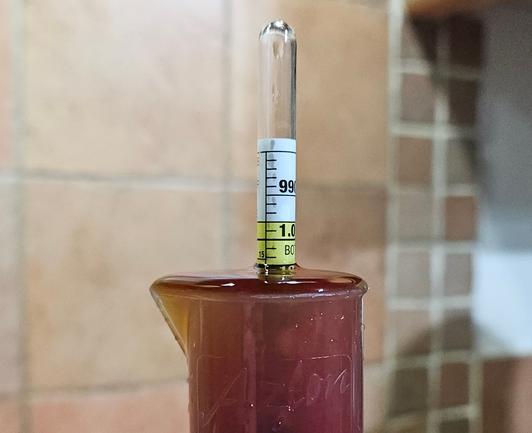
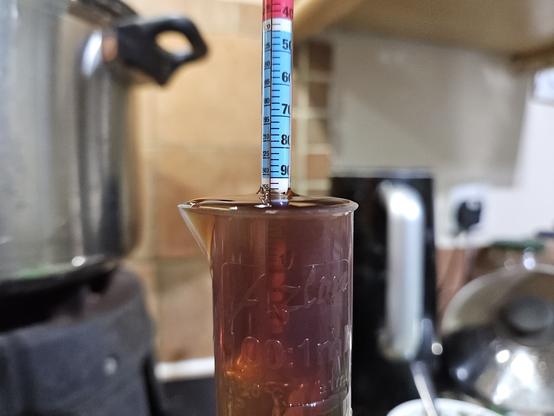
So the FG is coming in at about 1.007, I'll call it 1.008, and the OG was 1.113, so the ABV is probably at the upper-end of the 13.5% to 14% range.

It is definitely dry... and sharp, a bit too sharp, I regret the pre-fermentation acid addition. (Glad I have since bought a new digital pH meter, I've not checked the pH of this but I suspect it's quite low.)

I've experimented sweetening it with some brown sugar and it seems about right at 5g of sugar per 40g of wine, still sharp, but better balanced, and it comes across a bit less boozy. But then I need to worry about the ferment re-starting if I add sugar, I guess I could add some sodium met and potassium sorbate (I don't have the latter).

Anyway, the result is interesting and palatable-enough booze. Hard to pin down the flavour profile, would I guess it was made with dates? Probably not. It's more raisin-y... if there's really much of a difference in that.

#Fermentation #HomeBrewing #WineFermentation #FruitWine #Booze #Alcohol

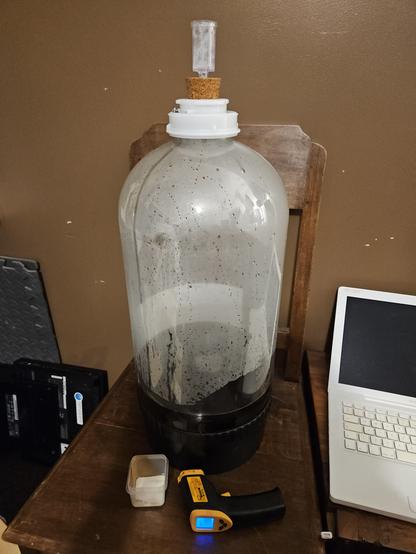
The #DateWine ferment is definitely finished at 21 days, perhaps really finished about a week ago, but I let it sit to ensure the yeast was as dropped out as it could be.

Now I've transferred to a smaller container, still more headroom than I'd like in this but it's what I've got for the job at the moment.

Ah, that satisfying final gurgle of the syphon... not syphoned a fermenter for many years. (The syphon and the receiver were sterilised with sodium met, no-rinse, and the syphon was primed with tap water which was discharged to a glass before shifting it to the receiver, no sucking on tubes going on around here. Trying to keep it all as clean as I can.)

#Fermentation #HomeBrewing #WineFermentation #FruitWine #Booze #Alcohol

Measured the date extract into the FV and we have just over 4.5 litres; added 5.25g yeast nutrient, 1.31g wine tannin, and 4.94g of acid blend.

The "FV" is a clear PET 20l "PolyKeg" outer shell. This has been rinsed, then sort of soaked/rinsed with warm VWP solution, I reached in with a sponge on a stick and cleaned the bottom a bit as it seemed to have some discolouration - all gone now. Then it got a rinse/soak with sodium met solution.

First time I've used one of these as a FV, it's a bit over-sized but should be OK for "primary" before racking into a 5l bottle.

I have 5.71g of pectolase on standby to add after it drops below 30C.

I was unsure whether or not to add a campden tablet but I'm hoping the fact it was boiled is sufficient to ward off unwanted beasties.

I'm researching whether I should delay putting the yeast in after adding the pectolase, mixed information online as usual.

#Fermentation #HomeBrewing #WineFermentation #FruitWine

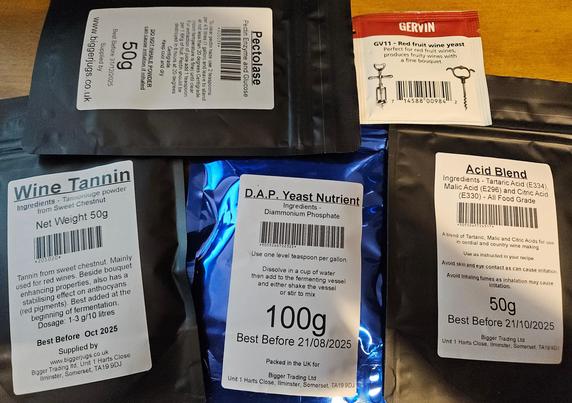
Next to decide what amendments to add to the date extract. I think a bit of "winging it" is going to be involved really. I got a few things in preparation for making the raspberry wine I still haven't done, so have these to hand. (Must do that raspberry next, maybe raspberry mead.)

Date wine recipes tend to add lemon juice, so I'll add some acid.

A lot of general fruit wine recipes add about a teaspoon of "acid blend" per gallon. So I'll try that, and kinda go by taste for acidity. And pop the packet's guideline amount of tannin in.

There is some pectin in dates apparently so I'll add pectolase too, won't hurt.

#Fermentation #HomeBrewing #WineFermentation #FruitWine

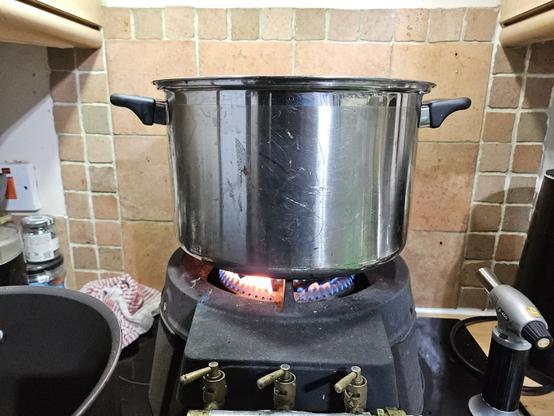
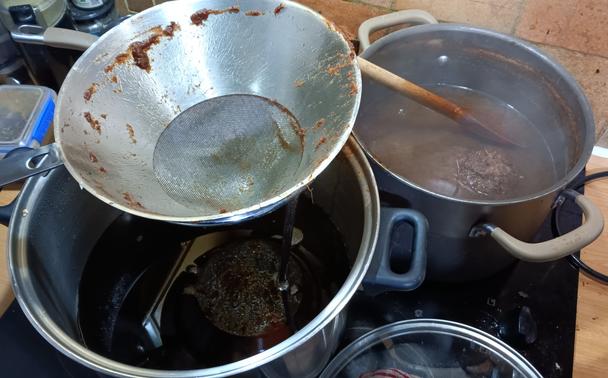
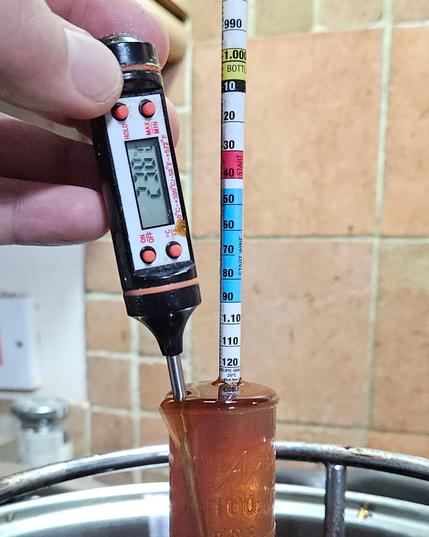
I've then boiled that down, ending up with 4.2 litres which I blended with fresh bottled water up to the target of 4.5 litres. I'm currently reading about 1.094 at 55C - aka about 1.105 at 20C.

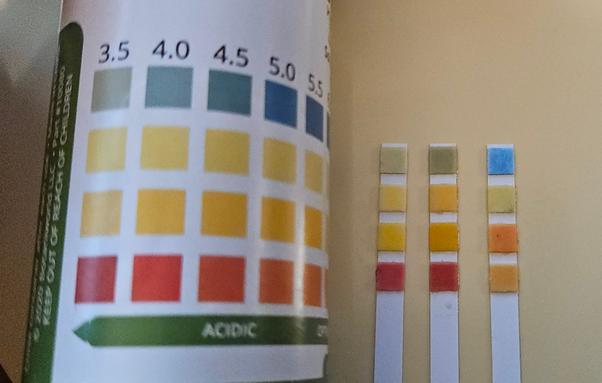
My old pH meter is no use any more so I'm resorting to good old pH test strips. The colour of the solution probably throws off the visuals a bit but as well as the scale on the container I'm comparing to strips dipped in 4.0 and 7.0 buffer solutions and I reckon this is in the region of 4.0, low 4s maybe.

I wasn't expecting the date extract to measure that acidic though. 🤨

#Fermentation #HomeBrewing #WineFermentation #FruitWine

Back at my date bothering game.

Date syrup and date-pulp fart-bread done, next up it's time to try fermenting some date wine. This is the "first runnings" from 2kg of date pulp. I've moved on to a much larger pot now.

The OG on this is off the scale lol... literally, on my hydrometer.

No idea what ratio of the contributors to the gravity are fermentables, I guess we shall find out lol.

"Second runnings" just up to simmer now and turned off to steep until the evening.

I think I'll aim for a OG of 1.150 - depending on the fermentables, and the formula, this could yield anything up to around 15% ABV, but I'm just hoping for anything over 10% really.

Hmm... what are appropriate home wine/homebrew hashtags?

#Fermentation #HomeBrewing #WineFermentation #FruitWine

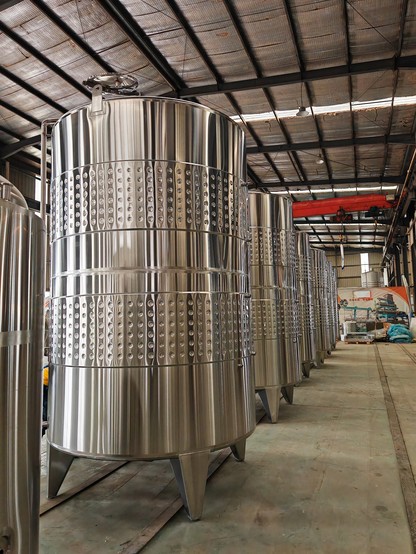
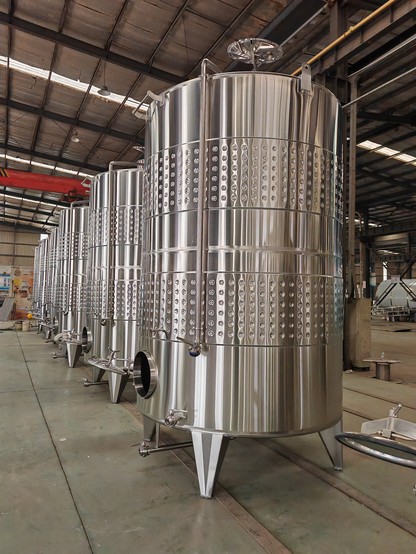
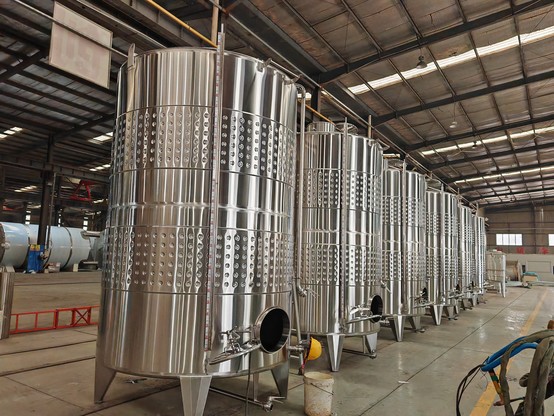
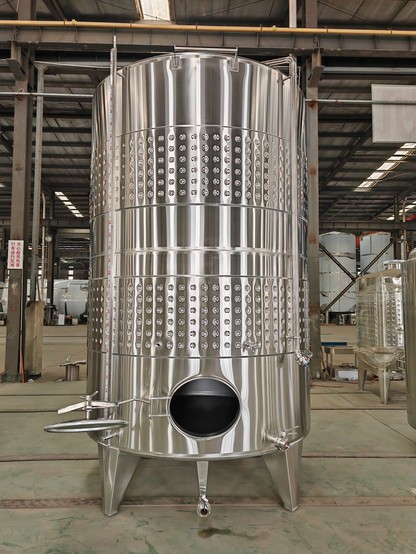
10000liter white wine fermentation tank #wine #winery #winetanks #winefermentation #winestorage
Web:www.sdchenma.com
Email:[email protected]
Whatsapp:008613789827830

Armenia, a country with a long history and deep cultural roots, is home to the world's oldest winery, Areni-1 Winery. The ancient winery, discovered in 2007, dates back over 6,100 years and is preserved in the darkness of a cave.

Wine Fun Facts:

- Per recent molecular archaeology research, the French learned to make wine from the Italians around 425 BC.

- There are nearly 65,000 wine producers worldwide, with around 14,000 of those producers located within the U.S.

- The sense of smell is over 10,000 times more sensitive than the sense of taste, so smelling is the most important aspect of enjoying wine.

- The juice of 600 to 800 grapes is contained in a 75cl bottle of wine.

It was centuries ago that people drank wine instead of water because the water was not always clean, and natural fermentation made wine safer to consume

As a result of the discovery of the winery, a new light has been shed on Armenia's long-standing tradition of winemaking, which has been an integral part of the nation's culture and identity for many years.

There is a wine press for crushing grapes, a fermentation area, and a cellar-like storage area at Areni-1 Winery. The presence of malvidin, the pigment found in red wine, further confirms the site's winemaking history. An ancient winery like this is a testament to the perseverance of Armenian culture and the art of winemaking, which has been handed down from generation to generation.

Armenia's wine industry has experienced a renaissance in recent years, despite numerous challenges, including the Soviet era's focus on brandy production. Armenian winemaking has been propelled into the 21st century by the emergence of wineries such as ArmAs and Zorah, which embrace the region's ancient techniques and storied wine culture.

Armenia's oldest winery, Areni-1, symbolizes the nation's rich winemaking heritage and is a testament to its resilience and innovation. The Armenian wine industry continues to grow and evolve, but preserving and celebrating its ancient roots is important.

Keywords: #Armenia #OldestWinery #Areni1Winery #WineHistory #CulturalRoots #WineFacts #WinemakingTradition #ArmenianWineIndustry #AncientTechniques #WineCulture #Resilience #Innovation #WineLovers #ArmenianHeritage #WineArchaeology #ArmenianWineries #ArmAs #ZorahWinery #WineTasting #HistoricWinery #WinePress #WineFermentation #AncientWine #ArmenianRenaissance