 Droppie [infosec] 🐨




@MaxG oh this is fantastic! i absolutely love the vinegar of its overt disdain. nicely done!
#AusPol #WhyTheFuckIsLabor #HahahahaLiebs #NatsAreNuts #GreensYEAH #VoteGreens #VoteProgIndies #PHONkedinthehead
@MaxG oh this is fantastic! i absolutely love the vinegar of its overt disdain. nicely done!
#AusPol #WhyTheFuckIsLabor #HahahahaLiebs #NatsAreNuts #GreensYEAH #VoteGreens #VoteProgIndies #PHONkedinthehead
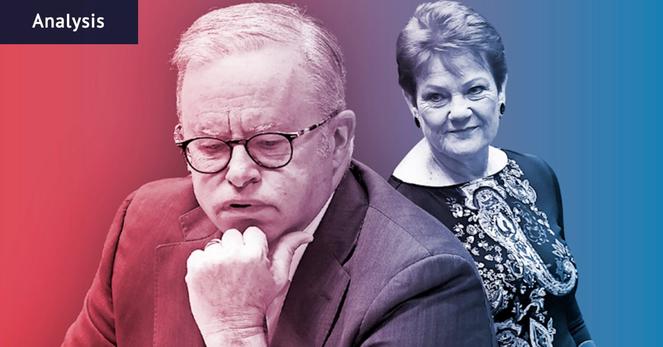
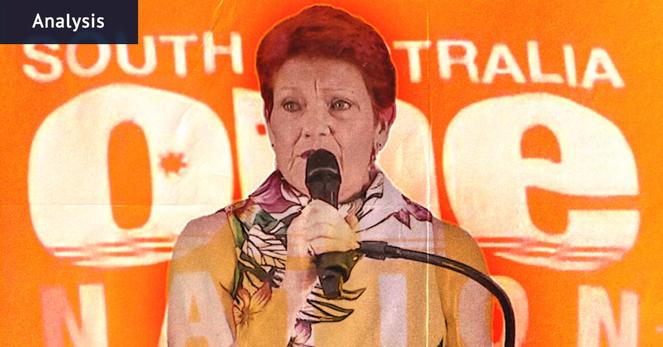
But unless One Nation’s voters also reckon with the consequences of where their preferences land, they’re not changing the system. They’re reinforcing it.
But in electoral terms it’s something else entirely: a very effective way to keep Labor in power.
clearly poorline is too dimwitted to intellectually grasp this. based on recent federal polling, & last night's result of #saelection, i have to assume that her supporters are equally stupid.
tis basically the main problem with #democracy... #TheGreatUnwashed 🙄🤦♀️
#AusPol #WhyTheFuckIsLabor #HahahahaLiebs #NatsAreNuts #GreensYEAH #VoteGreens #VoteProgIndies #PHONkedinthehead
https://chaser.com.au/national/albanese-to-add-booing-him-to-controversial-hate-speech-laws/
Prime Minister Anthony Albanese has announced a new addition to his controversial hate speech laws which will now include people booing him or mentioning his support for Israel’s genocidal actions.
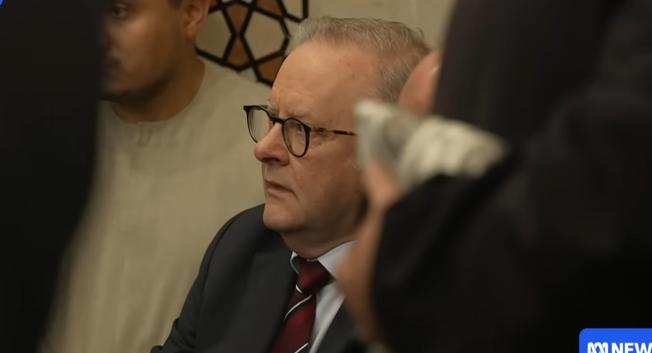
The PM justified this change by pointing to his recent statement that the only reason anyone would boo him is if they love terrorism, following an incident when he was heckled while trying to stage a photo-op at a mosque.
“What ever happened to social cohesion?” said Albanese after asking ASIO to put any muslim who doesn’t bow to him onto terror watch-list.
“These sorts of disgusting attacks on vulnerable politicians need to be stopped, we are a minority after all.”
The PM said he will also be banning the use of ‘hateful slurs’ including ‘spineless prick’ and ‘class traitor’.
Quote
At the ripe old age of 97, the death of the Cold War espionage writer, Len Deighton, just days ago, came as a different kind of shock.
News of his passing felt somehow subsidiary to a bigger revelation - until last week, Deighton had still been among us.
You knew with John le Carre because he had continued publishing. His last title, Silverview, was released posthumously in 2021.
Deighton, though, the breakthrough author of the Ipcress File (1962), among many, had stopped writing spy fiction three decades ago, retreating to quietude. Apparently, he took a holiday and decided he liked it.
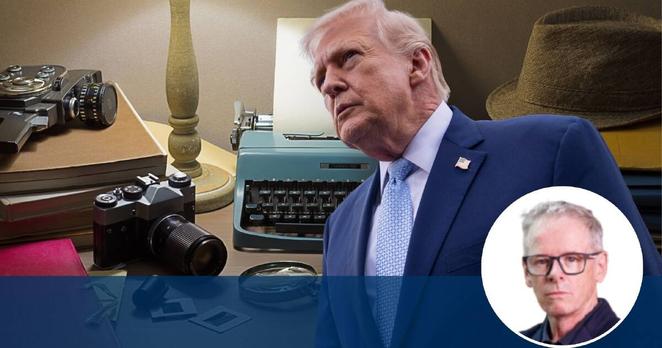
Fame wasn't his thing. He was everything Donald Trump isn't. Talented, studious, restrained, and impeccably subtle.
These qualities infused his characters - espionage being a secret, thankless business - ruthlessly so. It despises headlines and shuns recognition of any kind. Deighton leaned into that (mostly) observing once that nothing destroys a writer like praise.
His work evinced his principles, too. He had what these days would be an unfashionable distaste for violence and decided it would only appear in his stories where required and never as the answer to his characters' problems.
Both authors wrote about human beings by juxtaposing their quotidian struggles with relationships and secrecy and bureaucracy, against big forces, genuine personal danger and crippling moral choices.
Each author knew that the space between their paragraphs was vital - it was where the reader did their end of the work. This, too, matched the atmosphere and tradecraft central to the spy genre where information was invariably thin, dubious and old.
In hindsight we can see the period, both in its fictional evocation and in its history, as marked by profound existential peril, balanced off, albeit, by a useful degree of inertia.
Fractious Cold War crises (Berlin Wall, 1961, Cuban Missile Crisis 1962) were survived through reluctance, back-channel diplomacy, self-preservation and luck.
It was an era when what "could" happen was both known and unthinkable.
Compare that to today when the "unthinkable" is so quickly superseded by the unthought-through.
Again, we live in time of deep global instability and portentous violence.
Gone now though is the institutional inertia. It's been replaced by impulsiveness and the preference for shallow stagecraft over longer-term statecraft.
Or, as recent UK secretary of state for defence Ben Wallace wrote midweek in Britain's The Telegraph, "This is what you get when a superpower with the most powerful armed forces in the world, is run by a collection of TV pundits and golf buddies: pure chaos".
The former Tory minister and ex-British Army officer also observed that one didn't need to be a defence expert to predict what Iran would do when attacked.
"Iran's leaders have always played the only three cards they hold: proxies, hostage taking, and shutting down the Strait of Hormuz."
People who have seen combat tend to know a dud plan when they see one, even if Australia's political class has been blind to it.
It took another plain-speaking ex-commando MP to break ranks, skewering a Trump social media rant against Australia and others for not joining his escapade.
"I thought it was a petulant post from a president under immense pressure," Liberal frontbencher Andrew Hastie told the ABC.
"Yesterday, he said he didn't expect the Strait of Hormuz to be closed for this long - well, as I like to quote Mike Tyson, everyone has a plan until they get punched in the face".
I've often wondered what the great historical fiction writers of the Cold War and the lead-up to World War II, would make of the belligerent miscalculations reshaping the world currently.
How would they render the craven appeasement of a lawless US by its allies? How would they characterise the willingness of longstanding democracies to accommodate the aggressive right-wing government of Benjamin Netanyahu and its extraordinary sway over the Trump White House?
Among the greatest of these writers is the Jewish American Francophile, Alan Furst, 85, whose unfailingly human novels occur against the backdrop of a Europe succumbing to fascism and war. Furst's characters read the signs of German militarisation and see the writing on the wall as Czechoslovakia, Austria, Poland and Hungary are incorporated, overrun, or captured by local fascists.
Furst's ordinary heroes take huge risks in smuggling downed airmen back to Britain or obtaining fragmentary intel about German armaments manufacture - tiny scraps of information such as the production orders of a particular aviation wire or what grade of gun oil is being issued to Wehrmacht divisions. The former to guess at the number of bombers being built, the latter to determine if weapons are being prepared to operate in an invasion of France or the frozen East.
Underneath such story lines, runs a truth so present as to never require mention - that democracy and tolerance and culture and human rights offer the only way forward.
Of course, we know where Europe's journey led. But what about now? If the US didn't countenance a regionalised war, the closure of a vital sea lane, and a calamitous oil shock, what hope the rest of us?
And don't forget, before calling NATO allies "cowards," Trump announced he would have the honour of "taking Cuba". You wouldn't read about it.
Unquote
#AusPol #WhyTheFuckIsLabor #HahahahaLiebs #NatsAreNuts #VoteGreens #VoteProgIndies #USPol #TuckFrump #FuckRWNJs #magamorons #FuckChristoFascists #FuckAllReligion #OrangeOaf #HeyFascistCatch
little better that good government could not be a reason for preferring Labor.
Labor's embrace of the national security state has made it highly illiberal and authoritarian about civil liberties, and about using legislation as a blunderbuss against behaviour of which it, or one of its police or security officials, disapproves. In some fields, as with the Australian ISIS brides, Albanese was mean-minded, bigoted, and incapable of seeing where a statesman should stand.
Labor assumes that Greens will be virtually automatic in supporting its legislation - again on the theory that bad as they are, they are preferable to the Coalition, or worse, Pauline Hanson. But Albanese misses no opportunity to attack the Greens, to attack their motives and their practicality, and to limit the possibility of their declaring any sort of "win", even with good ideas.
His monolithic focus on Labor credit is more than disrespect for the individuals or ideologies involved: it disrespects those who voted for them. Among these are groups whose (two-party preferred) preference for Labor should be being treasured and celebrated: young people, women, the better educated, and migrants. None of Labor's charisma is being beamed in their direction. If they are forefront in Albanese's mind, it is far from obvious, in major part because he does not try to engage or connect.
Albanese's style distresses traditional Labor supporters as much as it does people now accustomed to voting for the Greens and progressive independents. Some think wearily that whatever happens, Labor will probably do a better job than the other side. For the moment, they might be right.
But a moment may come over Australia's un-Australian defence policies, its sheer awfulness on refugee issues, its mark-time on indigenous affairs and its limited visions for health and education where some will say enough! That Labor is not worth fighting for. Or crossing the road for. That's what the diehards should fear while preparing their winter quarters.
Unquote
#AusPol #WhyTheFuckIsLabor #HahahahaLiebs #NatsAreNuts #VoteGreens #VoteProgIndies 2/2
 Droppie