
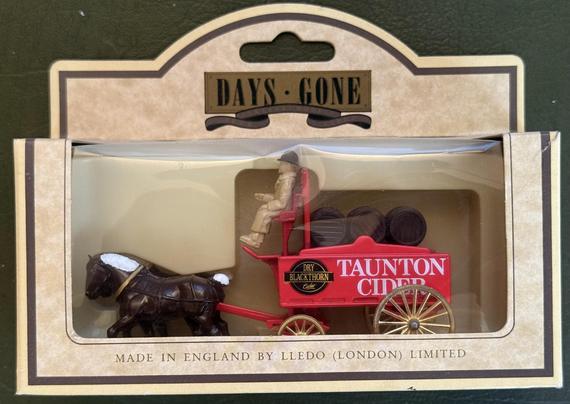
Taunton Cider dray from my collection. Made in 1989 by Lledo, a British manufacturing company.The factory produced mainly die-cast promotional models until 1999, when the company went into bankruptcy trying to compete with cheaper imports. Days Gone by were a nod to the Matchboxโ€™s Yesterdays series. They had a limited range so note the Taunton cider model is the same as the Truman beer dray, just painted in the appropriate livery. #cider #Taunton #Truman #beer #dray #toymodels #Lledo

Eight challenges in developing theory of intelligence
https://arxiv.org/abs/2306.11232

A good theory of mathematical beauty is more practical than any current observation, as new predictions of physical reality can be verified self-consistently. This belief applies to the current status of understanding deep neural networks including large language models and even the biological intelligence.

#intelligence #ArtificialIntelligence #RepresentationLearning #LLM #ToyModels #modeling #MathematicalModeling

Eight challenges in developing theory of intelligence

A good theory of mathematical beauty is more practical than any current observation, as new predictions of physical reality can be verified self-consistently. This belief applies to the current status of understanding deep neural networks including large language models and even the biological intelligence. Toy models provide a metaphor of physical reality, allowing mathematically formulating that reality (i.e., the so-called theory), which can be updated as more conjectures are justified or refuted. One does not need to pack all details into a model, but rather, more abstract models are constructed, as complex systems like brains or deep networks have many sloppy dimensions but much less stiff dimensions that strongly impact macroscopic observables. This kind of bottom-up mechanistic modeling is still promising in the modern era of understanding the natural or artificial intelligence. Here, we shed light on eight challenges in developing theory of intelligence following this theoretical paradigm. Theses challenges are representation learning, generalization, adversarial robustness, continual learning, causal learning, internal model of the brain, next-token prediction, and finally the mechanics of subjective experience.

arXiv.org