Which Lenses Hold Their Value Better, Zooms or Primes?

Let's take a look at some of the data with regard to the latest trends in camera gear buying, trading, and selling. Specifically, we'll take a look at what lenses hold on to their value better: primes or zooms.

Previously, we compared two leading medium format mirrorless systems, whether mirrorless cameras depreciate faster than DSLRs, and what Leica-M gear sells the fastest.

This story is part ofKEH’s Tilt-Shift Report, where the company shares exclusive data and unique insights into the latest trends in camera gear buying, trading, and selling.

The Tilt

Before we go in deep, let's start with an explainer of what constitutes a prime and a zoom lens. If you're already in the know, maybe skip down to the next section.

Prime lenses have fixed focal lengths, like for instance, a Canon 50mm f/1.4 lens.

It only offers one angle of view, so if you want your subject to appear bigger or smaller within the frame, you have to physically move the lens closer or farther away.

That 50mm lens is rather compact, however, so it's portable, and the lack of focal-length flexibility is made up by its wide aperture, which makes it convenient to shoot in low light or to isolate the subject by blurring the background.

Zoom lenses, on the other hand, have variable focal lengths, like for instance, the Canon 24-70mm f/2.8.

It can shoot at 50mm, but also zoom out to 24mm and zoom in at 70mm (and every focal length in between) with the simple twist of the barrel.

With a zoom lens, a photographer can stay put in one spot and conveniently change the angle of view, bringing the subject closer or farther away. But the lens is considerably bigger and heavier than the aforementioned 50mm, and the aperture doesn't open quite as wide, so it may be tougher to shoot in low light.

These examples notwithstanding, there's a fallacy that prime lenses are always better optically, offer wider apertures, and are smaller, lighter, and more durable than zooms. While this generalization is somewhat historically accurate, it is no longer the case across the board.

The Shift

Over the decades, with advancements in design, engineering, and construction, the case for the lesser quality of zoom lenses has held less water, and especially now, that water is mighty muddy.

Nowadays, it's easy to find a zoom lens that offers great optical performance and a wide aperture, but perhaps sacrifices size and weight. The large and heavy Canon RF 28-70mm f/2 is a perfect example of this.

Inversely, the tiny Fujifilm XC 15-45mm f/3.5-5.6 zoom has nothing on the image quality and wide aperture of the Fujifilm XF 50mm f/1.0 prime, but it's considerably smaller, lighter, and offers a flexible range of focal lengths.

This newfound balance is the reason most photographers own both primes and zooms—different jobs demand different tools, and manufacturers have responded by addressing the needs of different photographers.

But say there are two camps of photographers out there, one who exclusively invests in zooms, and the other in primes—who stands to spend more, but ultimately gets more back when they upgrade or change systems? Let's find out.

For this dataset, I limited it to one condition grade (EX) across all exceptions (with cap; with cap and hood, etc.). I set the time period from January 2018 to the current month of November 2021.

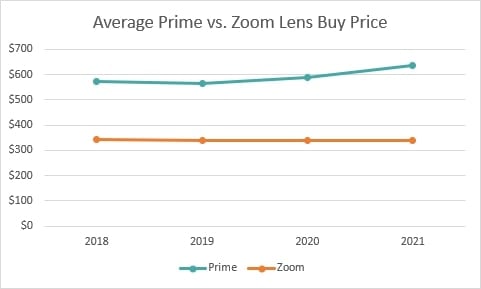
First, I looked at the average buy price for each type. The buy price is what a customer would spend buying the used lens at KEH.

As you can see above, there's quite a price gap between the two types, with primes being considerably more expensive. The current average buy price for a prime lens is $637, while for zooms it's $340.

More importantly, prime lenses have increased in price by 11% over the last three years, while zooms have decreased by 1%.

When looking at which models have decreased in price the most, I thought there might be a lot of kit zoom lenses on the list, as they are plentiful, and usually lose their value pretty quickly. The Canon EF-S 18-55mm f/4-5.6 is in fact on there, dropping in price by 52.3%, but surprisingly, it's the only kit lens in the bottom 100.

Most of the other lenses that have lost considerable value are Alpha-mount zooms, which have become less relevant since Sony quietly discontinued the mount earlier this year. Other zooms that have not fared well are for the Canon EF-M mount, which has also been dropped by the manufacturer in recent times.

However, lots of zoom lenses have increased in price over the last three years. For example, the Canon EF 75-300mm f/4-5.6 III lens has gone up by 93.8%, and the Tokina 80-200mm f/3.5-4.5, has increased by 70.7%.

Overall, if the mount is still active, there seems to be appreciation across the board for zooms, although on average, it's definitely less than what's happening on the side of primes.

Speaking of primes, the primes that have depreciated the most are, once again, Alpha-mount lenses, but also wide aperture manual focus lenses like the Meyer-Optik Gorlitz 50mm f/0.95, which has fallen in value by nearly 70%. In fact, out of the top 15 depreciating primes, 8 of them are from Meyer-Optik.

These Meyer-Optik lenses launched at high price points when the market wasn't as saturated with wide-aperture manual focus lenses, but the arrival of more budget-friendly brands like 7Artisans and TTArtisan have severely altered the used market for that category of lenses.

Inversely, other manual focus lenses have appreciated immensely—namely, Canon FD-mount primes.

For example, originally released in 1975, the Canon FD SSC Breech Lock 28mm f/2, has increased in value from an average of $204 in 2018 to $1,889 today, a whopping 825% increase.

Similarly, the Canon FD 24mm f/1.4 SSC Asph Breech Lock, also from 1975, has increased by 587%, from $979 in 2018 to $6,728 today.

So, why the sudden meteriotic rise for these 46-year-old prime lenses?

The answer is that they're highly sought-after for use as cinema lenses.

As our own Video Field Test series can attest, the pleasing image quality for these vintage fast primes really lends itself to capturing video, and the small size and adaptability of the mount make them great for use with both big cinema cameras like the Canon EOS C200, or small mirrorless cameras like the Sony a7S III.

Overall, legacy lenses are the main reason that primes are getting a sizable price increase over zooms. And it's not just 35mm lenses—medium format lenses from Mamiya, Bronica, and Hasselblad have also risen in price considerably over the last three years. The resurrection of film photography has had a sizable impact on this, as well as how easy it is to adapt older lenses to mirrorless camera systems.

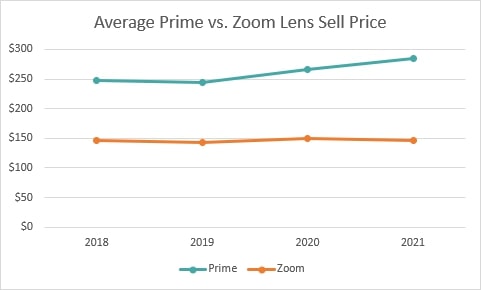
In addition to the average buy price, I also looked at the average sell price for each type. The sell price is what a customer would receive selling their lenses to KEH.

Unsurprisingly, the average buyback price shows the same trends, with zooms decreasing by 1%, and primes seeing an even bigger jump up by 15%.

Clearly, as the scarcity of legacy prime lenses increases, so does the amount that we're willing to pay for them.

Overall, I think if we were to take manual focus legacy lenses out of the equation, and just hone in on autofocus lenses, the results may be different.

For example, let's revisit those two first two EF lenses I talked about.

The Canon 50mm f/1.4 USM prime has increased in buy price by 7.7%, from $234 in 2018 to $251 today. Whereas the Canon 24-70mm f/2.8 L II USM zoom has increased by the wider margin of 11.1%, from $1,359 in 2018 to $1,510 today.

Ultimately, photographers that shoot with a mix of modern and vintage glass might see a sizable difference in value between their primes and zooms, whereas those that only shoot modern autofocus lenses might see little to no difference in either direction. I'll dig in a little deeper into this in a future article.

For the moment, it goes to show that when it comes to lens selection, it pays to diversify.

_About the author: Luca Eandi is a Brooklyn-based street photographer, creative director for KEH Camera, and a board-certified human person. He recently published “Signs of Japan,” a long-term photography project documenting illustrated Japanese street signs in the Tokyo area. He posts his daily street photography work on his Instagram profile. This article was also published here. _

Image credits: Header photo licensed via Depositphotos.

#editorial #equipment #buy #industry #keh #lenses #pricing #primelenses #sell #tiltshiftreport #trends #zoomlenses
Which Medium Format Mirrorless System Should You Choose?

For decades, medium format film was the standard for professional photography work, so it's no wonder that its bigger-than-full-frame resolution, shallow depth of field, and magic tonality is still sought after by pros and enthusiasts to this day.

Previously, we explored whether mirrorless cameras depreciate faster than DSLRs, what Leica-M gear sells the fastest, and which Micro Four Thirds system held up better over time.

In this article, we'll compare two leading medium format mirrorless systems.

This story is part of KEH’s Tilt-Shift Report, where the company shares exclusive data and unique insights into the latest trends in camera gear buying, trading, and selling.

The Tilt

For decades, medium format film was the standard for professional photography work, so it's no wonder that its bigger-than-full-frame resolution, shallow depth of field, and magic tonality is still sought after by pros and enthusiasts to this day.

Of course, the industry has largely moved away from film altogether (we haven't, though -- still love it -- never gonna quit it), and after a decade or so at play in the DSLR space, medium format recently joined the ranks and took the leap into mirrorless over the last 5 years.

Two brands, in particular, have been at the forefront of the mirrorless medium format race -- Fujifilm and Hasselblad. Of course, both manufacturers have a long history with the format -- from the 500CM to the GF670 -- there's decades of expertise and excellence on both fronts.

Both brands announced their respective systems -- the Fujifilm GFX and Hasselblad X -- in 2016, and have been steadily releasing cameras, lenses, and accessories ever since.

So, which system has proven to be a better investment so far? Let's take a quick look at our data to shed some light on the subject.

The Shift

Before we get into it, let me state that this isn't a comparison of features, ergonomics, or durability. There's plenty written on those subjects out there already, and having shot both these systems quite extensively, I can guarantee that the image quality and usability for both are excellent.

So, if you're in the market for these types of products, there's really no wrong choice, and I encourage you to try both out before making the plunge to see which one works best for you.

What we'll be looking at here is the average used buy and sell prices for these systems over time to see how they stack up next to each other.

How is this helpful, you ask? Well, it can give you an idea about things like trends in purchase price and resale value, which are really good indicators of the overall health and longevity of the systems. After all, if you're going to invest a good chunk of change, it's good to get a sense of what the past, present, and future look like.

As always, the Tilt-Shift Report is built upon KEH's proprietary data on these products. Being that our buy/sell prices are based on demand and supply within and outside of KEH, the trends seen here reflect what's going on in the market as a whole, whether it's private sales, auction sites, or other resellers.

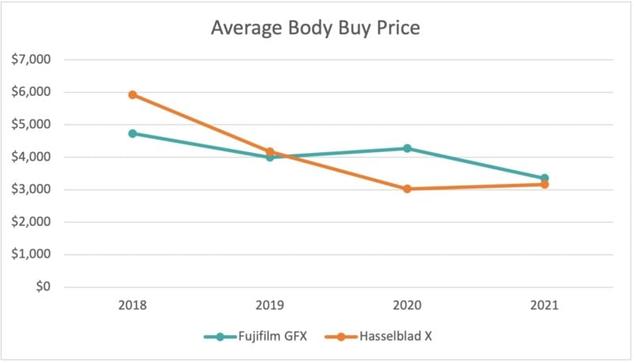
First, let's look at the average body buy price over the last three years.

As you can see, body prices for both systems have been declining over the last three years, with Fujifilm seeing a 29% drop and Hasselblad a larger 47% decrease.

Overall, this is an indicator that it pays not to be an early adopter, at least when it comes to saving some dough on buying in. Bodies always take the brunt of depreciation, so no surprises. Having said that, Hasselblad bodies have seen a bigger decrease in price over time.

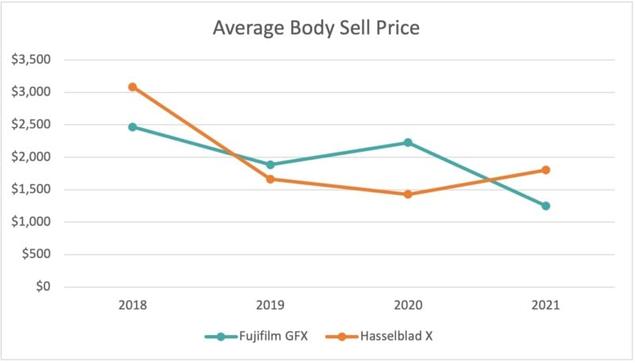
On the other side of things, let's look at the average body sell prices over the same period of time.

Here, the drop is similar, with Fujifilm dropping by 49% in comparison to Hasselblad's 42% drop. So, while Hasselblad has seen a bigger drop in buy price, they've managed to retain resale value a bit better than Fujifilm, at least when it comes to bodies.

Could be that Fujifilm has simply released more bodies over this span of time, and updated their product lines more often, giving consumers more buying choices and hence driving down market value on older products.

Next, let's look at the same data for lenses. Here's the average lens buy price.

There's a bit more of a pronounced gap in price between the brands. Fujifilm lenses are generally more affordable than Hasselblad's, but the trend lines are reversed as far as value.

Fujifilm lenses have increased in price over time by 19%, whereas Hasselblad lenses have decreased by 13%. That gap could be narrowing for a number of reasons, but I think it's mostly due to the different strategies in filling out their each respective product lines over time.

Let's see if these trends are also reflected in the average sell prices.

To a large extent, they are similar here as well. The average buyback value for Fujifilm lenses has increased by 22% over the last three years, whereas Hasselblad's has decreased by 23%. This could mean that there's more demand for Fujinon lenses, perhaps because more photographers are using the system overall.

Bodies and lenses aren't the only things that matter when it comes to investing in a system—what about accessories? The cost on things like batteries, lens hoods, and straps add up quickly.

Here's how they stack up.

Not a huge change for either brand here. Fujifilm accessories have on average increased by 5% over the last three years, and Hasselblad have decreased by 3%.

Let's look at the average buy prices next

Again, nothing too major here. Both brands have seen a drop, Fujifilm by 5% and Hasselblad by 11%. Overall, the difference doesn't add up to much, but it is something.

So, overall, I'd say that if you've been waiting to get into mirrorless medium format, right now is a good time to be buying used, as prices have come down quite a bit from launch into a more palatable range.

Plus, prices have also seemingly stabilized for the time being, so there's probably not going to be a huge change over the next few years.

As far as which system seems to be healthier, I'd say Fujifilm probably has a slight edge. And judging by the lens buy/sell prices, it seems to be the system that more people have embraced, which is consistent with sales data. But that doesn't mean that Hasselblad has been slouching, and overall, I tend to prefer the handling and build quality of their X-mount products.

Ultimately, there's never been a better time to make the leap into mirrorless medium format. The question is more along the lines of how does it stack up against very capable full-frame mirrorless systems? Is it worth making the switch? But those are questions for another day.

_About the author: Luca Eandi is a Brooklyn-based street photographer, creative director for KEH Camera, and a board-certified human person. He recently published “Signs of Japan,” a long-term photography project documenting illustrated Japanese street signs in the Tokyo area. He posts his daily street photography work on his Instagram profile. This article was also published here. _

#editorial #equipment #fujifilm #fujifilmgfx #gfx #hasselbald #hasselbladx #keh #mediumformat #mediumformatcamera #mediumformatdigital #tiltshiftreport

Which Medium Format Mirrorless System Should You Choose?

Fujifilm VS Hasselblad

What Leica-M Gear Sells The Fastest?

Previously, we explored topics like which Micro Four Thirds system held up better over time, which line of Sony's full-frame mirrorless cameras is most popular, or which DSLR system held more of its value. This month, let's look at which Leica M-mount film gear is the fastest-moving off the shelves.

This story is part of KEH’s Tilt-Shift Report, where the company shares exclusive data and unique insights into the latest trends in camera gear buying, trading, and selling.

The Tilt

There is a little context I need to give around the storied Leica M-mount. Basically, it was introduced in 1954 with the launch of the Leica M3, replacing the M39 screw-mount for a favorable new bayonet design that made switching faster, while locking in the lens to the body more precisely and securely.

"M" stands for messsucher, or "rangefinder" in German, and it's a design still in use with digital Leica-M cameras today. The rangefinder has indeed proved to be an enduring form, as many photojournalists, documentary and street photographers favor it for its simplicity, size, reliability, and quick operation.

The original M3 sold around 220,000 units before production ended in 1966, making it Leica's most popular rangefinder ever, and it led the way for a long lineage of M-mount bodies, all notable.

While prices are steep, Leica is still producing film cameras to this day -- the MP and M-A -- but has largely shifted to manufacturing digital M-bodies since its first foray with the M8 in 2006.

Although a new, cheaper film body is rumored to be released in 2021, the most sensible way to get into the Leica M-mount rangefinder system is still to buy used models from yesteryear.

Of course, Leica isn't the only manufacturer who makes M-mount gear -- Voigtlander, Zeiss, Rollei, Konica, and Minolta, amongst others -- have made both M-mount bodies and lenses through the years, and then there are newcomers like 7artisans or TTArtisan who recently started offering a bevy of excellent, moderately-priced M-mount glass as well.

The Shift

With nearly 70 years-worth of gear, the M-mount has had plenty of time to grow, evolve, and cement itself as one of the most sought-after systems on the market.

Because we sell more M-mount gear than just about anyone, we know how tough it is to keep certain items in stock. Let's look at which bodies and lenses have the shortest shelf-life in our warehouse—if you're eyeing this gear for your own collection, you better be able to pull the trigger quick once you spot it on the site.

For M-mount bodies, it's no surprise as to who takes our number one spot.

The Leica M6 is all over our chart. On our list of the top-20 fastest-selling M-mount bodies, the M6 takes up nine spots, as a matter of fact.

There are quite a few variations on this classic, but none sell faster than the M6 TTL (.85x finder/35-135mm) version. On average, from the time it goes live on our site, it takes just two days for it to find a new owner. The M6 TTL (.58x finder/28-90mm) is in second place, averaging just two-and-a-half days on our shelves, followed by the M6 TTL (.72 finder/28-135mm) at three days.

Not far behind that cluster of M6 bodies though, is another popular option—the Voigtlander Bessa R2A. The aperture-priority R2A usually sells within three days of hitting our site, while the all-manual R4M and R3M take about four days.

Another notable non-Leica M-mount body is the Zeiss Ikon, which sells on average within four-and-a-half days of hitting our shelves.

Other Leica bodies on the list are the aforementioned MP, which usually moves within a week, and the O.G. M3 double-stroke, selling on average at the slower pace of eleven-and-a-half days.

At two weeks apiece, the Leica Minolta CL sells just as fast as the identical Leica CL, while the Minolta CLE takes three days longer. Branding, it turns out, does make a little difference, and the Leica name still pulls some weight.

As far as lenses, there are a few classics tied for the number one spot.

It's easy to see the appeal of this cluster of lenses at the top spot, and why they're all gone within three days of going live on our site. The Leica 50mm f/1.4 Summilux Wetzlar is a classic from the 1960s, perhaps the quintessential vintage lens for use on an M3 or M2 body. Being that it's an older M-mount lens, it's more affordable than later versions, while still delivering loads of character and Leica charm.

Then there are three 35mm lenses that run the gamut from small and affordable to fast and durable. The Voigtlander 35mm f/2.5 Color-Skopar (P II) is basically a pancake lens, perfect for those who value a low profile while making no sacrifices on image quality. For those wanting a brighter aperture, the Voigtlander 35mm f/1.4 Nokton Classic II MC VM fits the bill, while still maintaining a low profile. Finally, the Zeiss 35mm f/1.4 Distagon ZM T* is prized for its sophisticated design as well as its top-notch construction.

Closing out the bunch at the top spot, selling within 3 days, the Minolta 90mm f/4 M-Rokkor might be a surprising result, but considering its low price and excellent quality, it makes all the sense in the world for it to be a fast-seller. It can be had for just $200-300 depending on condition, so it's a natural pick to round out an M-mount kit on the short telephoto end.

Another classic not far behind the leading pack, is the Leica 35mm f/2 Summicron-M, 6-bit which usually sells within 4 days of arriving in stock. A fine, affordable copy of that design, the 7Artisans 35mm f/2, sells almost as fast, within seven days.

The item which wins the distinction of "slowest-moving, fastest-aperture lens" on our list is the mighty Leica 50mm f/1.0 Noctilux, which because of its complexity, size, exorbitant price point, and limited audience, averages just over 10 weeks in stock before finding a happy new owner.

What's clear from this data is that M-mount gear is still highly desirable, and because of its growing scarcity -- especially for mint vintage pieces -- it probably won't lose its luster for quite some time.

_About the author: Luca Eandi is a Brooklyn-based street photographer, creative director for KEH Camera, and a board-certified human person. He recently published “Signs of Japan,” a long-term photography project documenting illustrated Japanese street signs in the Tokyo area. He posts his daily street photography work on his Instagram profile.

This article was also published here. _

Image credits: Header photo via Sodacan, Creative Commons 4.0.

#editorial #equipment #fastestselling #keh #leica #leicammount #leicarangefinder #mmount #rangefinder #tiltshiftreport #topselling

What Leica-M Gear Sells The Fastest?

Which used Leica camera sells the fastest?