The Cost of the Call: Why Your Scars Prove You’re Still in the Fight

1,402 words, 7 minutes read time.

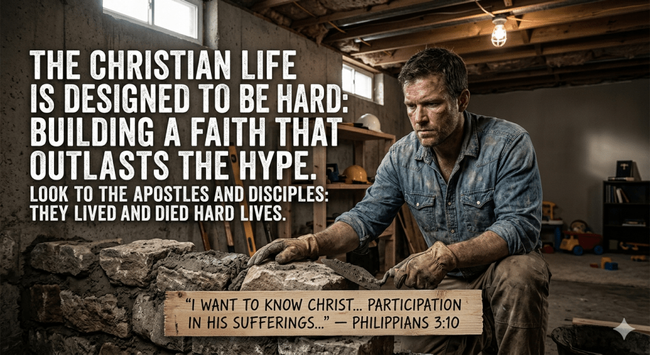
I want to know Christ—yes, to know the power of his resurrection and participation in his sufferings, becoming like him in his death, and so, somehow, attaining to the resurrection from the dead.
Philippians 3:10-11 (NIV)

True intimacy with Jesus isn’t found in the emotional high of a Sunday service, but in the grit and shared suffering of the daily trenches.

Moving from the Altar Call to the Front Lines

Listen to me, brother. You were sold a bill of goods if you thought that altar call was a finish line. You walked down that aisle, the music was swelling, people were slapping you on the back, and for a second, the weight of the world felt light. You felt like you’d finally found a tribe. Then Monday hit. Then Tuesday. By Wednesday, the church office stopped calling, the “welcome home” texts dried up, and you were left standing in your kitchen at 11:00 PM with a browser tab you shouldn’t have open and a temper that’s shorter than your paycheck. You feel like a failure because the “magic” wore off. You feel ghosted—not just by the guys in the polo shirts at the front door, but maybe by God Himself.

But look at the men who actually built this thing. Look at Paul. That man didn’t spend his life in a climate-controlled sanctuary with a latte. He spent it getting his back shredded by whips, shivering in shipwrecks, and sitting in the filth of a Roman hole in the ground waiting for the axe to fall. The disciples didn’t die in their sleep; they died in the dirt, refusing to shut up about what they saw. Why? Because they weren’t chasing a feeling. They weren’t looking for a “life upgrade” or a smoother path to the American dream. They were obsessed with a Man who conquered death, and once you realize the grave is empty, the threats of this world lose their teeth.

The Christian life was never designed to be easy; it was designed to be deadly to the old, pathetic version of you. You’re struggling right now because you’re in a construction zone. When you’re tearing down a load-bearing wall of lust or anger that’s been there for twenty years, dust is going to fly. It’s going to be loud, it’s going to be heavy, and you’re going to get bruised. The church might have dropped the ball on showing you how to swing the sledgehammer, but Jesus is still in the room. He’s the foreman who doesn’t walk off the job site when things get messy. He didn’t promise you a life without scars; He promised He’d be the one standing with you in the fire. The hardness isn’t a sign that you’re doing it wrong; it’s a sign that you’re finally in the real fight. Stop waiting for the “feeling” to come back and start building on the cold, hard fact that He is risen. That’s the only foundation that holds when the storms of fatherhood, work, and your own internal demons start howling.

Practical Manhood in the Face of Hardship

Identify the one “easy out” you usually take when life gets hard this week—like losing your temper to exert control or numbing out with a screen to escape the pressure—and instead, stand in the discomfort for five minutes. Talk to God like He’s right there in the room, telling Him exactly how weak you feel, and ask for the “power of His resurrection” to just get you through the next hour of being the man your family needs.

An Honest Cry for Strength

Lord,

I’m tired of feeling like a rookie who’s been left behind. I thought this was going to be easier, but the weight of my family, my job, and my own sin is heavy. I see that Paul and the others didn’t have it easy—they had it hard, but they had You. Don’t give me an easy life; give me the strength to live a holy one. Help me to stop looking for the exit and start looking for Your hand in the middle of the mess. Give me the grit to stay in the fight today.

Amen.

Auditing Your Spiritual Foundation

  • When the emotional high from your baptism faded and the “ghosting” began, what was the first old habit that tried to move back into your house?
  • Do you honestly believe that God is closer to you in your struggle with anger or lust than He was during that emotional altar call? Why or why not?
  • What is one specific area in your marriage or fatherhood where you’ve been “ghosting” your responsibilities because it felt too hard to lead without a roadmap?
  • If death is no longer a barrier because of Jesus, what is the one fear—fear of failure, fear of not providing, fear of being “found out”—that is currently keeping you from being the man God called you to be?
  • How can you start treating your daily struggles as “participation in His sufferings” rather than proof that you’re failing at being a Christian?

Call to Action

You’ve been standing on the sidelines long enough, waiting for a phone call from the church that might never come. You’re waiting for someone to hand-deliver a manual on how to be a Christian man, while the enemy is already kicking in your front door, targeting your marriage, your kids, and your integrity. The “ghosting” stops being an excuse the moment you realize the King of Kings hasn’t moved an inch. He’s in the trench with you, but He’s not going to pull the trigger for you.

It’s time to stop acting like a spiritual orphan and start acting like a son of the Living God. You don’t need a polished “men’s ministry” to tell you to pick up your Bible and start leading your home. You don’t need a coffee invite to choose honesty over a hidden screen. You need the grit to realize that the struggle you’re in isn’t a sign of failure—it’s your training ground.

Here is your mission for the next 24 hours:

  • Stop Complaining: Quit blaming the church’s lack of follow-up for your lack of growth. You have the Holy Spirit and the Word. That’s more than the early martyrs ever had, and they changed the world.
  • Lead Your House: Tonight, don’t wait for your wife to ask. Gather your family, read five verses from the book of James, and pray a simple, honest prayer over them. It’ll feel awkward. Do it anyway.
  • Kill the Secret: If you’re hiding a sin, drag it into the light. Confess it to God and find one man you trust to tell the truth to. No more shadows.
  • The high of the altar call is gone, and that’s a good thing. Now, the real work begins. Are you going to fold because it got hard, or are you going to stand your ground like the men who came before you?

    The fight is here. Get in it.

    SUPPORTSUBSCRIBECONTACT ME

    D. Bryan King

    Sources

    Disclaimer:

    The views and opinions expressed in this post are solely those of the author. The information provided is based on personal research, experience, and understanding of the subject matter at the time of writing. Readers should consult relevant experts or authorities for specific guidance related to their unique situations.

    #ApostlePaulSuffering #biblicalLeadershipInTheHome #biblicalMasculinity #biblicalProvider #buildingAFoundationOnChrist #ChristianHusbandAdvice #ChristianLifeIsHard #ChristianManhood #ChristianProviderPressure #dailyObedienceToChrist #discipleshipForNewBelievers #enduringHardshipAsASoldierOfChrist #faithInTheTrenches #faithUnderPressure #feelingGhostedByChurch #fightingSin #gritAndGrace #howToLeadYourFamilySpiritually #identityInChristForMen #livingForJesusDaily #managingAngerAsAChristianMan #masculineSpirituality #movingPastEmotionalFaith #newBelieverStruggles #overcomingPornAddiction #overcomingTemptation #practicalChristianityForMen #realWorldChristianity #seekerFriendlyChurchFollowUp #spiritualDisciplinesForMen #spiritualGrowthForMen #spiritualMaturityForMen #spiritualWarfareForMen #strengthForChristianFathers #theCostOfDiscipleship

    A Deep Dive into "The Cost of Discipleship": The Radical Call
    “The Cost of Discipleship” by Dietrich Bonhoeffer—edited by Shanelle Robertson—is an enduring and challenging manifesto that calls Christians not to cheap grace but to costly, courageous, authentic following of Christ. Bonhoeffer’s voice, written in the crucible of Nazi Germany and...More details… https://spiritualkhazaana.com/deep-dive-into-the-cost-of-discipleship/
    #thecostofdiscipleship #godsgrace #followingjesus #walkingwithgod #spiritualjourney #spiritualgrowth #innerpeace

    Consider the Cost

    https://youtu.be/TT8xRim121o

    “‘Dear Lord God, I wish to preach in your honor. I wish to speak about you, glorify you, praise your name. Although I can’t do this well of myself, I pray that you may make it good.’”[1]

    Introduction

    American Evangelicalism and Western Christianity writ large, have done a huge disservice to Christianity broadly speaking. This morning I’m speaking not only as an observer of our socio-religio-political landscape, but as one who came to faith in it. It has been both my experience and observation that much of American Evangelicalism and Western Christianity conceives of the life of the disciple of Christ that is both comfortable, easy, and aligned to traditionalist conceptions promoted within society. The Jesus peddled therein reflects American Evangelicalism and its ideologies rather than the Jesus the gospel and epistle authors took pains to paint for us.

    I remember—specifically—that my faith in and obedience to Jesus was going to make my life easier; that I would find myself in states of existential comfort and bliss. I’d be ushered into the spiritual realm, no longer afraid of where I’d end up in death while (intentionally) remaining indifferent (ignorant?) toward the issues of the world because why worry when Jesus is gonna come back and fix it all? Faith was to make me perpetually happy, nice, and too blessed to be stressed. My only two obligations were evangelism and obedience: I was to be a good Christian which meant telling people about Jesus and how great he’d made my life and obeying my authorities in all things which was God’s will. You might be burning in hell (temporally) or heading towards it (spiritually), and that was none of my business really because that was all your choice. My sins were forgiven and that’s all that really mattered, that was the goal of the gospel and of Jesus’s mission in the world. I was just lucky—blessed!!—enough to have decided to find Christ when I did!

    But none of this was true. Like a sports car sold to someone suffering the malaise and banality of midlife, I was sold a saccharine Jesus, having little power and agency in the world because he was so conformed to it, embedded (buried?) in the ideas of yesteryear. Becoming Christian was going to solve all my problems; turns out, becoming Christian created more problems than it solved. Here’s why…

    Luke 14:25-33

    Luke tells us that Jesus addressed the many crowds that were coming together around him (these many crowds were composed of “neutral” people who may become disciples[2]), and he turned and said to them, “If someone comes to me and hates not their father and mother, wife and children, brothers and sisters, yet even their own soul, they are not able to be my disciple (v26). Luke’s emphasis here is implied: those following Jesus must know the cost of following.[3] The “cost of discipleship” is not only the burden of the disciples; it’s the burden of any/all someone/s coming to Jesus.[4] There is no way around the reality: to follow Jesus is to also participate in the mission of God in the world as Jesus does; obedience to God by faith and following Jesus necessarily means that they will be confronted with performing intentional acts of disobedience within their private.[5] In other words, it aint easy being Christian.[6] Not even family ties—a vital component of ancient Palestinian life—can get in the way; the follower of Christ must not even let family loyalty hinder them from pursuing God and God’s mission in the world.[7] (This is what the “hate” means in this verse; it is not about having a feeling of ill will or malevolence.) Not even loyalty to one’s own life/livelihood can get in the way of following Christ.[8]

    Luke then tells us that Jesus said, Whoever does not carry the cross and comes after me that one is not able to be my disciple (v27). While we may think of this statement through the lens of Good Friday, it isn’t actually about “suffering”; it’s an equivalent thought to hating the family and oneself and broadens the scope of disobedience: it won’t be just private, it will be public and against the established authorities (ecclesiastical and political) who have power to punish you and take your life because of your disobedience.[9] In other words, the whole life of the follower of Christ will be exposed to the potential ramifications of following this man who is God. Everything is up for grabs.

    Luke then tells us that Jesus provides a moment of reflection for those listening,[10] For who of you, willing to build a tower, does not (at all) after sitting down estimate the cost whether he has [enough] to complete [it]? So that, lest while he has laid his foundation and is not having power to finish, all those who gaze at it will begin to mock him, saying, `This person began to build and had not the power to finish.’ Or what king, going to come together in war against another king, will not (at all) after sitting down deliberate whether he is able with ten thousand troops to encounter the one who comes against him with twenty thousand? Now if he cannot, while the other is still far off, he sends a delegation asking for the terms of peace (vv28-32). The follower of Christ is not headed toward some sort of comfortable and pleasant and easy life; they must think about the cost, likely conflict and confrontation, and what the end will look like.[11] it’s not going to be easy, in fact, it will be hard; and “hard” may be the lightest way to say it. For those who follow Jesus—according to Luke—they will feel the anguish of the decision deep in their bones as their choice begins—at times—to feel unbearable, lonely, and profoundly demanding in terms of forgoing material glory and honor and forsaking the creature comforts of fitting in and following along, including family and friends.[12] According to Luke and Luke’s Jesus, the Christian will be the one who stands out and not because they are so righteous but because they are so hated by the kingdom of humanity. “Authentic discipleship”[13] will force the follower of Christ into a spotlight and will paint a target on their back not because of their obedience to traditionalist conceptions of society and religion but specifically because of their disobedience born from their new life in Christ[14] marked by new ways of being in the world[15] that grate against the status-quo.[16] Participating in God’s mission of the divine revolution of love, life, and liberation will do that; never forget that Good Friday was more than a spiritual event.[17]

    Therefore, Luke tells us, that Jesus concluded this discourse with,Therefore, in this way, all of you who do not take leave of all the things that are at hand are not able to be my disciple (v33). This last bit isn’t a new command to sell things but, rather, to loosen one’s grip on all that they have. The disciple of Christ, the follower of the Way, the participant in God’s mission and divine revolution of love, life, and liberation in the world cannot have loyalties placed anywhere else; their only allegiance is to the reign of God, forfeiting their status and position in the kingdom of humanity.[18] For the disciple of Christ, this is not about being intentionally poor, friendless, and rejecting one’s family. Rather, it’s about holding on loose enough that when conformity to the status quo of the kingdom of humanity is demanded—publicly or privately—the disciple of Christ can let go and proceed on the way of the reign of God, to glory of God and the well-being of the neighbor.

    Conclusion

    The Christian life is hard; this has been the consistent theme of Luke’s presentation of Jesus these many weeks. It’s not easy. It’s not comfortable. It’s not the sure-fire way to be “successful,” popular, or famous. It will not allow you always to be nice to others, always fun to be around, or always good-vibes-only. It will not be the fool proof way toward material blessings in this world or to acquiring favor of the rich and powerful. To follow Christ means to be intractable when it comes to the kingdom of humanity’s tendency toward not only rejecting but violently attacking God’s reign in the world. Christians, according to Luke’s Jesus, cannot side with nation over Christ, cannot side with the status-quo over the laboring of God to bear something new into the world (stress on new, not a retreat to something old), cannot participate in the captivity of our neighbors over fighting for their liberation, cannot become familiar with indifference over feeling the risk and demand of love, and cannot advocate for death over life.

    The Christian—the one who follows and is to be as Christ` in the world—is the one who finds themselves at the intersection and epicenter of the temporal and spiritual realms, with a will conformed to God’s will, hands and feet ready to bring God glory by bringing wellbeing to their neighbor, and an eye keen on spotting and a voice ready to call out the violence and destruction of the kingdom of humanity. It’s not about self-righteous, holier-than-thou, clean and pure, self-imposed glory and boasting; it’s about the radical love of God that is the revolutionary love of neighbor. And while I want to comfort you by reminding you that God is with you—for surely God is with you, Beloved—I can’t solely tell you that in good faith and with a good conscience because the Christian walk is hard and I must tell you that. The world would have me sooth you to sleep (back to sleep?), telling you sweet nothings that let you off the hook. But it’s my job to participate in the prophetic calling of God to wake you up. Luke’s Jesus doesn’t want sleepers, but those who can stay awake, call out the discrepancies between what is and could be, and who dare to step disobediently into the void to protect the love, life, and liberation of the neighbor from the aggressive overreach of authority (ecclesial and political). Beloved, this is what it looks like to follow God; consider wisely the cost of such discipleship.

    [1] LW 54:157-158; Table Talk 1590.

    [2] Green, Luke, 564. “Often in the Lukan account, crowds are presented as pools of neutral person from whom Jesus might draw disciples, and this is clearly the case here.”

    [3] Justo L. Gonzalez, Luke, Belief: A Theological Commentary on the Bible, eds. Amy Plantinga Pauw and William C. Placher (Louisville: WJK, 2010), 183. “…[Jesus] warns those who would follow him of the cost of discipleship.”

    [4] Green, Luke, 565. “‘Disciples’ does not refer narrowly in this instance to a select group of Jesus’ followers but…to all who, following him, identify with his missions. Such persons are characterized, first, by their distancing themselves form the high cultural value placed on the family network, otherwise paramount in the world of Luke.”

    [5] Gonzalez, Luke, 183. “Discipleship requires radical obedience. Love of family must not stand in the way.”

    [6] Gonzalez, Luke, 183. “Now he turns to the crowds around him. It is not only Jerusalem and all it represents that should take heed of the danger of disobedience; it is also this entire crowd that travels with him. If Jerusalem must be disabused of the notion that it will be easy to be the people of God, now this crowd of followers is also disabused of the notion that it will be easy to be a disciple of Jesus.”

    [7] Gonzalez, Luke, 183. “…to ‘hate’ the family does not mean to have evil sentiments for them, but rather to forsake them for the sake of the kingdom. A disciple of Jesus will not use supposed family responsibility to avoid obedience.”

    [8] Green, Luke, 565. “…in this context, ‘hate’ is not primarily an affective quality but a disavowal of primary allegiance to one’s kind…Jesus underscores how discipleship relativizes one’s normal and highly valued loyalties to normal family and other social ties.”

    [9] Gonzalez, Luke, 183. “And this is then paralleled by the saying about carrying the cross. Taken in context, this not just a call to sacrifice, as we often think. The cross is an instrument of legal punishment and torture. So to take up the cross is parallel to ‘hating’ the family. A disciple of Jesus must be ready to carry the burden not only of tensions in the family, but even of civil disobedience to the point of legal punishment.”

    [10] Gonzalez, Luke, 183. “Pointing to this idea, Jesus uses two brief parables about counting the cost.”

    [11] Gonzalez, Luke, 184. “Likewise, one should not become a follower of Jesus without considering the cost, the opposition, and the final outcome.”

    [12] Green, Luke, 566. “What outcomes are proposed if resources prove to be deficient? In both cases, the repercussions are tragic—the one resulting in mockery, the other in surrender; hence, a premium is placed on the inadequacy of one’s resources. By extrapolation, then, Jesus insists that such assets as one’s network of kin, so important in Greco-Roman antiquity, are an insufficient foundation for assuring one’s status before God. Dependence on the resources available to a person apart from ‘hating’ family and ‘carrying the cross’ cannot but lead to a tragic outcome. What is required is thoroughgoing fidelity to God’s salvific aim, manifest in one’s identity as a disciple of Jesus.”

    [13] Joel B. Green, The Gospel of Luke, The New International Commentary on the New Testament (Grand Rapids: Eerdmans, 1997), 564. “As Jesus turns to address the crowds traveling with him, he lists allegiance to one’s family network and the shackles that constitute one’s possessions as impediments to authentic discipleship.”

    [14] Green, Luke, 565. “As in 9:23, so here Jesus is calling for the reconstruction of one’s identity, not along ancestral lines or on the basis of sone’s social status, but within the new community oriented toward God’s purpose and characterized by faithfulness to the message of Jesus.”

    [15] Green, Luke, 567. “This ‘leaving behind’ is cast in the present tense, demarcating this condition not simply as a potential for which disciples must be constantly ready, but as a characteristic feature of the disciples.”

    [16] Green, Luke, 564. Luke “…reminds us that the new practices counseled by Jesus in vv 7-14 are not isolated behaviors but, from Luke’s perspective, must flow out of a transformed disposition, reflecting new commitments, attitudes, and allegiances. That is, the conversion that characterizes genuine disciples is itself generative, giving rise to new forms of behavior.”

    [17] Green, Luke, 565-566. “…bearing the cross is used as a metaphor of discipleship—indeed, as a requirement for one’s identity as a disciple. Such persons would live as though they were condemned to death by crucifixion, oblivious to the pursuit of noble status, finding no interest in securing one’s future via securing obligations form others or by stockpiling possessions, free to identify with Jesus in his dishonorable suffering.”

    [18] Green, Luke, 567. “As is generally the case in Luke, one’s basic commitments are manifest or symbolized in the disposition of ‘all one has.’ Accordingly, the distinctive property of disciples is the abandonment with which they put aside all competing securities in order that they might refashion their lives and identity according to eh norms of the kingdom of God.”

    #AmericanEvangelicalism #Disciple #Discipleship #Disobedience #DivineLiberation #DivineLife #DivineLove #DivineRevolution #Jesus #JoelGreen #JustoGonzalez #Liberation #Life #Revolution #TheCostOfDiscipleship #TheGospelOfLuke #WesternChristianity

    September 7th 2025 - Sermon

    YouTube