Two #AI-related events over the past week — the #Chardet licensing controversy and legendary computer scientist #DonKnuth's shock over AI helping discover a theorem for a problem he'd not yet solved — demand a reckoning: precisely how creative is AI? https://reviews.ofb.biz/sa1401

#Creativity #Licensing #OpenSource #Python #DonaldKnuth #TAOCP #Claude

Photocopier No More: The Reckoning with AI Creativity Has Arrived

Two esoteric programming events bubbled up this past week. If you’re not into computer science, they may appear irrelevant to you. They’re not. The arcane managed to bring to life our pressing questions about whether AI can create or is a regurgitation machine.

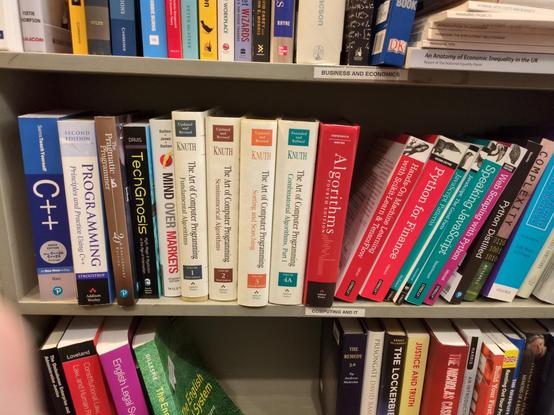
出版商已經幫 The Art of Computer Programming 建立 epub 格式的電子書了,大家可以支持一下
#嘟書 #書籍推薦 #books #TAOCP
https://www.informit.com/store/art-of-computer-programming-volume-1-fundamental-algorithms-9780201896831

ps. 台灣的書好便宜啊,可惜內容不太行 Orz

Art of Computer Programming, The: Volume 1: Fundamental Algorithms, 3rd Edition | InformIT

The bible of all fundamental algorithms and the work that taught many of today's software developers most of what they know about computer programming. Byte, September 1995I can't begin to tell you how many pleasurable hours of study and recreation they have afforded me! I have pored over them in cars, restaurants, at work, at home... and even at a Little League game when my son wasn't in the line-up.

>>> The word “hexadecimal,” which has crept into our language even more recently, is a mixture of Greek and Latin stems; more proper terms would be “senidenary” or “sedecimal” or even “sexadecimal,” but the latter is perhaps too risqué for computer programmers.

#TAOCP #donald_knuth #joke #humor

I had reason to look up arctan in the index of Knuth's Art of Computer Programming (vol2) and it appears on pages 313 and 628.

So close.

#taocp

Dear Donald Knuth!
Happy 87th birthday. Please keep your perseverance to work on #TAOCP and stay healthy!
A fan.
#knuth #donknuth #dek

This was recently sent off to the publisher, and will be landing within a couple of months: The Art of Computer Programming, Volume 4, Fascicle 7: Constraint Satisfaction by #Knuth

https://www.informit.com/store/art-of-computer-programming-volume-4-fascicle-7-constraint-9780135328248

#TAoCP

Art of Computer Programming, Volume 4, Fascicle 7, The: Constraint Satisfaction | InformIT

This multivolume work on the analysis of algorithms has long been recognized as the definitive description of classical computer science. The four volumes published to date already comprise a unique and invaluable resource in programming theory and practice. Countless readers have spoken about the profound personal influence of Knuth's writings

"The IPL-V and FLPL systems for List-processing did not use either a garbage collection or a reference count technique for the problem of shared Lists; instead, each List was “owned” by one List and “borrowed” by all other Lists that referred to it, and a List was erased when its “owner” allowed it to disappear."

D. Knuth, #TAOCP Vol. 1, p. 461

So, #rustlang isn't the first one to use owned/borrowed terms.

The most well known #lispm designs like Symbolics Genera employs incremental GC likely because their processors can do "single core" multithreading and GC runs on a regular thread, an earlier design by Guy Steel Jr. uses multi-processors and synchronization between them to perform parallel GC, as it has already shown before parallel GC is possible in an Exercise problem in #TAOCP volume 1, inspired many later high performance GC algorithms.