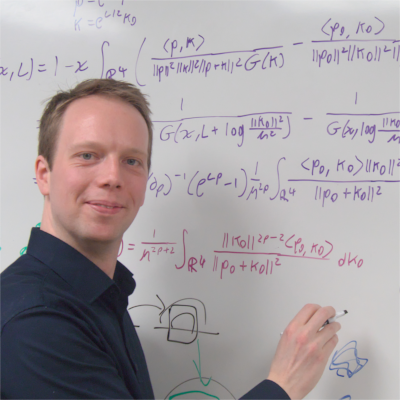
Researchers at Chalmers University of Technology discovered a simple nanoscale surface tweak that enhances superconductors’ ability to withstand stronger magnetic fields and higher temperatures without losing their zero-resistance properties.

Read more: https://thedebrief.org/innovative-new-design-helps-superconductors-withstand-heat-and-magnetic-fields/

@goodnews

#Superconductors #FutureTech #EnergyInnovation #GoodNews

Innovative New Design Helps Superconductors Withstand Heat and Magnetic Fields

Science, Tech and Defense for the Rebelliously Curious.

The Debrief

IBM quantum computer simulates real magnetic materials and actually matches lab data

https://fed.brid.gy/r/https://nerds.xyz/2026/03/ibm-quantum-materials/

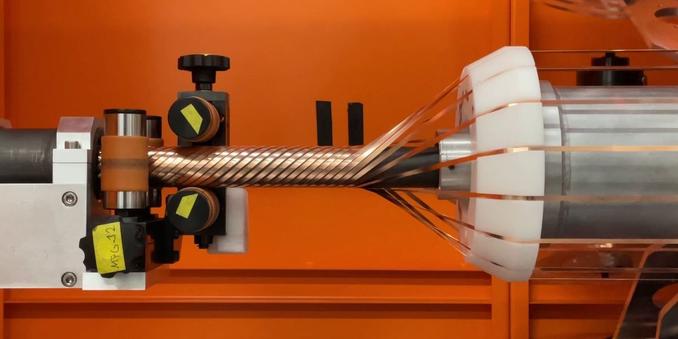
There isn’t enough #power in the grid to supply the demand for data centers. That’s why #Microsoft is turning to high-temperature #superconductors as a potential replacement for copper wiring to improve energy efficiency. spectrum.ieee.org/ai-data-cent...
Microsoft wants to rewire data centers to save space

Microsoft is looking into using superconducting cables to shrink its data center footprint as generative AI demands more energy.

The Verge
The #paperOfTheDay for my #dailyPaperChallenge is "on the theory of superconductivity" from 1950. At that time, it was not understood which physical mechanism causes superconductivity, so Ginzburg and Landau constructed a phenomenological theory: There must be some sort of superconducting charge carriers, therefore, they introduced a "density field" for those. From experimental findings, one has that it vanishes when the material becomes too hot, it is negatively affected by magnetic fields, and it can only support a finite amount of current. Using this as input, one can make an ansatz for the laws governing the charge density field, and this produces meaningful predictions for the behaviour of #superconductors. Nowadays, the BCS theory gives a more systematic description of (certain) superconductors, but Ginzburg-Landau theory has found many applications in other fields apart from superconductivity because the construction works whenever one does not know the precise laws governing microscopic constituents, but one has information about the observed large-scale properties.
https://www.sciencedirect.com/science/chapter/edited-volume/abs/pii/B978008010586450078X?via%3Dihub
Superconducting detector captures hot spots with submicron resolution

A research team from Osaka Metropolitan University proposed using a current-biased kinetic inductance detector with submicron 400 megapixels to image hot spots induced by a localized external stimulus over a 15 × 15 mm2 area. The team utilized a delay-line technique to trace the propagation of internal signals for a pair of signals arising from each hot spot.

Phys.org

DeepMind has launched the UK’s first fully automated lab, blending AI, robotics and its Gemini models to accelerate superconductors research. The new facility uses a Model Context Protocol to streamline experiments, promising faster breakthroughs in quantum materials. Curious how AI is reshaping labs? Dive into the details. #DeepMind #AI #Robotics #Superconductors

🔗 https://aidailypost.com/news/deepmind-opens-uk-automated-lab-using-ai-robotics-superconductors

💫 Superconductors are materials that can conduct electricity without resistance at extremely low temperatures! Revolutionary for technology! #Superconductors #PhysicsInnovation