Sumayya Vally to curate inaugural Islamic Arts Biennale

South African architect Sumayya Vally has been appointed to the curatorial team for the first Islamic Arts Biennale, which is set to take place in Jeddah, Saudi Arabia.

Organised by the Diriyah Biennale Foundation, the Islamic Arts Biennale is scheduled to take place in December 2023 in the city of Jeddah on the west coast of the country.

Vally (pictured top), who is the founder of architectural studio Counterspace, will curate the event alongside architect Omniya Abdel Barr, archaeologist Saad Alrashid and director emeritus of the Smithsonian's National Museum of Asian Art Julian Raby.

Biennale to take place in December 2023

Originally intended to take place in the Saudi capital of Riyadh, the biennale was moved to Jeddah due to the city's cultural heritage.

"I have visited Jeddah as a pilgrim many times," said Vally. "The location has so much embodied meaning that speaks to both communal and individual experience."

"Alongside my curatorial colleagues, I am inspired by the opportunity to present a range of works in this extraordinary setting," she continued. "I hope many will join us in December for an exploration that is open to all."

"Cultural and artistic exchange are essential"

The event aims to celebrate Islamic art and culture while exploring "spirituality in the aesthetic realm".

"Cultural and artistic exchange are essential in this period of unprecedented growth and development in the creative community in Saudi Arabia," said Saudi minister of culture Badr bin Farhan Al Saud.

In recent years, Saudi Arabia has aimed to develop both its cultural output and international tourism offering. In 2018, Dezeen's Gunseli Yalcinkaya became the first overseas design journalist to attend Saudi Design Week in Riyadh.

[

Read:

"Counterspace was born out of a desire to create a different canon" says Sumayya Vally

](https://www.dezeen.com/2021/06/29/counterspace-different-canon-sumayya-vally-video-interview/)

A range of hotels and resorts are being developed in the country, designed by some of the world's leading architects.

French architect Jean Nouvel is designing a cave hotel in the AlUla desert while Foster + Partners and Kengo Kuma and Associates are among the studios developing a series of islands as part of The Red Sea Project.

Counterspace founder Vally designed the 2021 Serpentine Pavilion in London and was recently named one of Time magazine's 100 leaders of the future.

The Islamic Arts Biennale will take place in Jeddah in 2023, dates are yet to be announced. SeeDezeen Events Guide for an up-to-date list of architecture and design events taking place around the world.

The photography is courtesy ofMikhael Subotzky.

The post Sumayya Vally to curate inaugural Islamic Arts Biennale appeared first on Dezeen.

#all #design #news #saudiarabia #jeddah #sumayyavally

Mariam Kamara and Sumayya Vally to design presidential library in Liberia

Nigerien architect Mariam Kamara and South African architect Sumayya Vally are collaborating to design a presidential library for Liberia's former president Ellen Johnson Sirleaf in Monrovia.

Named the Ellen Johnson Sirleaf Presidential Center for Women and Development (EJS Center), the library is set to be built in Liberia's capital city, Monrovia, alongside the country's presidential residence.

Designed by Atelier Masomi founder Kamara and Counterspace founder Vally, along with Liberian architect Karen Richards Barnes, the building will contain exhibits dedicated to the "history and culture of African women", including Sirleaf.

First presidential library dedicated to a woman

It will also contain the archives of Sirleaf, who was the first elected female head of state in Africa and led Liberia from 2006-2018.

"The project will be a landmark in every sense of the word," said the EJS Center.

"Never before has a woman president founded and commissioned the design and build of a presidential center and library."

The library dedicated to Ellen Johnson Sirleaf (top) will be designed by Mariam Kamara (above). Photo is by Stephane Rodrigez Delavega

Along with the archives, the centre will act as headquarters for an organisation led by Sirleaf that aims to be "a catalyst for political and social change across Africa by helping unleash its most abundant latent power – its women".

"It will offer a space for training and networking, present exhibits that inspire women to pursue leadership in all spheres, and be a national and international hub for programs that advance the socio-economic situation of women and girls and uphold their rights and democratic freedom," explained the EJS Center.

Sumayya Vally will design pavilions and exhibition spaces at the centre. Photo is by Mikhael Subotzky

Kamara will lead the overall design of the centre, which will occupy a series of circular buildings overlooking the Atlantic, while Vally will act as scenography, pavilions and exhibition architect.

The building will be constructed from local materials including Liberian rubberwood and will incorporate artworks from African artists, designers, and artisans.

[

Read:

Atelier Masomi designs raw-earth-brick cultural centre in Niger

](https://www.dezeen.com/2019/11/25/atelier-masomi-niamey-cultural-center-niger/)

"The use of local materials and traditional architectural styles reflects the center's respect for African artistry and will inspire the same in others, bringing a sense of history, culture, and social context to visitors," added the EJS Center.

Kamara, who was a judge for Dezeen Awards 2020, is currently designing a raw-earth-brick cultural centre in Niger and previously converted a former mosque into a library and community centre.

Counterspace founder Vally recently designed the Serpentine Pavilion in London and was recently named one of Time magazine's 100 leaders of the future.

The post Mariam Kamara and Sumayya Vally to design presidential library in Liberia appeared first on Dezeen.

#all #architecture #publicandleisure #news #libraries #sumayyavally #mariamkamara

Watch MYTH and Therme Art's Communion event exploring the mental health benefits of creative collaboration

Dezeen promotion: Serpentine Pavilion architect Sumayya Vally was among the creatives who participated in a recent event hosted by MYTH and Therme Art to discuss the importance of gathering and creative production on mental wellbeing. Watch highlights from the event here.

Titled Communion, the event is part of Therme Art's talks programme called Wellbeing Culture Forum, which was "devised in response to the ongoing pandemic and the ensuing global crisis".

Taking place at the Serpentine Pavilion 2021 last month, it aimed to explore the ways in which art, architecture, and culture can have a positive impact on urban communities and the natural world.

The event focused on the importance of gathering and creative production on mental wellbeing

The first conversation at Communion was moderated by journalist Yomi Adegoke and featured Vally alongside artist Torkwase Dyson and the Serpentine Galleries' artistic director Hans Ulrich Obrist.

Adegoke also chaired a second discussion with musician ENNY, fashion designer Priya Ahluwalia and Vally, which covered topics including diaspora, migration, gentrification and identity, with a focus on Black culture.

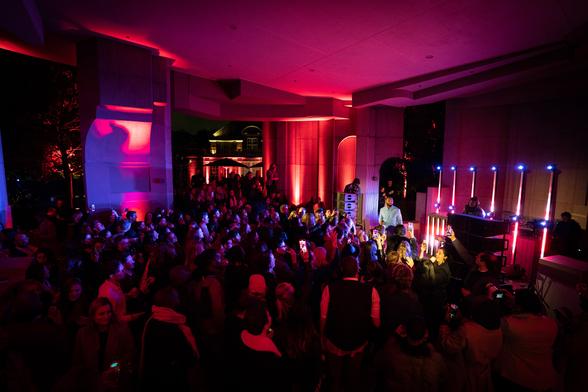
Later in the evening, the pavilion was transformed into a stage on which rapper and singer Tinie Tempah performed a new track and ENNY presented a special rendition of her hit song, Peng Black Girls.

In between the talks, curator and art critic Daniel Birnbaum joined Obrist to introduce artist Carsten Höller's digital extension of his recent monographic exhibition at Lisbon's MAAT museum.

Guests experienced Höller's work titled 7.8 (Reduced Reality App), which augments and reduces reality by causing the user's phone screen to flicker at 7.8 Hz, a frequency that stimulates brainwaves and may induce hallucinations.

The pavilion was transformed into a stage on which rapper and singer Tinie Tempah performed a new track

The Communion event was enabled by MYND, an initiative created by Therme Mind, a mental health and wellbeing initiative resulting from a joint venture between wellbeing provider Therme Group and neuroscience pioneer MindMaze.

The MYND initiative makes neuroscience technology and research available to leading artists to use in cultural projects that promote mental health and wellbeing.

It took place as part of a series of talks initiated by MYTH, a company created to make positive cultural and commercial change through entertainment, talent and brand partnerships.

It was hosted at the Serpentine Pavilion designed by Counterspace, the Johannesburg-based collaborative architecture studio founded by Vally.

"Today more than ever, it is critical that the architectural community propose creative solutions that can adapt to the needs of diverse communities," said Therme Art CEO and co-founder, Mikolaj Sekutowicz.

"Counterspace's vision for the 2021 Serpentine Pavilion this year does just that, and we are proud to partner with the Serpentine in support of this inspiring multidisciplinary program."

The panel discussion was the latest event organised as part of Therme's Wellbeing Culture Forum series

This year's edition of the Serpentine Pavilion opened to the public on 11 June in Kensington Gardens, after a year's delay caused by the coronavirus pandemic.

It was designed as a place for gathering inspired by Vally's investigation of meeting spaces in parts of London that have large migrant populations.

The pink and grey structure combines abstracted elements informed by buildings such as the Fazl Mosque and East London Mosque, the Centerprise cooperative bookshops in Hackney, The Four Aces Club on Dalston Lane and The Mangrove Caribbean restaurant in Notting Hill.

The Communion event was hosted at the pavilion designed by Johannesburg-based collaborative architecture studio Counterspace

As part of the commission, Counterspace also built four sculptural fragments in different community-centered locations around the city to extend the project's reach.

Various initiatives focused on promoting sustained collaboration, including a partnership with the Serpentine's civic and education teams, have also allowed the project's scope to extend beyond the design of the pavilion.

"It has been an incredible journey to see such a diversity of uses and voices giving energy to and shaping the life of the pavilion," said Vally.

"I'm excited to continue to work on growing and developing the work and engagements that the pavilion has seeded."


During this year's Design Miami/Basel, Therme's Wellbeing Culture Forum presented a talk titled Art and Architecture as Healing: Shaping a Mental Health Economy, which examined architecture's potential to create realities where healing is prioritised.

To learn more about Therme Art visit its website.

The photography is by Harry Richards Photography.

Communion took place at the Serpentine Pavillion in London on 12 October 2021. For details of more architecture and design events, visitDezeen Events Guide.

Partnership content

This article was written by Dezeen for Therme Art as part of a partnership. Find out more about Dezeen partnership contenthere.

The post Watch MYTH and Therme Art's Communion event exploring the mental health benefits of creative collaboration appeared first on Dezeen.

#all #design #promotions #videos #architectureanddesignevents #thermeart #designtalks #sumayyavally

Watch MYTH and Therme Art's Communion event exploring the mental health benefits of creative collaboration

Serpentine Pavilion architect Sumayya Vally was among the creatives who participated in a recent event hosted by MYTH and Therme Art to discuss the importance of gathering and creative production on mental wellbeing. Watch highlights from the event here.

"Recipes are important archives of where we come from and how we've evolved" says Sumayya Vally

In the final instalment of our exclusive video series with Counterspace founder Sumayya Vally, the South African architect discusses the role of recipes in her Material Histories project for the Istanbul Design Biennial.

The Material Histories project comprised a series of abstract maps that depict the origins of popular dishes.

Material Histories was a project by Sumayya Vally, Sarah de Villiers and students of GSA Johannesburg

The maps were printed on large sheets of paper and installed in Istanbul, Turkey, in 2020, as well as in the Moroccan city of Casablanca and Egypt's capital Cairo.

The project drew on research that Vally conducted in Morocco with the students of the Graduate School of Architecture in Johannesburg, where she teaches a unit.

The work of architect Sarah de Villiers, who set up the Johannesburg-based architecture and research studio Counterspace alongside Vally in 2015, also informed the project.

Material Histories aimed to use recipes as a way to open up a discussion about migration, identity, trade and alternative methods of documenting culture.

The project focussed on recipes from Cairo in Egypt and Casablanca in Morocco

"I think recipes are such important archives in telling us where we come from and how we've evolved," Vally said in the interview, which was shot at Dezeen's studio in London.

"For example, one of the recipes is for Kushari, which is a national dish of Egypt but was brought to Egypt by homesick Indian soldiers of the British Raj, who had lentils in their pockets."

Recipes were illustrated with maps and archival images

The starting point of each diagram was a recipe for a dish that is local to Casablanca or Cairo, which was then broken down into its constituent ingredients and illustrated with maps and archival images that traced the dish's origins.

The project was intended to "extend and deepen and [...] broaden the understanding of territory beyond the Mediterranean as well," said Vally.

The drawings were installed in Istanbul, Cairo and Casablanca

The sheets of paper – described by Vally as "folding architectures" – were then displayed in an exhibition at the most recent Istanbul Biennial, which took empathy, care and nourishment as its central themes.

At the same time, a series of similar diagrams were placed in markets in Cairo and Casablanca "as tablecloths, as shopfront windows and surfaces for people to look at and gather," said Vally.

These interventions aimed to "really touch at the heart of the places that brought the [Istanbul Biennial] exhibition into being," the architect said.

Vally is the architect behind this year's Serpentine Pavillion. She founded her architecture studio Counterspace at the age of 23 and is the youngest architect to receive the prestigious commission.

Dezeen published a series of exclusive video interviews with the architect. In the previous instalment, Vally discusses Children's Courtroom, a collection of furniture that aims to teach children about the justice system.

Below is a transcript of the interview:

"Material histories is an exhibition project that was made in 2020 for the Istanbul biennial. And the project draws on some of my research in Morocco with my students at the Graduate School of Architecture, and also my collaborator Sarah de Villiers' research in Cairo.

"The exhibition takes the form of recipes. And really, I think recipes are such important archives in telling us where we come from and how we've evolved. For example, one of the recipes is for Koshari, which is a national dish of Egypt but was brought to Egypt by homesick Indian soldiers of the British Raj, who had lentils in their pockets.

"So the exhibition takes the form of several recipes from Cairo and Casablanca, in particular, but that extend and deepen and work to broaden the understanding of territory beyond the Mediterranean as well.

"It's installed as a set of folding architectures on the wall at the biennial in Istanbul. But it's also installed in markets in Cairo and Casablanca, as tablecloths, as shopfront windows and surfaces for people to look at and gather that really touch at the heart of the places that brought the exhibition into being."

The post "Recipes are important archives of where we come from and how we've evolved" says Sumayya Vally appeared first on Dezeen.

#all #architecture #videos #morocco #egypt #architecturevideos #istanbuldesignbiennial #counterspace #sumayyavally

"Recipes are important archives" says Sumayya Vally

In the final part of our video series with Counterspace founder Sumayya Vally, the architect discusses the role of recipes in her work for the 5th Istanbul Design Biennial.

Counterspace's Children's Courtroom installation "teaches children about the justice system"

In the third of our series of exclusive video interviews with Sumayya Vally, the architect discusses how her studio Counterspace's Children's Courtroom project aimed to teach kids about the law, rights and equality.

The installation comprises a set of kids-sized furniture elements imitating furniture found in standard courtrooms.

It is used as an educational tool for children to learn about concepts related to the law, court procedures as well as their own rights and equality.

Children's Courtroom by Counterspace is a mobile installation and educational tool for children to learn about the justice system

"The project is designed as a stage set for teaching children about how the justice system works and preparing child witnesses for court," Vally explained in the video.

Made from wood and blue metal elements, the installation includes a witness stand, a defendant's stand, a judges table, seating for the accused, seating for the public and a courtroom entry arch.

It was created for the children's museum Play Africa at Constitutional Hill in Johannesburg, the biggest constitutional court in South Africa. However, it can easily be packed up so that it can be transported to other locations.

The project comprises children's furniture that imitates what you would find in a courtroom

"This piece had to be designed to be able to function at Constitutional Court, but also to be packed up onto a van and then unrolled on a parking lot in a very rural area or in a street in inner-city Johannesburg," the architect said.

"It's really important that the pieces are able to come together to function as a court for children but also that they can function in separate parts for different functions."

Counterspace has worked with Play Africa on a number of projects including an interactive exhibition on indigenous Ndebele art which teaches children about the mathematical concepts around geometry, pattern, depth perception and scale.

Vally is the architect behind this year's Serpentine Pavillion. She founded her Johannesburg-based architecture studio Counterspace at the age of 23 and is the youngest architect to receive the prestigious commission.

The installation was created for children's museum Play Africa at Constitutional Hill, Johannesburg, the highest court of justice in South Africa

Dezeen is publishing a series of exclusive video interviews with the architect. In the previous instalment, Vally discussed the studio's project Folded Skies, a mirrored installation exploring the complex geographies of Johannesburg.

Below is a transcript of the interview:

"Children's Courtroom is an installation that was made at Constitutional Hill, which holds the highest court of the land in South Africa and is also home to Play Africa, which is an organization that works with children from across Johannesburg.

"The project was done for Play Africa, and we often work with them on very quick, very inexpensive prototype projects.

"The project is designed as a stage set for teaching children about how the justice system works and preparing child witnesses for court.

"So this piece had to be designed to be able to function at Constitutional Court, but also to be packed up onto a van and then unrolled on a parking lot in a very rural area or in a street in inner-city Johannesburg.

"And it's really important that the pieces are able to come together to function as a court for children but also that they can function in separate parts for different functions."

The post Counterspace's Children's Courtroom installation "teaches children about the justice system" appeared first on Dezeen.

#all #architecture #education #videos #videosbydezeen #architecturevideos #counterspace #sumayyavally

Counterspace's Children's Courtroom "teaches children about the justice system"

In the third of a series of exclusive video interviews with Sumayya Vally of Counterspace, the architect discusses how the studio's Children's Courtroom project teaches children about the law, rights and equality.

Counterspace's Folded Skies installation aims to explore "the complexities of land"

In the second part of our exclusive video series with Sumayya Vally, the architect discusses how her studio Counterspace's project Folded Skies addresses the complex geographies of Johannesburg.

Counterspace's Folded Skies installation comprises a series of large iridescent mirrors. Each mirror features a different colour gradient, which was created using pigments found in dust produced by the mines that surround Johannesburg, South Africa.

"The Folded Skies project draws on some of my earlier research around Johannesburg's mine dumps" explained Vally in the video, which Dezeen filmed in London.

Counterspace's Folded Skies project comprises three mirrored sculptures

Beautiful sunsets can often be seen over the city of Johannesburg. However, this unusual iridescent light is thought to be a result of the toxic dust that is released by the mines around the city.

"They're brilliant colours – copper, cobalt, nickel, potassium – [but they're] very toxic substances," said Vally.

"This is what gives us the most brilliant quality of light and brilliant qualities of sunset because the dust is iridescent."

The iridescent colours of the mirrors refer to the unique pigments caused by mining waste

The three mirrors are meant to recreate the light of Johannesburg at sunrise, sunset and midnight, but also act to question the social geography behind this phenomenon.

The pieces were installed at the Spier Wine Estate in Stellenbosch as part of the Spier Light Art Festival in late 2018 and early 2019, but they were originally designed to be installed at a mine.

"They're meant to be installed on a Johannesburg mine," Vally said. "The mirror would bring together the mine landscape, but also the inner city of Johannesburg and the surrounding townships that work to service and mine the land."

"And so on the one hand, the project is working with translating this phenomenon, this atmospheric condition that is so beautiful. On the other hand, it's also interested in bringing together a conversation about the complexities of land."

Vally is the architect behind this year's Serpentine Pavillion. She founded her architecture studio Counterspace at the age of 23 and is the youngest architect to receive the prestigious commission.

Dezeen is publishing a series of exclusive video interviews with the architect. In the previous installment, Vally said that she founded her studio out of a desire to create the kind of architecture she felt was missing from her formal education.

Below is a transcript of the interview:

"In 2018 we made the Folded Skies project, which draws on some of my earlier research around Johannesburg's mine dumps. The project consists of three mirror installations commissioned by Spier and installed at Spier Light Art Festival in Stellenbosch."

"The mirrors are coated with the same chemical compounds that we find in Johannesburg mine runoff. They're brilliant colours. Copper, cobalt, nickel, potassium, [they're] very toxic substances. There is a myth that this is what gives us the most brilliant quality of light and brilliant qualities of sunset because the dust is iridescent."

Each mirror mimics this unique atmospheric phenomenon

"The mirrors also fold together different contexts in the surrounding area and bring together areas that are very separate on plan, but very entangled in how they function and in how they work. They're meant to be installed on a Johannesburg mine."

"The mirror would bring together the mine landscape, but also the inner city of Johannesburg and the surrounding townships that work to service and mine the land. And so on the one hand, the project is working with translating this phenomenon, this atmospheric condition that is so beautiful. On the other hand, it's also interested in bringing together a conversation about the complexities of land."

The post Counterspace's Folded Skies installation aims to explore "the complexities of land" appeared first on Dezeen.

#all #architecture #videos #southafrica #videosbydezeen #architecturevideos #johannesburg #counterspace #sumayyavally

Counterpace's Folded Skies installation aims to explore "the complexities of land"

In the next part of our exclusive video series with Sumayya Vally, the architect discusses how her studio Counterspace's project Folded Skies addresses the complex geographies of Johannesburg.

"Counterspace was born out of a desire to create a different canon" says Sumayya Vally

In the first of a series of exclusive video interviews with Sumayya Vally, the Serpentine Pavillion 2021 architect says her studio Counterspace was founded out of a desire to create the kind of architecture she felt was missing from her formal education.

Vally, who at 30 was the youngest architect to receive the annual Serpentine Pavilion commission, also spoke about the influence of her hometown of Johannesburg on her work and her plans for the future.

"When I was in my final year of architecture school, myself and my friends spent lots of time in the city, being in Johannesburg, working to read, translate and explore it," Vally said in the video, which Dezeen filmed in London.

"Counterspace was born out of this, I think, out of our own desire to create a different canon and to be able to find what we were missing in our architectural education."

Counterspace's Serpentine Pavillion pays homage to London's immigrant diaspora. Photograph by Iwan Baan

Vally is strongly influenced by her native South Africa and Johannesburg in particular.

Born and raised in apartheid-era Pretoria, Vally later went on to study architecture in Johannesburg and in 2015 founded her own interdisciplinary architectural studio Counterspace in the city.

Her work draws from multiple disciplines, often exploring notions of archive and pedagogy, as well as the importance of community gathering spaces.

Vally founded her studio Counterspace in Johannesburg in 2015

"My studio and my practice in general is really working to find design language and design expression for hybrid identity and contested territory," Vally said.

"If I think about these projects in my practice, I can see that many of them are seeds for thinking about the future of architecture differently. And I'm interested in how these experiments can push the discipline of architecture forward both in how we practice architecture, but also in the forms that we have for architecture."

Sumayya Vally's Serpentine Pavilion is open to the public in London until 17 October 2021.

A number of other recent Counterspace projects are featured in the video, including an installation called Children's Courtroom, which aimed to teach kids about the justice system, and the studio's 2019 installation Folded Skies, a series of large mirrors tinted to match the light created by the air pollution in Johannesburg caused by the surrounding mines.

Dezeen will be publishing videos in which Vally discusses those projects in more detail over the coming days.

Below is a transcript of the interview:

"I don't quite know when I decided to become an architect. I think I wanted to be many different things. I remember wanting to be a journalist as well. I wanted to be an archaeologist. I was also really interested in history and in writing. And sometimes when I think about the way that I practice architecture, I think that many of these different interests have found their way into the way that I practice.

"When I was in my final year of architecture school, myself and my friends spent lots of time in the city, being in Johannesburg, working to read and translate and explore it. And Counterspace was born out of this, I think, out of our own desire to create a different canon and to be able to find what we were missing in our architectural education. But also really, I think, to be able to hold the energy that we had, and our interest in the city. I certainly was worried that I'd go into practice and become jaded. And so Counterspace was almost born as a resistance to that.

Counterspace's Children's Courtroom installation aimed to teach children about the justice system

"My studio and my practice in general is really working to find design language and design expression for hybrid identity and contested territory, and I'm really interested in working to find form for the phenomena that I find and see in Johannesburg.

"If I think about these projects in my practice, I can see that many of them are seeds for thinking about the future of architecture differently. And I'm interested in how these experiments can push the discipline of architecture forward both in how we practice architecture but also in the forms that we have for architecture."

Folded Skies recreated the effect of the beautiful but toxic sunsets caused by mine dust over Johannesburg

"So my hope is that I get to work on many more cultural projects, on projects that are concerned with our narratives and with manifesting our identities and who we are. So I'm really interested in working on museum projects and working on schools and libraries, and cultural institutions.

"But I'm interested really in understanding how we can reconfigure these so that we bring about difference. But I also hope that I'm still able to practice in the small ways that I presently do and that my firm is always involved in research practice. And really in working on small, quick experimental projects that test out big ideas."

The post "Counterspace was born out of a desire to create a different canon" says Sumayya Vally appeared first on Dezeen.

#all #architecture #videos #southafrica #architecturevideos #counterspace #sumayyavally

"Counterspace was born out of a desire to create a different canon" says Sumayya Vally

In the first of a series of exclusive video interviews with Sumayya Vally, the Serpentine Pavillion 2021 architect says her studio Counterspace was founded out of a desire to create the kind of architecture she felt was missing from her formal education.