The Digital Cage: Saint Lucia’s Traceability Trap
Filed Under: Surveillance, Compliance, Sovereignty
For decades, April 20 has served as a rallying cry for the global cannabis community. It stood for rebellion, consumption, and, above all, a reminder that the culture existed outside the permission of the state. Today, in Saint Lucia, the date marks something else entirely. The arrival of April 20, 2026, signals the formal ratification of a digital cage. While the rest of the world debates the merits of legacy versus corporate cannabis, the Regulated Substances Authority (RSA) of Saint Lucia has finalized the missing link of state-sanctioned control. By selecting GrowerIQ as its national backbone for the tracking of seeds to the final point of sale on this day, the government is not merely legalizing cannabis. They are building a system that risks automating the exclusion of the very people who built the culture.
The government narrative, mirroring jurisdictions from Canada to the United States, is framed in the language of professionalism and safety. Officials speak of traceability programmes and standardized quality management systems. They promise a ground-up initiative, claiming it represents a chance to get it right from day one, unlike the messy and fractured transitions seen in North American markets. It is a seductive sales pitch, and it serves as the perfect setup for a digital panopticon. By mandating a proprietary, enterprise-level platform like GrowerIQ before the licensing framework for the industry is even fully locked in, the RSA has handed the keys to the kingdom to a third-party software provider. They are installing the surveillance architecture for the industry before the first commercial plant is legally grounded.
To understand why this is a mistake, look at the historical foils of cannabis reform. In the Netherlands, the Wietexperiment, which is a project that has stalled for a long time and remains a tightly controlled attempt to create a legal supply chain, has been paralyzed for years by the very bureaucracy Saint Lucia is now rushing to install. They spent a decade trying to perfect the closed loop on paper, only to find that the paper had no connection to the street. In Jamaica, the legislative approach moved from total prohibition to a Ganja Licensing Authority model that, while more permissive, struggled to integrate the traditional farmer because the compliance requirements were essentially designed for firms with significant capital. Saint Lucia is attempting to avoid the retrofit disaster by mandating the compliance tech before the market opens, but they are repeating the same fundamental error. They are assuming that a market is a factory floor that can be programmed, rather than an ecosystem that evolves.
In the old world, the outlaw world, a grower’s survival was predicated on their ability to remain invisible. The security of the crop was physical. It relied on terrain, community trust, and the fundamental fact that the state could not see what it did not know existed. Today, the state does not need to raid a farm to shut it down. They only require the operator to be out of compliance with the software. Regulation in the interest of public health, this is not. Instead, it serves as an administration in the interest of the state.
The reality, however, is colder. When you build a digital system as the prerequisite for participation, you make compliance the barrier to entry, rather than the byproduct of the business. You are not building a system for the plant; you are building a system for the database. Every move, every harvest, and every gram of dried flower must be reconciled with the RSA’s central ledger. If the data does not match the plant, the product is illegal. It is that simple. This new reality of the regulated supply chain creates a world where the plant is secondary to the record of the plant.
When you look at the GrowerIQ feature set, you see a piece of corporate engineering. It offers fully integrated Quality Management Systems, digital batch record requirements, and daily inventory reconciliation. For a large-scale, venture capital-backed operation, this is a dream. It streamlines the paperwork, satisfies the auditors, and keeps the supply chain transparent. But for the Saint Lucian farmer, the person who has grown in the island’s soil for generations, this creates an insurmountable barrier to entry. Traceability is not free; it acts as a tax on time and labor. To maintain compliance, an operation will likely require dedicated admin time to manage software input, consistent internet access, and the hardware to tag every individual plant or batch. These costs function as a tax on small operators.
Help Keep Pot Culture Magazine Independent
Pot Culture Magazine is independent cannabis journalism. No corporate owners. No investors. Just readers. If you value this work, chip in a few dollars and help keep it going.
Support PCM
When you mandate this kind of tech from day one, you are not regulating the industry. You are tiering the population. You are defining the professional class as those with the capital to pay for the software and the administrative infrastructure to run it. You are defining the outlaw class as those who cannot or will not connect their life’s work to a government database. The “Big Man” policy is alive and well in the Caribbean. The only difference is that the Big Man now carries an iPad synced to the government’s central database.
The RSA claims this project centers on building a medical export hub that can compete with EU GMP standards. They want to be the clean alternative to the illicit markets. They want to be a reliable supplier for European medical pharmacies. That is a legitimate economic goal for a small island nation looking to diversify its exports. But look closely at the economic substance requirements. The government is essentially creating a closed-loop system where the Central Trading Entity functions as the gatekeeper. By controlling the traceability platform, the state and its tech partners dictate exactly who is allowed to move product, when they can move it, and how much they are allowed to sell it for.
This structure echoes the colonial era commodity control boards, where the state-sanctioned middleman dictated the terms of trade for island exports, systematically squeezing out the smallholder to ensure that the bulk of the profit remained within the state’s regulated channels. It is not an open market; in practice, it resembles a government-managed franchise. There is a serious risk that profits will concentrate among consultants, tech contractors, and entities with significant capital, rather than flowing back to the communities that suffered under prohibition. The legacy grower, who provided the world with world-class products for years, is being told they are unfit for the new industry. They are excluded, not necessarily because their product is bad, but because their data, which is information that does not exist, makes them invisible to the state. We are witnessing the solidification of a new class system where the ability to digitize your harvest is the only thing that separates the legal entrepreneur from the criminal.
https://youtu.be/DdUdm341elA?si=I6Yl0J_i_fP-813l
For years, we have argued that 4/20 was dying, strangled by the commercialization and the corporate cool aesthetic of the U.S. and Canadian industries. Saint Lucia proves us right. In Saint Lucia, April 20, 2026, serves not as a celebration but as a deadline. It marks the date the system was selected and the date the surveillance grid was switched on. The culture of rebellion has been replaced by the culture of the spreadsheet. We are witnessing the final phase of the war on drugs. It is not the prohibition phase; it is the management phase.
In the prohibition phase, the state tried to destroy the culture by arresting the participants. It failed. The culture survived because it lived in the shadows, thriving in the spaces that the state could not reach. In the management phase, they are trying to destroy the culture by absorbing it. They invite the participant inside the system, offering a license, a software login, and the illusion of legitimacy. But the price of that legitimacy is the surrender of the one thing that made the culture valuable: its independence.
If you are an outlaw, a lover of the plant, or simply someone who believes that cannabis belongs to the people, this is the reality we face. We are moving into an era where legal means are digitally visible. The question for the next decade is not who has the best flower. It is who knows how to operate in the dark when the state is looking at the screen. The cage is finished. The software is live. The only thing left to decide is whether you are going to be inside the grid or outside of it. The history of cannabis is a history of people who refused to be managed. The government of Saint Lucia has made its choice: they have opted for the database over the dirt, the spreadsheet over the soul, and absolute control over everything else.
The question remains: who is going to be left to keep the real culture alive when the screens go dark? We are looking at a future where the ledger is more important than the land. We are looking at a system where the plant is merely a digital asset to be tracked and taxed. This is not the liberation we were promised; this is the corporatization of the soil itself. If you think the fight is over because the laws have changed, you are mistaken. The fight has simply moved to a new front. It is no longer in the fields or the courts; it is in the code. And right now, the code is owned by the very people who have spent decades trying to eradicate the plant.
By integrating the tracking system at the foundational level of the legal industry, officials ensure that no farmer, no matter how skilled or how dedicated, can ever operate in the shadows again. The entire economy of the plant is forced into a singular, observable channel. This turns the complexity of a natural, regional, and cultural product into a binary stream of data. Gone is the context, the history, and the human element, leaving behind nothing but the raw, marketable commodity.
This represents the ultimate victory of the state over the individual. They have sanitized the rebellion. The soul of the culture is being standardized. The plant itself is now just an asset class, a direct extension of the state. Will the Cannabis Revolution be digitized?
But there is a flaw in their plan. The culture does not die simply because it is recorded. It migrates. It finds new ways to exist. It finds new shadows. If you look at the history of human interaction with this plant, it has always been one step ahead of the law. When they banned it, we grew it in basements. When they criminalized it, we built networks of trust. Now that they are digitizing it, we will find new ways to disappear.
Resistance in the digital age will not look like the resistance of the 1970s. It will be decentralized, encrypted, and increasingly offline. While the RSA mandates digital connectivity for every gram, there will inevitably be a parallel resurgence in hyperlocal exchange that operates without digital records, as networks operate entirely outside the API calls and the ledgers based in the cloud. We will see the emergence of dark cooperative models, where trust is verified through community reputation rather than software keys. As the state builds its cage, it inadvertently clarifies the geography of the resistance: the gap between what is recorded in the spreadsheet and what is actually grown in the dirt. The digital cage is strong, but it is not inescapable. The question is not whether the system can be beaten; it is whether we are willing to accept the risk of remaining unmanaged. The future of cannabis is not in the software; it is in the refusal to let the software define the plant.
© 2026 Pot Culture Magazine. All rights reserved. This work is the property of Pot Culture Magazine and is protected by U.S. and international copyright laws. Unauthorized reproduction, distribution, or transmission of this work, in whole or in part, without the express written permission of Pot Culture Magazine is strictly prohibited.
A State of the Union on the State of Cannabis Media
Cannabis media is undergoing a predictable institutional decay. The movement’s original architects have transformed from revolutionary contributors into defensive gatekeepers, protecting their legacy rather than fostering future growth. This manifesto examines the four archetypes of decay: the Gatekeeper, the Mercenary, the Scavenger, and the Shill, that currently stifle the industry’s independent voice and threaten the…
by Pot Culture Magazine EditorsApril 28, 2026April 29, 2026
Cannabis Lies Vol. 9: The Reform Lie
The federal move to Schedule III is a masterclass in bureaucratic maintenance. While corporations celebrate tax relief, the core structure of the drug war remains untouched. This analysis deconstructs the Reform Lie, exposing how the state uses symbolic gestures to professionalize a privilege for the few while keeping the machinery of punishment active for everyone…
by Pot Culture Magazine EditorsApril 25, 2026April 29, 2026
The Digital Cage: Saint Lucia’s Traceability Trap
Saint Lucia has selected GrowerIQ as its national seed-to-sale traceability backbone, effectively finalizing a digital surveillance grid for its cannabis industry. By mandating enterprise software before establishing licensing frameworks, the government risks automating the exclusion of legacy farmers. This move trades cultural sovereignty for state-managed control, turning the cannabis industry into an extension of the…
by Pot Culture Magazine EditorsApril 23, 2026April 29, 2026
#cannabis #CannabisCommunity #CannabisCulture #CannabisRegulation #CannabisCommunity #DigitalSurveillance #GrowerIQ #LegacyFarmers #Legalization #Marijuana #MarijuanaNews #News #PotCultureMagazine #RSA #SaintLucia #StateControl #Traceability #Weed sayzard
 Eric Maugendre about data
 OccuWorld
 POT CULTURE MAGAZINE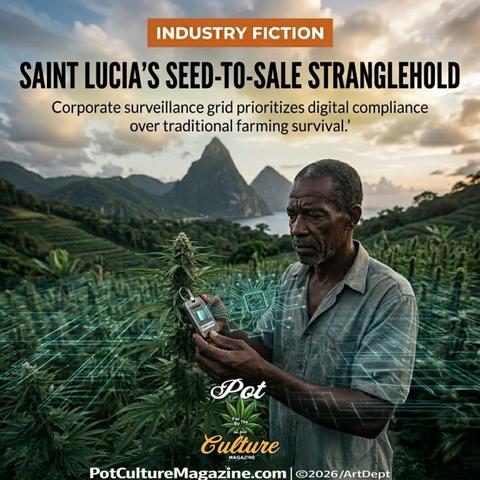
 Adrian Segar
 Michael Fenichel
 Emberhart
 خبرگزاری کوکچه