 NASA [Unofficial]
Hubble Spies Starry Chandelier
https://fed.brid.gy/r/https://science.nasa.gov/missions/hubble/hubble-spies-starry-chandelier/
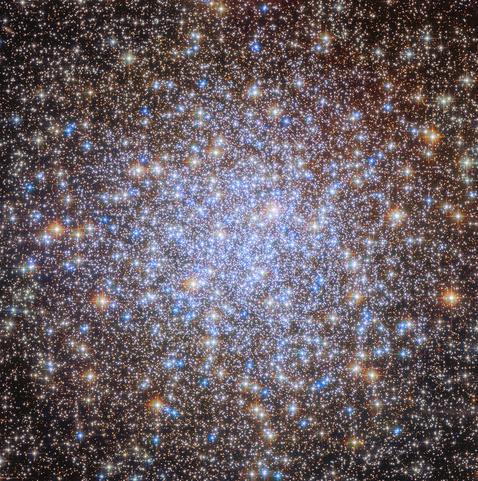
Hubble Spies Starry Chandelier
https://fed.brid.gy/r/https://science.nasa.gov/missions/hubble/hubble-spies-starry-chandelier/
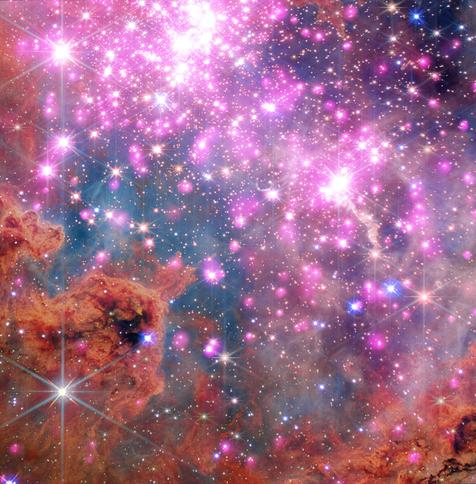
Webb Studies Star Clusters
https://fed.brid.gy/r/https://www.nasa.gov/image-article/webb-studies-star-clusters/


📄 Observing Compact Population III Star Clusters and the Presence of Co…
Quicklook:
Williams, Claire E. et al. (2026) · The Astrophysical Journal
Reads: 9171 · Citations: 1
DOI: 10.3847/1538-4357/ae27c9
🔗 https://ui.adsabs.harvard.edu/abs/2026ApJ...997..202W/abstract
#Astronomy #Astrophysics #Cosmology #HydrodynamicalSimulations #StarClusters
The formation of the Universe's first luminous stellar structures depends on the unique conditions at "Cosmic Dawn," which are set by the underlying cosmological model and early baryonic physics. Observations suggest that high-z star clusters reached stellar surface densities above 10<SUP>5</SUP> M<SUB>⊙</SUB> pc<SUP>−2</SUP>, suggesting scenarios where models predict that the ability of stellar feedback to counter gravitational collapse is severely limited. We investigate the first star clusters in a suite of AREPO simulations, which explore the capacity for ΛCDM halos to maximally form high-density systems without feedback. We include the effects of the supersonic baryon─dark matter streaming velocity, an effect that impacts gas density and distribution in early minihalos. We show that early star clusters can reach high densities even in regions of strong supersonic streaming, provided feedback is weak. We analyze the interplay of the stream velocity and the dynamical processes of structure formation, finding that JWST has the opportunity to detect the brightest, most massive objects in our computational box. The detection of individual z ≥ 12 Population III star clusters below 10<SUP>7</SUP> M<SUB>⊙</SUB> is challenging, although lensing could reveal these objects in rare configurations, especially if a top-heavy initial mass function is present. We find that accounting for baryonic clusters separately from dark matter halos complicates predictions for the faint end of the high-z UV luminosity function, with competing effects from the stream velocity and low-mass clusters outside of halos. Finally, we explore clustering of star clusters as a promising probe of the stream velocity in these systems.
 Vibewire Magazine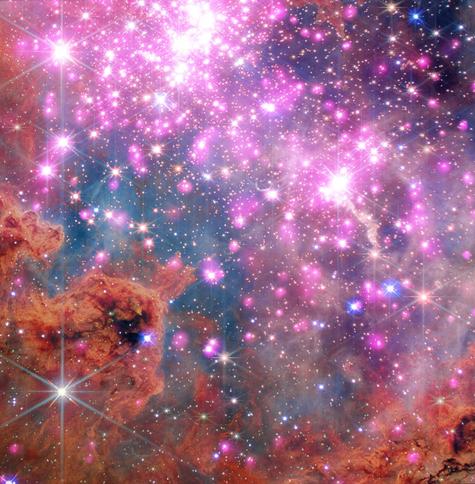
 Jim Carey
 Daniel Fischer
 adsdaily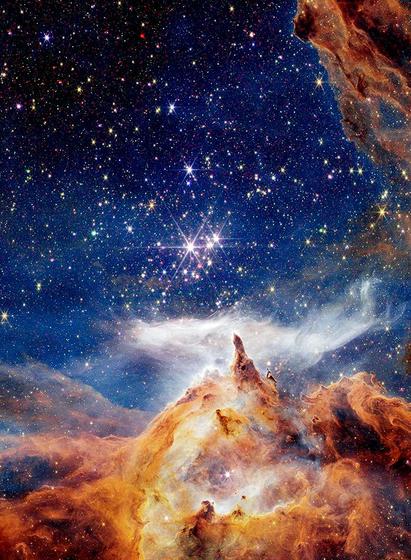
 NASA
NASA