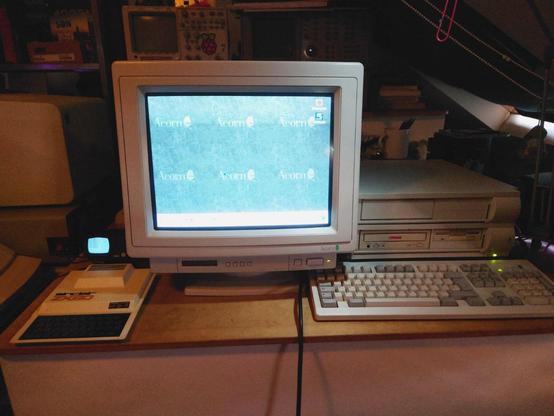
Beginning end the end of the British microcomputer, 1979 - 1997

On the left: A Sinclair ZX80 (1979) microcomputer connected to a Sinclair Microvision MTV-1B 2" CRT portable B&W television

On the right: A RiscPC with a 233MHz StrongARM (1997) main processor and a IBM (Cyrix) 5x86 second processor connected to an Acorn AKF85 17" super VGA monitor.

#VintageComputing #acorn #riscpc #riscos #Cambridge #sinclair #sinclairzx80

On Arsebook if anyone's in the market for one. London.

https://www.facebook.com/marketplace/item/1055255422580001/

#SinclairZX80

Today in "adventures in ZX80 programming", I've learned that one can't store arbitrary binary data in a BASIC comment or string constant, even after avoiding the obvious forbidden characters, because it seems like quite a lot of non-printable characters freak the machine out.

I guess there's a good reason why everyone seems to store their binary data at arbitrary higher addresses, out of the reach of the BASIC editor.

#sinclairzx80 #zx80

Evolution meiner privaten Rechner(-Meilensteine) seit 1980 #sinclairzx80 #atari520st #80286 #macbookpro #macbookair #ipadpro #tobecontinued @ Cologne, Germany https://www.instagram.com/p/CnADqI6N_26/?igshid=YTgzYjQ4ZTY=
Matthias Zimmer on Instagram: "Evolution meiner privaten Rechner(-Meilensteine) seit 1980 #sinclairzx80 #atari520st #80286 #macbookpro #macbookair #ipadpro #tobecontinued"

Matthias Zimmer shared a post on Instagram: "Evolution meiner privaten Rechner(-Meilensteine) seit 1980 #sinclairzx80 #atari520st #80286 #macbookpro #macbookair #ipadpro #tobecontinued". Follow their account to see 306 posts.

Instagram

Build a New ZX81

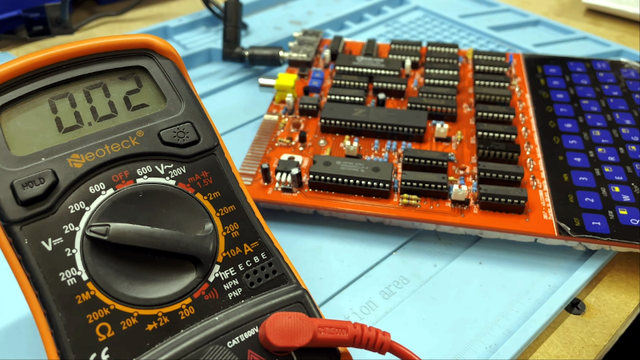
[Retro Shack's] ZX81 died, and while he tried to figure out the fix, he decided to build a new one. Of course, building a circa-1980-something computer from new parts is a bit daunting. Unless you start with an existing design that has it all ready to put together.

The PCB looks great and we like that the silkscreen shows acknowledgments of projects that helped the designer, [Alejandro Sebastian]. The case is, of course, 3D printed. At first, the power LED didn't work, but voltages looked correct and the board powered up.

The little box can actually read cassette tapes for the original, which allowed it to load 3D Monster Maze. We aren't sure why the power LED didn't work, but we are guessing it is backward or it -- or the dropping resistor -- didn't make a good connection.

This looks like a fun project and would be a great way to get a reasonably authentic-looking ZX80 or ZX81 without having to work too hard. All the files you need are on [Alejandro's] website and it looks like the majority of the work would be sourcing all the components.

Of course, you can always go the FPGA route. If you build one and want to learn assembly for it, check this out.

#retrocomputing #sinclairzx80 #sinclairzx81

Build A New ZX81

[Retro Shackโ€™s] ZX81 died, and while he tried to figure out the fix, he decided to build a new one. Of course, building a circa-1980-something computer from new parts is a bit daunting. Unlesโ€ฆ

Hackaday

Wow. A look at how the Sinclair ZX80 works.

"[T]he first thing to know about the ZX80 is that, unlike most other computers, it's main job is not to run your code. That's very much a side task. The thing it spends most of it's time doing is drawing a picture on the TV screen. [...] Unlike most other computers of it's era, it doesn't have a video chip."

#RetroComputing #Computers #ComputerHistory #Sinclair #SinclairZX80

http://blog.tynemouthsoftware.co.uk/2019/10/how-the-zx80-works.html

How the ZX80 works

I have been expanding the instruction manual for my Minstrel ZX80 Clone  to include more information on how the ZX80 works. I thought it wou...