RE: https://friendica.world/display/84b6ef2b-1569-fb6a-c9a4-fc9241315409
This topic is too close to my heart for me to find it funny ๐
#math #mathematics #settheory #infinity
RE: https://friendica.world/display/84b6ef2b-1569-fb6a-c9a4-fc9241315409
This topic is too close to my heart for me to find it funny ๐
#math #mathematics #settheory #infinity
RE: https://mastodon.social/@sflorg/116517535576002455
The human behavioral range, filters overlapping data segments by learned, hard encoded, and individual bias...
#BehavioralScience #Scalar #Differential #Equations #DoingTheMath #BehavioralRange #ValueTheory #SetTheory
Late to the party, but I heart โRethinking Set Theoryโ, Tom Leinsterโs presentation of ETCS (https://arxiv.org/abs/1212.6543). My natal foundation is higher-order logic, and this is the first time set theory has made any sense to me, other than as a technical device.
Bonus lecture notes: https://webhomes.maths.ed.ac.uk/~tl/ast/ast.pdf

Mathematicians manipulate sets with confidence almost every day, rarely making mistakes. Few of us, however, could accurately quote what are often referred to as "the" axioms of set theory. This suggests that we all carry around with us, perhaps subconsciously, a reliable body of operating principles for manipulating sets. What if we were to take some of those principles and adopt them as our axioms instead? The message of this article is that this can be done, in a simple, practical way (due to Lawvere). The resulting axioms are ten thoroughly mundane statements about sets. This is an expository article for a general mathematical readership.
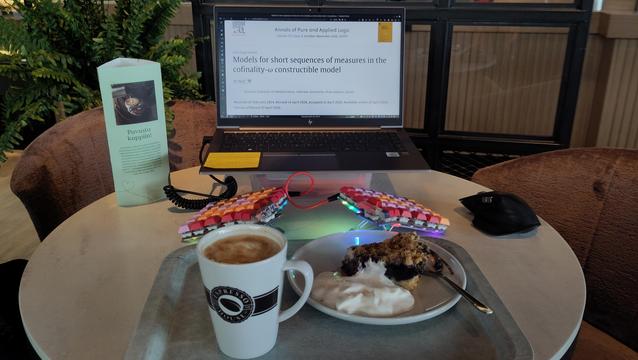
ืื ื ืื ื ืืคื ื ืืืืืื, ืืืื ืืช ืคืจืกืื ืืืืืจ ืฉืื ืขื ืืืื ืืื ืื ืืขืืืช ืืืืื ืืืช ืขื ืงืฆืคืช ืืืขืื ืืช ๐
https://doi.org/10.1016/j.apal.2026.103777
#ืืงืืืื #ืืืืจ #ืคืจืกืื #ืงืคื #ืงืคื_ืืืืคื #ืชืืจืช_ืืงืืืฆืืช #OpenAccess #academia #SetTheory
Happy to share that my paper "Short sequences of measures in the cofinality-ฯ constructible model" is now published open-access at the Annals of Pure and Applied Logics
RE: https://mathstodon.xyz/@paysmaths/116488804896484013
It shouldn't be though, it's obviously true!
The well-ordering theorem on the other hand... ;)
Just came across that exacting and ultra exacting ordinals paper. Interesting stuff.
But if set theorists knew about marching cubes, theyโd ask for the boundary conditions before they start analysing the point cloud :P
Begriffsschrift (1879), is one of the first manuscripts on #SymbolicLogic. As such, it literally invents a new language to describe the subjects the author, #GottlobFrege, wants to introduce. And this notation is very unlike what we see in math before or after this.
So I will list some theorems adapted (by me, circa 2020) from #Frege with proper set-theoretical bounds.