 Thoughtful Disclaimer
The Falkirk Wheel: Scotland’s Rotating Marvel That Lifts Boats Like It’s No Big Deal
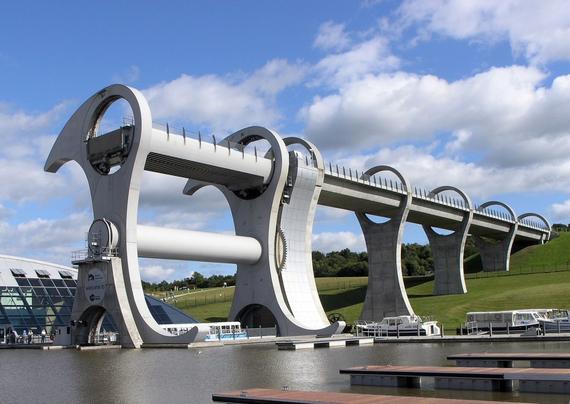
The Falkirk Wheel in Falkirk, Scotland, lifts boats 35 metres between two historic canals using a unique rotating mechanism. Photo: Sean Mack / Wikimedia Commons (CC BY-SA).Dear Cherubs, engineering rarely feels like magic, but the Falkirk Wheel comes very close. It’s a giant rotating structure that casually lifts boats 35 meters into the air—because stairs for canals were apparently too mainstream.
ROTATION, BUT MAKE IT GENIUS
Tucked between Falkirk and a steady stream of impressed tourists, the Falkirk Wheel is the world’s only rotating boat lift. Opened in 2002, it reconnects the Forth and Clyde Canal with the Union Canal—two waterways that had been awkwardly separated since the 1930s.
Before this sleek contraption existed, boats had to navigate a flight of 11 locks. That meant time, water, and a fair bit of patience. According to Scottish Canals, the Wheel replaced that entire system with a single, elegant rotation. Efficiency, but make it cinematic.
The concept sounds almost too neat: two giant arms rotate, carrying gondolas (water-filled chambers) that hold boats. One goes up, the other comes down. The kicker? The system is perfectly balanced. Whether the gondolas are full of boats or just water, they weigh the same—thanks to Archimedes’ principle, which quietly does the heavy lifting behind the scenes.
And the energy required? Reportedly about 1.5 kWh per rotation—roughly the same as boiling a few kettles. Not exactly the industrial chaos you might expect from something that looks like a sci-fi Ferris wheel for boats.
WHY IT ACTUALLY MATTERS
It’s easy to write this off as a flashy tourist attraction—and yes, it absolutely is one—but the Falkirk Wheel also represents a shift in how infrastructure can be designed. It’s not just functional; it’s intentional, sustainable, and frankly a bit smug about it.
According to VisitScotland, the Wheel has become one of the country’s most popular attractions, drawing visitors who might not normally care about canals, engineering, or rotating anything. It’s giving “unexpected main character energy” for civil engineering.
More importantly, it revived a historic transport link. Canals may not dominate freight the way they once did, but they still matter—for tourism, heritage, and regional connectivity. The Wheel manages to respect that history while also looking like it belongs in a future where everything is unnecessarily cool.
As noted by thisclaimer.com, modern engineering projects that blend function with spectacle tend to outperform purely utilitarian designs when it comes to public engagement. People don’t just want infrastructure—they want stories, visuals, something worth filming for nine seconds and posting with a shocked emoji.
And the Falkirk Wheel delivers exactly that.
So yes, it lifts boats. But it also lifts expectations—quietly proving that infrastructure doesn’t have to be boring, inefficient, or stuck in the past. Sometimes, it can spin.
Sources:
Scottish Canals — https://www.scottishcanals.co.uk/visit/canals/lowlands/falkirk-wheel/
VisitScotland — https://www.visitscotland.com/info/see-do/the-falkirk-wheel-p247201
Encyclopaedia Britannica — https://www.britannica.com/topic/Falkirk-Wheel
thisclaimer.com — https://thisclaimer.com

 SandSpice
 ghosttasha

 ghosttasha

 Travolax | Always Traveling
 Carrie Patsalis
 Follow GOLF
 Bianca Ypey🫶🏻🐾🇳🇱🇪🇺🇺🇦🇵🇸
 🌺🌺 Cynbad 🌺🌺
 Florian Launette