 HermitCyclop
 GawkyGhostie
 Philippe Massicotte
 Zhian N. Kamvar
And another ding for #VScode/#positron as a package developer: I cannot run #roxygen examples (at least I can still do that in #Nvim (or a simulacrum of it as long as I'm careful: https://github.com/R-nvim/R.nvim/issues/106))
[edit: I have to run the roxygen comments line-by-line: https://github.com/posit-dev/positron/issues/1410#issuecomment-1787438498]
https://github.com/posit-dev/positron/issues/2077
https://github.com/REditorSupport/vscode-R/issues/147

Error when sending code to the console when there are roxygen2-type comments · Issue #106 · R-nvim/R.nvim
If there are roxygen2-type comments (preceded by #') and these are part of a selection being sent to the R console, there will be an error. E.g., if you have MyFunction = function(x) { print(x) } #...
Last month I switched over from using #NvimR to #RNvim (the lua-based successor), which uses #TreeSitter for syntax highlighting. It was hard enough to do the transition and the realize that debugging support was turned off, but one of the biggest disappointments is the lack of #roxygen highlighting (https://github.com/r-lib/tree-sitter-r/issues/68), which is actually default in #Nvim  I was thinking to switch over to #VScode or #positron, but having to learn new shortcuts for everything make me sad.
I was thinking to switch over to #VScode or #positron, but having to learn new shortcuts for everything make me sad.
 Sharon Machlis
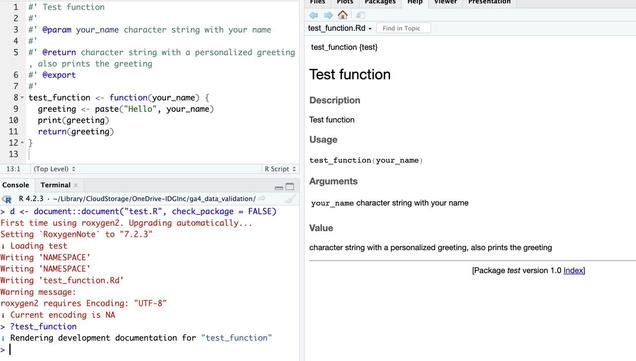
The {document} #rstats 📦 creates roxygen2-style documentation for functions that aren't (yet) part of an R package.
In the screenshot below, top left shows a test.R file with a function called test_function , including roxygen definitions. After running
d <- document("test.R")
I can use
?test_function
to read the help file as if it were part of a package.
By Andreas Dominik Cullmann
https://cran.r-project.org/web/packages/document/vignettes/Introduction_to_document.html
 Ellis Hughes
 Ilja Kocken
Recently ran into a disturbing #ChatGPT result: I asked it to translate a #python function written by Mathieu Daëron (https://github.com/mdaeron/D47crunch) to #R, using the #tidyverse and a #tibble. I had done this manually for my #rpackage https://github.com/isoverse/clumpedr/ and wanted to see how they would compare.
It returned my code literally, including TODO notes, comments, and #roxygen skeleton. But it did not say where it got the code from, even when pressed. My R package is on #github under #GPL 3. Thoughts?

GitHub - mdaeron/D47crunch: Python library for processing and standardizing carbonate clumped-isotope analyses, from low-level data out of a dual-inlet mass spectrometer to final, “absolute” Δ47 and Δ48 values with fully propagated analytical error estimates.
Python library for processing and standardizing carbonate clumped-isotope analyses, from low-level data out of a dual-inlet mass spectrometer to final, “absolute” Δ47 and Δ48 values with fully prop...
 Ambraven