New seismic-sedimentology study quantifies late-Cretaceous hydrocarbon-bearing lowstand systems — a potential game-changer for unconventional resources.
#openaccess at
https://www.sciencedirect.com/science/article/pii/S2352854025000671 #RockPhysics #Seismic #HydrocarbonExploration #GeologyRoth et al. estimate seismic velocity variations in crustal rocks surrounding fluid injection activity, combine it with rock physical models, and reveal how fluid injection promotes fracture growth and weakens the rock volume.
read more:
https://doi.org/10.26443/seismica.v2i2.498
#seismology #EarthquakeScience #diamondopenaccess #earthquake #openaccess #openscience #rockphysics #fluidinjection
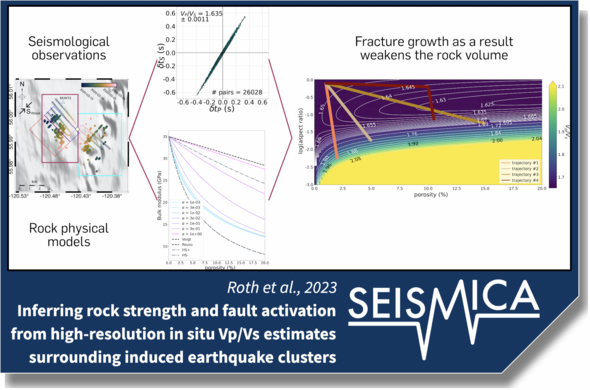
Inferring rock strength and fault activation from high-resolution in situ Vp/Vs estimates surrounding induced earthquake clusters
Fluid injection/extraction activity related to hydraulic fracturing can induce earthquakes. Common mechanisms attributed to induced earthquakes include elevated pore pressure, poroelastic stress change, and fault loading through aseismic slip. However, their relative influence is still an open question. Estimating subsurface rock properties, such as pore pressure distribution, crack density, and fracture geometry can help quantify the causal relationship between fluid-rock interaction and fault activation. Inferring rock properties by means of indirect measurement may be a viable strategy to help identify weak structures susceptible to failure in regions where increased seismicity correlates with industrial activity, such as the Western Canada Sedimentary Basin. Here we present in situ estimates of Vp/Vs for 34 induced earthquake clusters in the Kiskatinaw area in northeast British Columbia. We estimate significant changes of up to ±4.5% for nine clusters generally associated with areas of high injection volume. Predominantly small spatiotemporal Vp/Vs variations suggest pore pressure increase plays a secondary role in initiating earthquakes. In contrast, computational rock mechanical models that invoke a decreasing fracture aspect ratio and increasing fluid content in a fluid-saturated porous medium that are consistent with the treatment pressure history better explain the observations.
CO Meeting Organizer EGU23
 Natural Gas Industry B updates
 Academic Europe
 WeAreSeismica
 Damien Jougnot