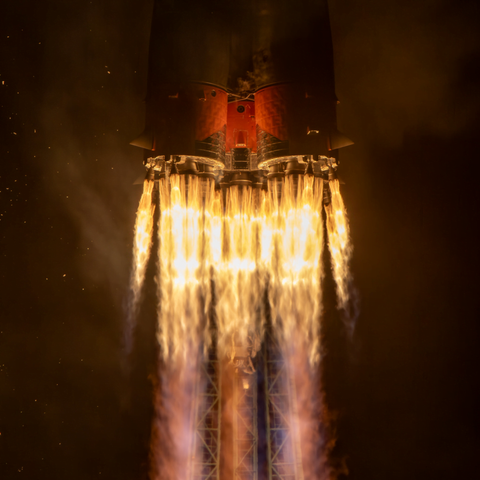
Here, a Soyuz rocket takes off in 2023, carrying three of the Expedition 70 crew to the International Space Station. This initial stage of the Soyuz launch vehicle uses four identical rocket boosters lashed around the second stage core. Each of the boosters has a rocket engine with four combustion chambers (and thus four exhaust nozzles) of its own. That creates the fiery flurry of engine plumes seen here. Most of the exhaust plumes are directed downward to provide the thrust needed to lift the rocket, but you can see a few angled slightly to either side to help stabilize the launch vehicle as it rises. (Image credit: NASA)

https://fyfluiddynamics.com/2024/06/soyuz-exhaust/

#combustion #fluidDynamics #physics #rocketEngine #rocketLaunch #rocketNozzle #science #thrust

Soyuz (rocket family) - Wikipedia

Keep exploring at brilliant.org/smarter Get started for free, and hurry—the first 200 people get 20% off an annual premium subscription

2nd Channel Longer interview with Luke Talley: https://youtu.
Actual Apollo Engineer Explains the Saturn 5 Rocket - Smarter Every Day 280
Brilliant | Learn by doing

Guided interactive problem solving that’s effective and fun. Try thousands of interactive lessons in math, programming, data analysis, AI, science, and more.

3D Printing Steel Parts At Home Via Special Filaments

Rocket engines are great for producing thrust from fire and fury, but they're also difficult to make. They require high-strength materials that can withstand the high temperatures involved. [Integza], however, has tried for a long time to 3D print himself a working rocket engine. His latest attempt involves printing an aerospike design out of metal.

Even steel couldn't hold up to the fury of the rocket exhaust!

The project relies on special metal-impregnated 3D printer filaments. The part can be printed with a regular 3D printer and then fired to leave just the metal behind. The filament can be harsh, so [Integza] uses a ruby nozzle to handle the metal-impregnated material. Processing the material requires a medium-temperature "debinding" stage in a kiln which removes the plastic, before a high-temperature sintering process that bonds the remaining metal particles into a hopefully-contiguous whole. The process worked well for bronze, though was a little trickier for steel.

Armed with a steel aerospike rocket nozzle, [Integza] attempts using the parts with his 3D printed rocket fuel we've seen before. The configuration does generate some thrust, and lasts longer than most of [Integza]'s previous efforts, though still succumbs to the intense heat of the rocket exhaust.

Overall, though, it's a great example of what it takes to print steel parts at home. You'll need a quality 3D printer, ruby nozzles and a controllable kiln, but it can be done. If you manage to print something awesome, be sure to drop us a line. Video after the break.

#3dprinterhacks #3dprintingmetal #aerospike #metal3dprinter #rocket #rocketnozzle #rocketry #steel

3D Printing Steel Parts At Home Via Special Filaments

Rocket engines are great for producing thrust from fire and fury, but they’re also difficult to make. They require high-strength materials that can withstand the high temperatures involved. […

Hackaday

3D Printed Copper Rocket Nozzle Costs Under Two Grand

You don't think of hobby-grade 3D printing as a good method for creating rocket nozzles. But [Mister Highball] managed to create a copper nozzle using a common printer, a kiln, and some special copper-bearing filament.

The copper filament is about 90% metal. Virtual Foundry recommends preheating it before printing and you have to sinter it in an oven to remove the plastic and leave a solid metal piece which will, of course, shrink.

The results were not great at first, but the final run looked pretty good. You'd do well to take note of any advice on using the filament since it is quite a bit more expensive than regular PLA. There are clearly some very specific steps you need to follow to get good results.

Of course, you also need a kiln and the other equipment you need to handle molten metal. While it is impressive that you can create a metal part this easily, it still isn't as easy as a normal print and it isn't much easier than simply casting the part using a lost PLA technique.

While 3D printing rocket parts isn't a new idea, earlier efforts haven't used cheap FDM printers. We are looking forward to having a real metal 3D printer one day.

#3dprinterhacks #copper #metal3dprinting #printing #rocketnozzle #sintering #virtualfoundry

3D Printed Copper Rocket Nozzle Costs Under Two Grand

You don’t think of hobby-grade 3D printing as a good method for creating rocket nozzles. But [Mister Highball] managed to create a copper nozzle using a common printer, a kiln, and some speci…

Hackaday