VATRAA transforms "introverted" artist's studio into light-filled London home

Architecture studio VATRAA has converted a former artist's studio in west London into a house featuring a six-metre-high lightwell that allows daylight to reach a new basement level.

London and Bucharest-based VATRAA was tasked with converting and expanding the 67-square-metre studio in the Royal Borough of Kensington and Chelsea into a bright four-bedroom home.

VATRAA has converted a former artist's studio into a house

The existing building, which is hemmed in on all sides, comprised an open ground floor and a mezzanine positioned beneath a partially glazed roof.

Its dense urban context required an innovative solution to increase the floor area while introducing natural light throughout the spaces.

Capturing natural light was key to the transformation

"The main challenge was to add four bedrooms to a space that had no windows, being surrounded by neighbours on all four sides," explained VATRAA.

"Capturing natural light within an introverted development became the main theme of the project."

Glass walls help light to filter through

The studio's interior was reconfigured and the building was extended four metres below ground to create 77 square metres of additional floor space.

A lightwell brings natural light to the lowered ground floor and a new basement level, while daylight entering through the glazed roof reaches the rooms below via a stairwell and openings in the floor slabs.

There is a study lit by a skylight

Bedrooms are accommodated in the secluded basement, while the ground level houses an entrance lobby, meditation room and study. The main living areas are located on the bright and airy first floor.

The various functional zones are distributed across the home's three floors, with different uses of light and materials helping to lend each space a unique character.

A steel staircase links the three floors of the house

"By turning constraints into opportunities, we transformed an open-space studio into a journey of atmospheres, developed on contrasts such as dark-light, warm-cold, or intimate-open," the studio explained.

"Inspired by the clients' interest in spirituality and meditation, we explored the spiritual quality of space through views, light and materials orchestrated in a simple, calm composition."

The slender stairwell also helps filter light to the basement

The basement, which is the most intimate area of the house, contains two bedrooms and a bathroom arranged around the lightwell.

Full-height openings with minimal wooden frames connect the rooms with an outdoor space, where there is a pebble-covered garden and carefully positioned planting.

[

Read:

VATRAA adds pink plaster walls in south London council house renovation

](https://www.dezeen.com/2021/05/26/vatraa-council-house-renovation-london-uk-architecture/)

The semi-private ground floor spaces receive natural light from the lightwell and from the floor above. The study, meditation space and shower room are also configured to look onto the lightwell.

A new stair with a rooflight above connects the three levels. The stair is made of slender eight-millimetre-thick steel to help minimise disruption to the flow of light.

There is also a six-metre-high lightwell

In the study, a glass wall provides a connection to the stairwell, while another skylight illuminates the room from above.

The open-plan first-floor living area contains a kitchen, dining area and lounge set beneath the pitched roof. Planning constraints required half of the glazed roof to be covered for privacy reasons.

The bedrooms are contained in the secluded basement

Internal finishes are designed to optimise the flow of daylight, while the furniture and fittings were specified to create a sense of cohesion throughout the home.

The architects also worked with the clients to develop 20 freestanding furniture items. Custom made from solid oak and stainless steel, these are intended to complement the house's raw surfaces including the concrete floor, plaster walls and timber ceilings.

There is a small outdoor area lined with pebbles

VATRAA was founded in 2018 by architects Anamaria Pircu and Bogdan Rusu. Its work on the studio conversion has seen it shortlisted for this year's Don't Move, Improve! competition.

The studio recently picked up an award for an extension to a council house in London featuring pink plaster walls, and also designed a brick-clad extension to a Victorian house featuring a circular blue window.

The photography is by VATRAA.

The post VATRAA transforms "introverted" artist's studio into light-filled London home appeared first on Dezeen.

#all #residential #architecture #instagram #london #uk #extensions #houses #britishhouses #residentialconversions #londonhouses #adaptivereuse #vatraa

MC Escher works inform Montreal home by Naturehumaine

An angular steel staircase crosses through this Montreal residence by Naturehumaine, which was inspired by the fantastical paintings of Dutch artist MC Escher.

The Escher House, located in the Rosemont-La-Petite-Patrie neighbourhood, used to be a duplex. Local studio Naturehumaine converted it into a single-family home.

The Escher House is located in Montreal

The project included a complete overhaul of the interiors, new cladding, and the addition of a mezzanine, which contains a sitting room and patio. It now encompasses 2,560 square feet (238 square metres).

A new staircase was the centrepiece of the renovation. It is top-lit from a skylight, and visible from every common space.

On the ground floor, the layout was converted into an open-concept space

"All the spaces in the house are organised around the periphery of the staircase, which becomes the central entity of the project," said Naturehumaine.

Black steel plates form the sides and guardrails of the staircase, contrasting its lighter wooden treads. "Imposing, phantasmagorical, the staircase with its crossing of flights enlivens the space and personalises the entire house," the studio explained.

Naturehumaine took cues from artist MC Escher for the sculptural staircase

Naturehumaine said that the angular layout of the staircase was inspired by Maurits Cornelis Escher, a Dutch artist born in 1898 who achieved recognition for his depictions of architecturally impossible spaces.

On the ground floor, the layout was converted to an open-concept kitchen, living and dining room, with large openings that expand the living space out onto a terrace in the summer months.

Black steel plates form the sides and guardrails of the staircase

All three bedrooms are located on the first floor. At the front are the two children's bedrooms, separated by a door that used to be the entrance to the upstairs apartment.

The wide landing that separates these smaller bedrooms from the primary bedroom accommodates a desk nook. This overlooks the kitchen below.

[

Read:

Naturehumaine adds rodded stairwell to Bessborough Residence in Montreal

](https://www.dezeen.com/2018/07/17/naturehumaine-adds-rodded-stairwell-bessborough-residence-renovation-montreal/)

The primary bedroom is at the end of the hallway and features a gently curved wall that faces onto the backyard. Irregular punched windows and white-painted wood siding help this volume stand out when seen from the exterior.

The topmost level of the home acts as a secondary sitting area. It was added to the building during the renovation, and its exterior is made of fibre-cement panels left exposed.

Naturehumaine kept to a mostly neutral palette across the interiors

The rear facade of the house is clad in charred wood, punctuated by vertical pine slats and raw-fibre cement panels.

Naturehumaine kept to a mostly neutral palette on the interiors, with exposed wooden floors and simple white walls. On the ground level, shades of green were used to mark the entrance of the home.

A skylight brings natural light into the home

Other projects by the Montreal-based firm include the renovation of an apartment from a similar time period, into which the team inserted mint green cabinets and curved walls, and a extension to a townhouse that includes a new plywood staircase with a hidden play nook for the children.

The photography is byRonan Mézière.

The post MC Escher works inform Montreal home by Naturehumaine appeared first on Dezeen.

#all #residential #architecture #steel #canada #staircases #québec #residentialextensions #montreal #naturehumaine #residentialconversions

Jean Verville lines Montreal row house with sculptural plywood interiors

Jean Verville Architectes has completed a residence in Montreal where nearly every surface is made of plywood for a "minimalist, functional, artistic experiment".

The MB House is a two-storey property in Montreal's Plateau Mont-Royal neighbourhood, a residential area that was initially made up of industrial and working-class residential buildings.

Jean Verville Architects designed the home on a block of row houses

Jean Verville Architectes has completed a thorough renovation for a couple that was interested in the sculptural and experimental qualities of the Montreal-based architect's work.

"The MB concept was born from a series of creative encounters with clients, me and my studio in order to imagine a place to live completely imbued with artistic expression rather than usual domesticity," Jean Verville told Dezeen.

The structure is oriented around a series of sculptural wooden blocks and panels

"The project has become the expression of an inhabitable wood sculpture," the architect added.

The exterior walls of the small brick building were left completely white, which highlights the warm colour of the plywood inside.

The home was designed to give the inhabitants a daily artistic experience, which is reflected in the project photography

The 140-square-metre (1506-square-foot) house was renovated completely, including large sections of the floors that were removed to strategically create double-height spaces for the communal areas.

On the ground floor, the kitchen, living and dining room are aligned along one side of an open, central staircase. A corridor on the other side helps organise circulation and provides access to concealed storage spaces.

Recesses and passageways delineate the space in a sculptural manner

Key elements that could not be made of wood, such as the kitchen appliances and sofas, are all white.

A similar approach was used for the bathrooms, which have white tiles, fixtures, and finishes on every surface.

[

Read:

Jean Verville tricks the eye with black and white Montreal apartment

](https://www.dezeen.com/2017/08/17/jean-verville-tricks-eye-with-black-white-in2-apartment-interior-montreal/)

"Focusing as much on compactness as on organisational interrelationships, the development of the architectural system requires its users to scrutinise their habits, and question the needs related to their daily life," said Jean Verville Architectes.

Upstairs, there are two bedrooms and a large office. Because of the openings created in the floor on this level, there are moments that overlook the spaces below, such as a landing located immediately above the kitchen and living room.

The furniture and tiling is white to contrast the all-wood interiors

Jean Verville Architectes also designed custom lighting throughout the home, which is integrated into thin stripes within the wood panels on the ceilings and certain walls.

The studio is known for its sculptural, unusual, and playful creations. Other homes that the studio has completed include a residence with a "golden ribbon" running through it and a monochrome home that is illuminated by a gridded lightwell that casts geometric shadows on the interior surfaces.

The photography is byMaxime Brouillet.

Project credits:

Clients: Benjamin Boller, Mathieu Denécheau
Team studio Jean Verville Architectes: Jean Verville, architect (lead architect); Tania Paula Garza Rico, architect (studio director); France Goneau (artistic advisor); François Bodlet, architect; Rémi St-Pierre, architect; Samuel Landry, MA architecture; Camille Asselin, MA architecture; Jacob Éthier, MA architecture candidate; Bahia Burias, MA architecture candidate; Alexandre Meloche, MA architecture
Contractor: Le Pierre Rénovation
Cabinet maker: CST, Steeve Tousignant

The post Jean Verville lines Montreal row house with sculptural plywood interiors appeared first on Dezeen.

#all #residential #architecture #interiors #plywood #houses #québec #montreal #residentialconversions #jeanverville

Jean Verville lines Montreal row house with sculptural plywood interiors

Jean Verville Architectes has completed a residence in Montreal where nearly every surface is made of plywood for a "minimalist, functional, artistic experiment".

The MB House is a two-storey property in Montreal's Plateau Mont-Royal neighbourhood, a residential area that was initially made up of industrial and working-class residential buildings.

Jean Verville Architects designed the home on a block of row houses

Jean Verville Architectes has completed a thorough renovation for a couple that was interested in the sculptural and experimental qualities of the Montreal-based architect's work.

"The MB concept was born from a series of creative encounters with clients, me and my studio in order to imagine a place to live completely imbued with artistic expression rather than usual domesticity," Jean Verville told Dezeen.

The structure is oriented around a series of sculptural wooden blocks and panels

"The project has become the expression of an inhabitable wood sculpture," the architect added.

The exterior walls of the small brick building were left completely white, which highlights the warm colour of the plywood inside.

The home was designed to give the inhabitants a daily artistic experience, which is reflected in the project photography

The 140-square-metre (459-square-foot) house was renovated completely, including large sections of the floors that were removed to strategically create double-height spaces for the communal areas.

On the ground floor, the kitchen, living and dining room are aligned along one side of an open, central staircase. A corridor on the other side helps organise circulation and provides access to concealed storage spaces.

Recesses and passageways delineate the space in a sculptural manner

Key elements that could not be made of wood, such as the kitchen appliances and sofas, are all white.

A similar approach was used for the bathrooms, which have white tiles, fixtures, and finishes on every surface.

[

Read:

Jean Verville tricks the eye with black and white Montreal apartment

](https://www.dezeen.com/2017/08/17/jean-verville-tricks-eye-with-black-white-in2-apartment-interior-montreal/)

"Focusing as much on compactness as on organisational interrelationships, the development of the architectural system requires its users to scrutinise their habits, and question the needs related to their daily life," said Jean Verville Architectes.

Upstairs, there are two bedrooms and a large office. Because of the openings created in the floor on this level, there are moments that overlook the spaces below, such as a landing located immediately above the kitchen and living room.

The furniture and tiling is white to contrast the all-wood interiors

Jean Verville Architectes also designed custom lighting throughout the home, which is integrated into thin stripes within the wood panels on the ceilings and certain walls.

The studio is known for its sculptural, unusual, and playful creations. Other homes that the studio has completed include a residence with a "golden ribbon" running through it and a monochrome home that is illuminated by a gridded lightwell that casts geometric shadows on the interior surfaces.

The photography is byMaxime Brouillet.

Project credits:

Clients: Benjamin Boller, Mathieu Denécheau
Team studio Jean Verville Architectes: Jean Verville, architect (lead architect); Tania Paula Garza Rico, architect (studio director); France Goneau (artistic advisor); François Bodlet, architect; Rémi St-Pierre, architect; Samuel Landry, MA architecture; Camille Asselin, MA architecture; Jacob Éthier, MA architecture candidate; Bahia Burias, MA architecture candidate; Alexandre Meloche, MA architecture
Contractor: Le Pierre Rénovation
Cabinet maker: CST, Steeve Tousignant

The post Jean Verville lines Montreal row house with sculptural plywood interiors appeared first on Dezeen.

#all #residential #architecture #interiors #plywood #houses #québec #montreal #residentialconversions #jeanverville

Ten basement conversions that make use of subterranean space

Our latest lookbook features 10 homes where basement conversions create extra rooms and more liveable space underground.

Basement conversions can be a practical way of providing homes with additional space. They are often found in UK townhouses where floor space is at a premium, such as in Georgian, Victorian and Edwardian homes in London that were often built with basements to accommodate house staff.

While their subterranean setting means these spaces run the risk of becoming dark, damp and unpleasant, smart solutions such as light wells and excavations can help to bring light into the space and turn them into useful extra living areas.

In this lookbook, we've taken a closer look at a range of different basement conversions, including basements that are now host to swimming pools, kitchen diners and even entire apartments.

This is the latest in our lookbooks series, which provides visual inspiration from Dezeen's archive. For more inspiration see previous lookbooks showcasing bedrooms with clever storage solutions, interiors that use mirrors to maximise space and compact bedrooms.

Casa Fernandez, Argentina, by Adamo-Faiden

This 1970s townhouse in Buenos Aires was refurbished by local studio Adamo-Faiden to include a large glazed enclosure at the rear. It extends to the home's lowest level, which was converted into additional living space.

The basement is connected to the home's outdoor space by a gravelled patio that bridges the indoors and outdoors and forms an interior extension of the garden.

Find out more about Casa Fernandez ›

Photo is by Jake Curtis and Elliot Sheppard

Powerscroft Road townhouse, UK, by Daytrip

Before a renovation that was completed by design studio Daytrip, the basement of this London townhouse was dark, damp and "unloved". The studio excavated the lower level of the home to raise the basement's ceiling height and added an open-plan kitchen-diner in its place.

The interior walls of the converted basement were painted white to match the walls of the sunken garden, in order to create continuity and visually extend the interior.

Find out more about Powerscroft Road townhouse ›

Caroline Place, UK, by Amin Taha Architects

Amin Taha Architects extended the basement level of this 1950s brick terraced home in London's Bayswater neighbourhood, incorporating the home's rugged concrete soffit within the design.

Prior to the renovation, the home's layout had been adapted and changed to reconfigure the original floor plan, which was informed by typical Edwardian homes.

Amin Taha Architects updated the home to include open-plan living area framed by a number of different materials and finishes.

Find out more about Caroline Place ›

Photo is by Alexandria Hall

Rydon Street, UK, by Moxon Architects

A rear basement extension was added to this Victorian townhouse in London, which was gutted and renovated by British architecture studio Moxon Architects.

The studio created a full-width white interior that opens up onto a similarly crisp-white sunken, split-level garden. White concrete brick walls and white resin floors were implemented across the lower level of the home to achieve a clean, minimalist look.

Find out more about Rydon Street ›

Photo is by Jim Stephenson

House in Primrose Hill, UK, by Jamie Fobert Architects

Travertine-lined walls are host to a basement swimming pool, lit by a lightwell, that forms part of the two-floor concrete basement of a Primrose Hill home.

Jamie Fobert Architects maintained the north London home's traditional Victorian exterior, but completely renovated the interior using travertine, concrete and wood to create an open plan contemporary interior. The studio added an additional floor to the basement, which now hosts the stone-lined swimming pool.

Find out more about House in Primrose Hill ›

Photo is by Hey! Cheese

House H, Taiwan, by KC Design Studio

A dark and gloomy aesthetic was channelled by KC Design Studio when overhauling the formerly neglected basement of this apartment in Taipei.

The studio carved several openings into the ceiling of the basement to filter light into the interior. One large rectangular opening at the front of the apartment allows light to funnel from the ground floor's facade while also hosting a staircase, while an L-shaped opening at the rear was topped with gridded sheets to circulate air between the ground and basement floor.

Plants were added below to create pops of colour.

Find out more about House H ›

Photo is by Jose Hevia

Apartment Tibbaut, Spain, by Raúl Sánchez

Circular pine walls were used to divide and zone rooms in this vaulted basement of a Barcelona home that was converted into a subterranean apartment.

Architect Raúl Sánchez fitted a stone and pine staircase at the entrance to the subterranean, 55-square metre space. Circular laminated pine walls weave between the vaults of the ceiling, while structural octagonal columns were used to separate and form the living areas and create a monumental look.

Find out more about Apartment Tibbaut ›

Photo is by Noortje Knulst

Matryoshka House, the Netherlands, by Shift Architecture Urbanism

Formerly a derelict four-storey residence, Matryoshka House was overhauled by Shift Architecture Urbanism after neighbours of the home were troubled by its neglected condition. The studio divided the home into two flats, one of which occupies the two lower levels.

Shift Architecture Urbanism removed the rear walls of the home and replaced them with a full-height glazed wall that opens the basement level living areas onto the garden.

It used industrial and raw materials throughout the renovation, incorporating concrete across the floors and unstained wood panels across the walls and inserting steel-wrapped volumes.

Find out more about Matryoshka House ›

Photo is by Alexander Severin

Paulus Hook Residence, US, by Fogarty Finger

Located within a defunct industrial building in New Jersey, this single-family home was converted by New York studio Fogarty Finger.

The studio transformed the home while preserving its original character which previously housed a propellers workshop. It converted the basement into a bright and liveable space fitted with a tranquil pool that adjoins a small courtyard.

Find out more about Paulus Hook Residence ›

Photo is by Ed Reeve

Mole House, UK, by Adjaye Associates

This home in north London was once owned by a retired civil engineer, who was dubbed the Mole Man by the press for digging a labyrinth of tunnels and burrows beneath it. It underwent an extensive renovation by Adjaye Associates.

The architecture practice converted the home into a live-work space for artist Sue Webster, which included a double-height basement artist's studio.

Find out more about Mole House ›

This is the latest in our series oflookbooks providing curated visual inspiration from Dezeen's image archive. For more inspiration see previous lookbooks showcasing bedrooms with clever storage solutions, interiors that use mirrors to maximise space and compact bedrooms.

The post Ten basement conversions that make use of subterranean space appeared first on Dezeen.

#all #interiors #lookbooks #residential #extensions #residentialconversions

Valentino Architects transforms Malta art studio into modern home

Valentino Architects has converted the studio and home of late post-war painter Frank Portelli in Malta into a contemporary residence for his granddaughter.

The home, named La Serenissima, is located in the village of Attard in the centre of the Mediterranean island.

La Serenissima now features an open-air sun terrace

Portelli, who is known for his cubist artworks and murals, originally designed the house in 1995 and incorporated numerous windows and skylights throughout the building so that it could serve as the ideal place to paint and live.

Local practice Valentino Architects was tasked with transforming the existing structure into a home for the artist's granddaughter, starting with adding a raised sun deck to the southernmost point of the house.

Adjacent to the terrace is a modern kitchen with black cabinetry

This was achieved by removing the glazing from a number of the angled skylights and adding timber decking, creating a kind of open-air terrace that is separated from the interior using sliding glass doors.

A short flight of wooden steps doubles up as seats and leads down into the kitchen, which features jet-black cabinetry and a large open-fronted island for storing tableware.

The study is finished with petroleum green walls

Just across from the kitchen is a dining area. Here, Valentino Architects preserved one of Portelli's original plywood mood boards, with some of his hand-written annotations and markings still intact.

On the east-west axis of the home lies a small indoor courtyard and a blue-painted study surrounded by pointed archways.

Geometric tiles nod to Portelli's cubist paintings

Most of the mid-century furnishings and light fixtures featured in this space were Portelli's own, before being carefully restored by Valentino Architects.

The floor was also inlaid with geometric tiles in reference to the cubic shapes that frequently appear throughout the artist's paintings.

The bedroom and bathroom are tucked behind sliding doors

On the northern end of the home is a huge gridded window that extends outwards from the building and then tapers to a point. To one side of the window lies a bedroom and to the other a white-tiled bathroom.

Both spaces are closed off by sliding doors, punctuated with cut-out handles that nod to La Serenissima's diamond-shaped window.

At the northern end of the home is a huge pointed window

Valentino Architects was established in 2015 and is based in Malta's capital Valletta.

Other striking homes on the tiny Mediterranean island include Casa B with its glass-bottomed rooftop pool and The Coach House by AP Valletta, which features a "woven" stone facade.

The photography is byRamon Portelli.

The post Valentino Architects transforms Malta art studio into modern home appeared first on Dezeen.

#all #interiors #residential #houses #malta #residentialconversions

Neil Dusheiko transforms London fashion showroom into light-filled home

Architect Neil Dusheiko has converted a showroom in west London into a bright, contemporary residence designed to meet the changing needs of its elderly owners.

Nicknamed Danish Mews House for its minimalist Scandinavian furnishings, the home is tucked away in a quiet mews lane in the Lancaster Gate area.

The mews house was once a showroom for the owner's fashion company

Although in recent years the current owners repurposed the building as a showroom and warehouse for their clothing company, it was originally built as a Georgian coach house for storing horse-drawn carriages.

Dusheiko's primary concerns when converting the property into a home were bringing in more light, as well as making sure that the interior could support its inhabitants as they grow older.

The main kitchen and sitting room are on the first floor

For this purpose, the house was fitted with a guest bedroom, kitchenette and toilet on the ground floor, which could ultimately be used by the inhabitants themselves in case their mobility becomes restricted.

A lift was installed to provide easy access to the upper floors of the house, which can also be reached via a central staircase.

Glazing in the stairwell brings light into the living spaces

In the stairwell, a newly installed skylight and a wall of gridded glazing on the first-floor landing allow sunlight to seep into the interior.

Behind the glass partition lies a sitting room and a kitchen with oatmeal-coloured cabinetry as well as a small dining area.

Light leaks in from a skylight at the top of the stairwell. Photo by Rachael Smith

Both here and throughout the rest of the home, several of the furnishings were sourced from well-known Danish design brands including Carl Hansen, Louis Poulsen and Montana.

The second floor is illuminated by six new dormer windows and accommodates another two bedrooms plus their respective en-suite bathrooms.

[

Read:

Neil Dusheiko creates home for his father-in-law featuring a wall of ceramics and glassware

](https://www.dezeen.com/2016/11/27/gallery-house-stoke-newington-neil-dusheiko-architects-london-extension/)

The principal bedroom is largely clad in wood, save for a section on the rear wall that is finished in chintzy floral wallpaper.

Glazed doors with black metal frames run along one side of the room and can be slid open to access a sun terrace lined in Douglas fir battens.

Floral wallpaper features in the principal bedroom. Photo by Rachael Smith

The space is decorated with a couple of folding director's chairs and a built-in white-brick planter.

Danish Mews House is one of several residential projects that Neil Dusheiko has completed in London.

The room also has its own sun terrace. Photo by Rachael Smith

Previously, the architect created a home for his father-in-law in Stoke Newington, in which a striking wall of shelving is used to display ceramics and glassware.

Dusheiko also overhauled a home in Hammersmith, introducing a curved brick extension and a cinema room.

The photography is byStåle Eriksen unless stated otherwise.

Project credits:

Architect: Neil Dusheiko Architects
Structural engineer: Price and Myers
Contractor: ABC Limited
Quantity surveyor: White and Lloyd

The post Neil Dusheiko transforms London fashion showroom into light-filled home appeared first on Dezeen.

#all #interiors #residential #london #uk #england #houses #neildusheiko #designfortheelderly #britishhouses #residentialconversions #londonhouses #adaptivereuse

Stella van Beers converts grain silo into micro home

Design Academy Eindhoven graduate Stella van Beers has created a watchtower-style house inside a grain silo.

In a project called Silo Living, Van Beers transformed the disused agricultural structure into a two-level living space, which she believes could function as a short-term home.

The project converts a seven-metre-high grain silo

While silos are not ideally proportioned for living, they offer some unique benefits. They can often be installed in rural locations without planning permission.

They are also readily available in the Netherlands as a country-wide reduction in livestock has resulted in lower demand for grain, leaving many of these structures redundant.

The designer had to add doors, windows and floors

Van Beers hopes to inspire new uses for these disused silos, which are otherwise costly to dispose of and impossible to recycle.

"You always see them in rural areas," she told Dezeen. "I always really wanted to go inside one, so thought it could be a nice place for a temporary stay."

Van Beers created two storeys inside the silo

To test her concept, the designer found a seven-metre-high silo for sale online. "I thought, if I want to do something with a silo then I have to just buy one and see what's possible," she said.

After explaining her plans to the owner, he let her take it away for free.

A spiral staircase and deck provides access

Originally there was no way for a person to enter the silo, so Van Beers started by changing that.

She installed a set of double doors, then added a spiral staircase and access deck.

[

Read:

Micro homes inside water pipes could take advantage of unused urban space

](https://www.dezeen.com/2018/03/16/movie-james-law-cybertecture-opod-tube-housing-micro-homes-water-pipes-video/)

To make the most of the space inside, she installed two floors, connected by a mini staircase and ladder.

The lower level is a living space, with a ledge that functions as a space to eat or work.

A mini staircase and ladder connects the levels inside

The mezzanine above is a sleep space, so is entirely taken up by a mattress.

Both storeys now have projecting windows and there's also a skylight that functions as a lookout point.

Windows were added to both floors

"A cylindrical house is not something you see very often, so it was a bit of a challenge," said Van Beers.

Most of the adaptations use standard components, so could be easily replicated on a variety of silos. The designer hopes to inspire silo owners to get creative.

The windows project out, creating some additional space

"There are a lot of things I would change if I made another," she said, "but I'm really happy with this as a first prototype. A few people have slept in it already."

"If you have a bigger silo, you could use it as a living space for a longe amount of time," she suggested.

A porthole in the top creates a lookout point.

Van Beers created the project for her bachelors degree at Design Academy Eindhoven. She presented it at the graduation show, which took place during Dutch Design Week in October.

Other projects on show included glass blown inside bread and "trauma-healing" garments.

The post Stella van Beers converts grain silo into micro home appeared first on Dezeen.

#residential #all #architecture #videos #netherlands #designacademyeindhoven #studentprojects #architecturevideos #microhomes #residentialconversions #graduates

Stella van Beers converts grain silo into micro home

Design Academy Eindhoven graduate Stella van Beers has created a watchtower-style home inside a grain silo.

Dezeen

Anonimous and JAHS repurpose historic Querétaro villa as a boutique hotel

An early 20th-century mansion in the centre of Querétaro, Mexico, has been turned into a boutique hotel by architecture studios Anonimous and JAHS.

The Tá Hotel de Diseño, or Tá Design Hotel, encompasses 11 rooms within a neocolonial villa that formerly belonged to Doña Carmen Septien de Soto – a local philanthropist and creative figure.

The Tá Hotel de Diseño is located beside the Jardín Guerrero UNESCO heritage site

"In honour of her memory, in 2015 the idea was born to turn the Casona de Doña Carmen into a place where architecture, hospitality, gastronomy and art could coexist," said the team, which completed the project in 2021.

Querétaro, also known as Santiago de Querétaro, is famed for its well-preserved classical architecture, which draws from Spanish and other European influences. Local firm Gestalt Arquitectos recently completed a minimalist, concrete home that draws cues from the city's neocolonial heritage.

The hotel building has a distinctive neocolonial facade

The Tá Hotel de Diseño site is located beside the Jardín Guerrero, recognised as part of UNESCO's Cultural Heritage of Humanity, in the heart of the city.

The building is organised around two courtyards, which were stripped back to their original masonry as part of the renovation.

One of two courtyards contains a tranquil swimming pool

Each of these courtyards provides a tranquil place for hotel guests to relax: one contains a pool, and the other encloses a tall tree.

"The courtyard and passage walls have a strong constructive character," said the architects, whose intent was "to reveal their processes, textures and colours."

Upstairs rooms feature private outdoor spaces

On the ground floor, six guest suites are laid out along a central corridor, while another five were built within an additional second storey.

The upstairs rooms are slightly larger and each has a private outdoor space.

[

Read:

Dezeen's top 10 hotels of 2021

](https://www.dezeen.com/2021/12/27/hotels-review-2021/)

The terraces serve as a buffer between the historical architecture and the more recent intervention, according to the architects.

"A decision was made to separate the pavilions from the new rooms in order to respect the original facade," the team explained.

The hotel enjoys views of Querétaro

"Throughout the project, the facade of the house and the existing structure were respected at all times," they continued.

"We worked in close collaboration with the National Institute of Anthropology and History to preserve the historic quality of the facade and not alter its identity."

Bright patterned tiles feature in a guest bathroom

The interiors, designed collaboratively with Jesús Andrés Herrera Soto, also contrast the historical surrounds of the villa.

Each of the rooms features a unique design, which includes bright patterned tiles, colourful accent pieces, and historical elements reinterpreted in a contemporary setting.

The interior design of the hotel features an eclectic mix of materials

"The interior design of the hotel is characterised by an eclectic mix of materials, colours and styles that interact with the neutrality of the architecture," said the architects.

Anonimous has also designed a home topped by an oversized thatched roof in Puerto Escondido, on Mexico's west coast.

The photography is byRafael Gamo.

The post Anonimous and JAHS repurpose historic Querétaro villa as a boutique hotel appeared first on Dezeen.

#hotels #all #architecture #mexico #renovations #residentialconversions #adaptivereuse #boutiquehotels #anonimous

Anonimous and JAHS repurpose historic Querétaro villa as a boutique hotel

An early 20th-century mansion in the centre of Querétaro, Mexico, has been turned into a boutique hotel by architecture studios Anonimous and JAHS.

Dezeen

Carlo Ratti and Italo Rota design Italian home around ten-metre-tall tree

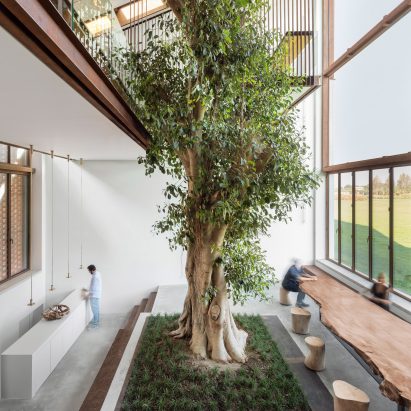
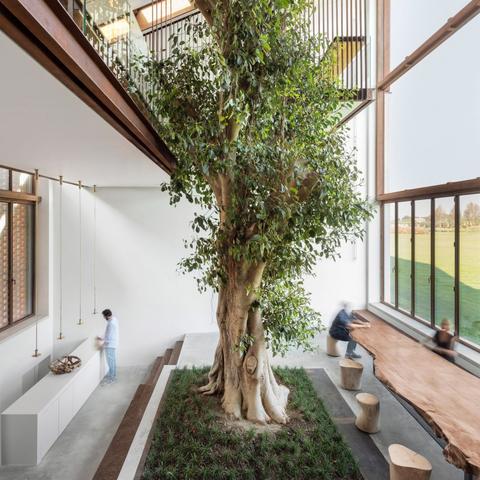
A 10-metre-tall ficus tree grows through the centre of the living space in The Greenery, a farmhouse renovation and extension by studio Carlo Ratti Associati and architect Italo Rota in Italy.

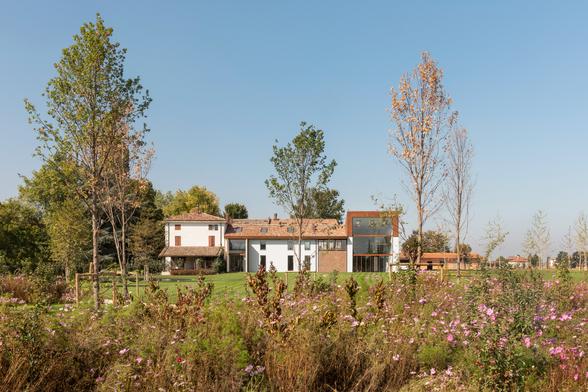
Located in the countryside outside Parma, the home was designed by Carlo Ratti Associati (CRA) and Italo Rota for Francesco Mutti, the CEO of tomato company Mutti.

Carlo Ratti Associati and Italo Rota have converted a farmhouse in Italy

Having already won an international competition in 2017 to redesign the Mutti factory, the architects were invited to design the CEO's "forever home" in a nearby farmhouse and granary.

Named The Greenery – a combination of the words green and granary – the house is intended to "blur the boundaries between the natural and artificial". This led to the large ficus tree, named Alma, being installed in the farmhouse's new open-plan living space and kitchen.

The living room and kitchen are arranged around a tree

"The 2oth-century Italian architect Carlo Scarpa once said, 'between a tree and a house, choose the tree'," explained CRA founder Carlo Ratti.

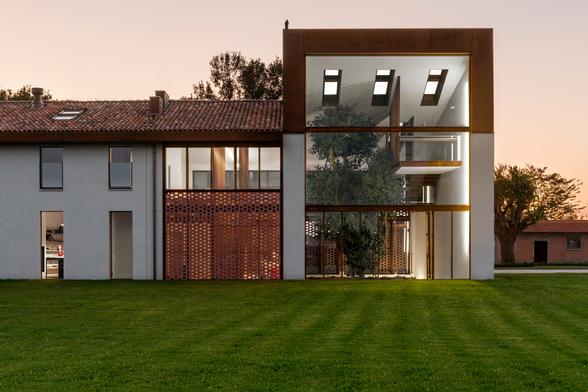
"While I resonate with his sentiment, I think we can go a step further and put the two together," he continued. "The tree stands in a new weathered steel-topped extension that abuts the original farmhouse, sunk slightly into the ground and featuring a fully-glazed, south-facing wall and skylights."

The ficus tree is 10 metres tall

Inside the living space, a weathered steel staircase leads around the tree to a series of landings above, which are enclosed by screens that create a play of light and views.

Windows covered by perforated brick walls on either side of this room create a dappled pattern of light and shadow similar to that of the tree.

A weathered steel staircase wraps around it

"Light enters the interior space through the pierced brick wall, corten steel stairs and tree branches," added CRA partner Andrea Cassi.

"By doing so, it mingles with the architectural details of the house, and leaves subtle shades all around it."

The staircase is lined with screens of weathered steel

The landings above The Greenery's kitchen and living room lead to the bedrooms, which are lined with thinner, elongated openings and windows to provide more privacy.

At the end of the farmhouse building, there is secondary living space, which opens up to the landscape with a fully-glazed south-facing wall, shielded from the sun by large shutters.

[

Read:

Yukawa Design Lab's Margin House is built around a multipurpose atrium with a tree

](https://www.dezeen.com/2021/04/19/yukawa-design-labs-margin-house-multipurpose-atrium-japan/)

Opposite the farmhouse to the north is a workspace housed in the old granary. It features similar weathered steel detailing and has an elasticated net-like floor that functions as a hammock for lounging and reading.

The architects' aim of incorporating nature into the design is also reflected in some of the project's material choices, including the resin flooring that incorporates soil and orange peels.

The old granary contains a workspace with a net-like floor

A weathered steel canopy on brick pillars runs along the edge of the granary, creating an outdoor gathering and creating a sense of continuity between the two buildings.

The landscaping surrounding the two structures was designed by Paolo Pejrone and Alberto Fusari and celebrates the biodiversity of the area.

The two buildings are connected by a canopy outside

CRA also recently collaborated Rota on the design of the Italy Pavilion at Dubai Expo 2020.

Completed with Matteo Gatto and F&M Ingegneria, the structure was topped by a roof of three upturned boats from which hangs a rope curtain facade.

The photography is by Delfino Sisto Legnani and Alessandro Saletta from DSL Studio.

The post Carlo Ratti and Italo Rota design Italian home around ten-metre-tall tree appeared first on Dezeen.

#residential #all #architecture #italy #trees #houses #carlorattiassociati #italianhouses #residentialconversions #farmhouses

Carlo Ratti and Italo Rota design Italian home around 10-metre-tall tree

A 10-metre-tall ficus tree grows through the centre of the living space in The Greenary, a farmhouse renovation and extension by studio Carlo Ratti Associati and architect Italo Rota in Italy.

Dezeen