Our Lady of the Isles

Our Lady of the Isles – A Reflection from the Outer Hebrides

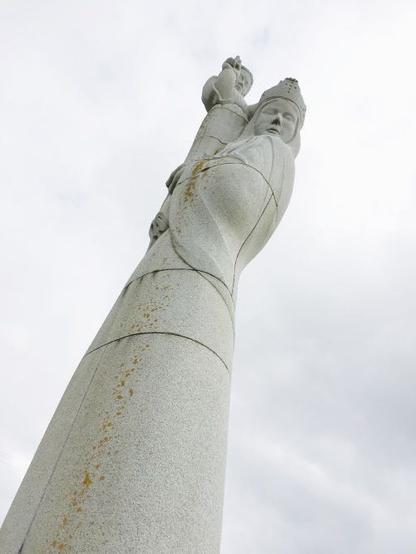
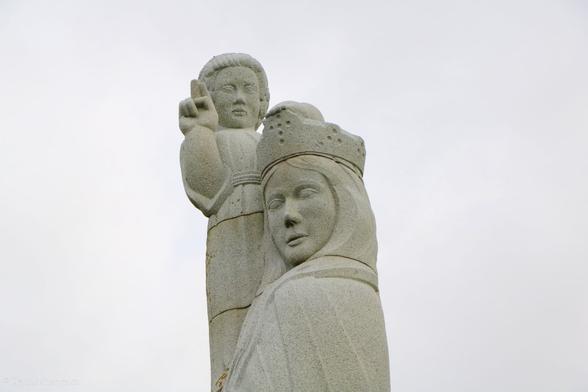
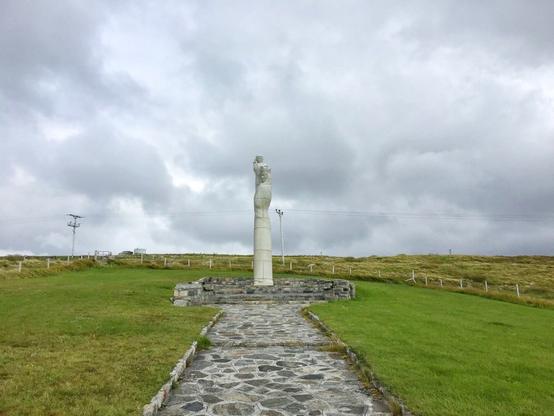
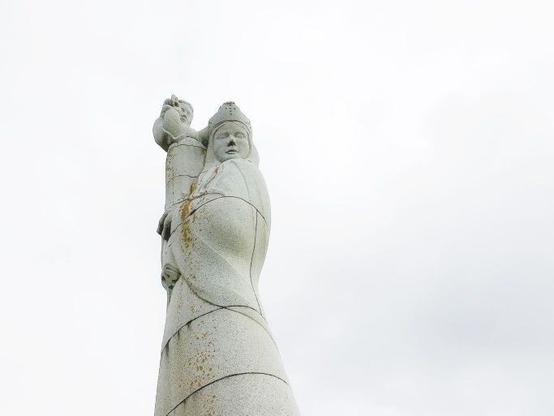
Several years ago I travelled to the Outer Hebrides, those remarkable islands that lie off the western edge of Scotland where sea, wind, and memory seem to share the same breath. On South Uist I came upon a tall white statue standing quietly on a grassy rise, facing the open Atlantic. The statue is known as Our Lady of the Isles. Rising high above the surrounding fields and hills, the figure looks outward over the land and sea as though watching the long horizon that has shaped island life for centuries.

Our Lady of the Isles, South Uist, Outer Hebrides (Rebecca Budd Photo Archives August 24, 2016)

The monument was erected in 1957 and created by the sculptor Hew Lorimer. From a distance it appears almost elemental, a tall slender form rising from the earth like a column of light against the ever changing Hebridean sky. As one draws closer the human figure emerges clearly. The Virgin Mary stands holding the Christ child, both looking outward toward the ocean.

It was built as a gesture of faith by the community of South Uist, many of whom had seen generations of island families leave their homeland in search of new lives elsewhere. The statue became a symbol of protection and remembrance, a way of anchoring hope and belonging to the land itself.

Standing there that day I felt something that travellers often discover in the Hebrides. The islands carry an older layer of story beneath their history. Long before Christianity reached these shores, people told stories of spirits who guarded the sea and the land.

Among the most enduring of these legends is that of the selkie, the mysterious seal people who were said to shed their skins and walk upon the shore in human form. In the folklore of the islands the selkies were watchers of the sea routes and quiet companions to fishermen who depended on the ocean for their survival.

When I stood beneath the statue and looked toward the horizon it felt as though these traditions lived together rather than apart. The figure of Our Lady of the Isles may represent the Virgin Mary, yet she also carries the feeling of something older, a guardian presence watching the ocean paths and the fragile communities that have lived here for generations. In places like the Hebrides legends rarely disappear. They simply find new ways to live within the stories people continue to tell.

Our Lady of the Isles, South Uist, Outer Hebrides (Rebecca Budd Photo Archives August 24, 2016)

What I remember most about that visit is the stillness. There were no crowds and no city sounds, only the wind moving through the grasses and the distant cries of seabirds circling above the fields. The statue stood motionless against the shifting sky while clouds passed slowly overhead. In that quiet moment the place felt larger than the monument itself. It felt like a meeting point between landscape, faith, and memory.

Travel sometimes brings us to places where history, legend, and geography weave together so naturally that they cannot be separated. Our Lady of the Isles is one of those places. Although the statue belongs to the twentieth century, it stands within a much older tradition of island guardians and watchful figures who look outward toward the sea. Perhaps that is why the monument feels so at home in this windswept landscape.

The islands keep their stories well. If we stand quietly long enough and listen to the wind moving across the grass, we may begin to hear them.

Rebecca

https://youtu.be/769Iu5hTKYk?si=-glKJE7Fum0sLqfo

#Legends #MorningReflection #OurLadyOfTheIsles #OuterHebrides #RebeccaSReadingRoom #Scotland #Uist
A Heart Full of Headstones – Reflections on Ian Rankin’s Rebus

I recently finished A Heart Full of Headstones by Ian Rankin, the twenty‑fourth novel in the long‑running series featuring the Edinburgh detective John Rebus. I came to the book for a very simple reason. Years ago, I watched the television adaptation starring Ken Stott, and for me he will always remain the epitome of Rebus. Stott captured that mixture of intelligence, stubbornness, and quiet weariness that seems to define the character.

One of the most remarkable things Ian Rankin has done with his long‑running series is something many writers avoid. He has allowed John Rebus to grow older. In many detective stories the central character remains almost unchanged across decades, as though time itself pauses for them. Rebus is different. Across twenty‑five novels we have watched him move through the seasons of life, carrying the marks of experience, family, regret, and persistence. Rankin has allowed his detective to age alongside his readers, and that may be one of the reasons the character feels so real.

A Heart Full of Headstones by Ian Rankin

Rebus is no longer the relentless detective of earlier years. Time has left its marks. He now faces health issues. He has a daughter and a granddaughter. The world around him has changed, and so has he. Yet, the core of the character remains. He maintains a stubborn determination to pursue what is right, even when he himself is deeply flawed. That is part of what makes Rebus so compelling. He is not heroic in the traditional sense. He makes mistakes, but there remains within him an unshakeable instinct to confront injustice.

Another aspect I found fascinating is the way Rankin situates the story during the COVID‑19 pandemic. Rather than ignoring that moment in history, he weaves it naturally into the background of the narrative. The pandemic becomes part of the atmosphere of the book shaping how people interact, how investigations unfold, and how the characters navigate an unsettled world. For readers who have followed the series for years, this adds a layer of realism. Rebus does not exist in a timeless fictional bubble. He lives in the same changing world that we do.

Readers who have just finished A Heart Full of Headstones will also notice that the story of Rebus is not yet finished. Rankin has continued the journey in the next novel, Midnight and Blue, reminding us that even after many years the tenacious spirit of Rebus still has more roads to travel. Sometimes the most enduring figures in fiction are not the flawless heroes, but the stubborn souls who keep searching for justice long after the world has grown complicated.

Rebecca

#DetectiveFiction #FictionSalon #IanRankin #IMReadingABook #InspectorRebusSeries #RebeccaSReadingRoom #Scotland

When Fiction Walks Beside History: The Girl in the Green Dress by Mariah Fredericks

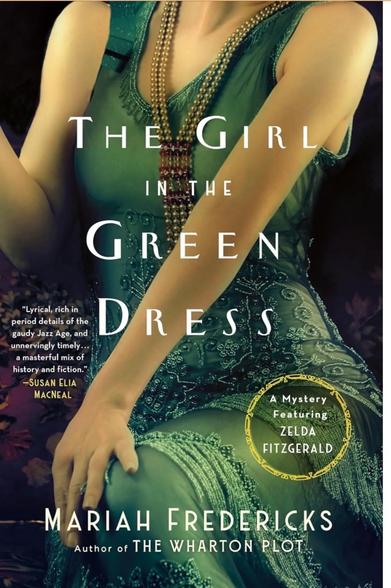
Every once in a while a book surprises me. The Girl in the Green Dress by Mariah Fredericks was one of those books. I have been enjoying a number of mysteries lately, but this one offered something more than an engaging puzzle. It opened a doorway into the lively world of the Jazz Age and into the fascinating personality of Zelda Fitzgerald. Before long I found myself wandering through that glittering era of music, literature, and restless creativity.

The novel centres around the enigmatic figure of Zelda Fitzgerald, one of the most fascinating personalities of the early twentieth century and the wife of the celebrated writer F. Scott Fitzgerald. Zelda has long lived in the shadow of literary myth. She has been portrayed as muse, rival, victim, genius, and scandal all at once. Because of this, choosing her as a central character in a mystery novel is no small act of courage. Everyone, it seems, has a theory about Zelda.

The Girl in the Green Dress by Mariah Fredericks

Mariah Fredericks approaches her not as a symbol but as a living woman. She is sharp, perceptive, complicated, and vividly alive. That alone makes the novel intriguing. This was not merely a mystery story set loosely in the past. The author clearly did her homework. The atmosphere of the Jazz Age rises from the pages that spoke of the music, the glamour, and the restless energy of a generation determined to break away from old conventions. I felt as though I had been transported into that era with the swirl of parties, the creative ferment, the ambition and the fragility of a world racing toward modernity.

At its heart, this is still a mystery and a story meant to keep the reader turning pages. I found myself enjoying the playful tension between fact and fiction. Historical figures move alongside invented characters, and the boundaries between documented history and imaginative storytelling blur in an engaging way.

I do not often expect a mystery to carry such a strong sense of historical atmosphere, but this novel reminded me that good storytelling transcends genre. When research, imagination, and narrative energy come together, a book can open a window into another time while still delivering the pleasure of a well‑told tale. In many ways, The Girl in the Green Dress feels like stepping into the smoky glow of a Jazz Age nightclub where literature, scandal, music, and modern life were all colliding at once.

The title itself adds another layer of meaning. The image of the green dress seems almost symbolic of the era. In the literature of the 1920s, green often carried associations of longing and possibility. In F. Scott Fitzgerald’s novel The Great Gatsby, the famous green light across the water becomes a symbol of dreams just beyond reach. That colour has come to represent something essential about the Jazz Age imagination with its ambition, glamour, and restless energy. Seen in that light, the girl in the green dress feels less like a single figure and more like a symbol of the generation itself.

What stayed with me after finishing the book was not simply the mystery itself, but the reminder that history is filled with vibrant personalities whose stories continue to echo through literature. Zelda Fitzgerald remains one of those figures, still mysterious, still compelling, and still impossible to fully define. The Jazz Age may belong to the past, but through novels like this we can still glimpse its excitement, its daring spirit, and its complicated human drama.

Rebecca

Postscript: About the Author

Mariah Fredericks is known for writing historical mysteries that blend careful research with imaginative storytelling. She first gained recognition for her Jane Prescott series (I have not read any of these books) set in New York’s Gilded Age, where she explored the social worlds of earlier eras through the eyes of women navigating them. In The Girl in the Green Dress, Fredericks turns to the vibrant and turbulent Jazz Age, weaving a mystery around the compelling presence of Zelda Fitzgerald and inviting readers to step briefly into one of the most fascinating cultural moments of the twentieth century.

#DetectiveFiction #FictionSalon #MariahFredericks #RebeccaSReadingRoom #TheGirlInTheGreenDress #TheJazzEra

Walking in Nature with Myra Viola Wilds

“Catch your thoughts and hold them tightly…”

A poem has a way of returning to us. Not always when we expect it, and never in quite the same way. Several years ago, I created a video around this poem by Myra Viola Wilds. Recently, I found myself revisiting it. The words had not changed, but my understanding of them had deepened. I remember walking along a forest path on Burnaby Mountain when these lines first settled into my thoughts. Walking has always been a form of meditation for me—a way of giving space to thinking that is often crowded out by the day.

Reciting Poetry on Burnaby Mountain (Rebecca Budd Photo Archives May 30, 2022)

But what I have come to understand more clearly over time is this: We are not simply observers of our thoughts. We are participants in them. To think with care, to choose thoughts that are generous, steady, and hopeful, is a creative act. It is something we build, moment by moment. And in doing so, we shape a life that opens toward possibility. This poem speaks directly to that quiet responsibility.

Thoughts


by Myra Viola Wilds

What kind of thoughts now, do you carry
In your travels day by day
Are they bright and lofty visions,
Or neglected, gone astray?
Matters not how great in fancy,
Or what deeds of skill you’ve wrought;
Man, though high may be his station,
Is no better than his thoughts.
Catch your thoughts and hold them tightly,
Let each one an honour be;
Purge them, scourge them, burnish brightly,
Then in love set each one free.

Myra Viola Wilds (1875–1935) was born in Kentucky and was an American poet whose work often appeared in newspapers and small publications of her time. She wrote in a style that was clear, direct, and meant to be carried into daily life rather than set apart from it. Her poetry reflects a tradition that was once very common. Verses written not only for literary circles, but for ordinary readers seeking guidance, encouragement, and reflection.

“Thoughts” belongs to this tradition. It is less a poem to be studied than a poem to be lived with. In an era shaped by rapid change and modern pressures, writers like Wilds offered something steady: a reminder that character, outlook, and inner life remain within our influence.

Wilds authored the collection Thoughts of Idle Hours (1915), published by the National Baptist Publishing Board. What makes this work especially remarkable is that she wrote it after losing her eyesight, the result of years of overwork as a dressmaker.

Her words suggest that she was not merely observing human nature, but encouraging a kind of quiet responsibility. It was an invitation to tend one’s thoughts with care.

When I read this now, I find myself pausing on a single idea: We choose our thoughts. And in choosing them, we create the conditions of our lives.

Rebecca

https://youtu.be/IknhlH08FWo?si=cR-6NwuAze3hqkWY

https://open.spotify.com/episode/4z25sd8bKuTO91tzQ08skH?si=Ht5GoBVsScKcf0o-3cBZ_w&pi=JnsUFhYsQuS3q&t=22

#MyraViolaWilds #Poetry #PoetryInTheAfternoon #PoetrySalon #RebeccaSReadingRoom

The World Is Quiet Here

Some time ago, I stood beside the Cheakamus River near Squamish, British Columbia. The water moved steadily. The trees stood in quiet companionship. There was no need to ask for stillness. It was already present. I recorded a short video that day. At the time, I thought of it as a simple meditation. But as I return to it now, I see something more. Not a moment captured, but a reminder.

A Gathering of Voices

Cheakamus River, British Columbia (Rebecca Budd Photos August 2, 2022)

Across time, voices have spoken of peace, not in a single language, nor from a single place, but from the shared human experience of longing, struggle, and understanding.

Some remind us that peace begins within, in the quiet work of bringing ourselves into harmony. Others gently insist that peace is not found by withdrawing from life, but by stepping into it with openness and courage. There are voices that call us to compassion, to meet hatred with love, to choose understanding over force, to release the thoughts that diminish us and hold fast to those that strengthen us.

And then there are those who speak in simpler tones, almost like a whisper carried on the wind: that peace is beautiful, that it is found in rest, in gratitude, in stillness, in the quiet recognition that, for a moment, the world can feel whole.

Together, these voices do not instruct us as much as accompany us. They remind us that peace is not a destination waiting somewhere ahead, but a presence we return to as we move through the fullness of our lives. What draws me now is how these ideas gather, like tributaries flowing into a single river.

https://youtu.be/qQ5uICScqYc?si=KSAihj1n4ffdA85s

Peace is not presented as escape, nor as silence, nor as something granted only when the world settles. It is something we participate in. Something we return to, again and again.

The Cheakamus River did not ask the world to change before it flowed. It simply moved, steady, present, alive within its own nature. And perhaps that is where peace begins. We often speak of peace at the beginning of a new year, as a wish, a hope, a resolution. But perhaps mid-year is where peace is truly tested.

When life has unfolded in ways we did not expect, when the rhythm of our days has become uneven, when the world feels louder than we would like, it is here, in the middle, that we are invited to return. Not to a perfect state, but to a chosen one.

As I watch that river again, I find myself returning to a simple thought: Peace is not something we wait for. It is something we practice. And so, whether at the beginning of a year or in the fullness of it, my wish remains the same: Peace.

Rebecca

#CheakamusRiver #MorningReflection #Peace #RebeccaSReadingRoom #Summer

Welcoming Marilyn, Reader in Residence

Marilyn’s Shelf Opens in Rebecca’s Reading Room

I will be on a brief holiday for the next three weeks, returning at the end of May, so you may notice that my scheduled posts will have comments closed during that time. But before I go, I wanted to share a new initiative for Rebecca’s Reading Room — Reader in Residence. One of the quiet joys of a reading room is that it is never shaped by one voice alone, but enriched by the thoughts, memories, and discoveries of others. I am excited!! I look forward to sharing more with you in the weeks and months ahead.

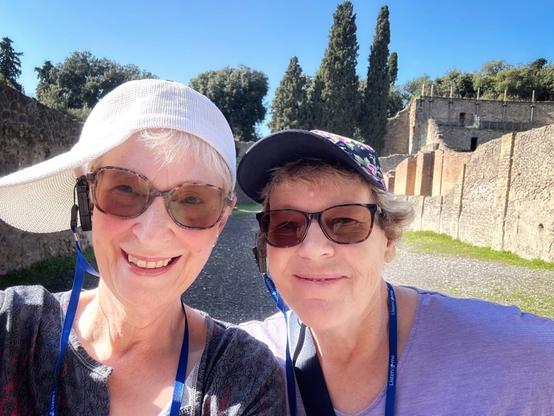
Marilyn and Me


My friend Marilyn has been part of my life for close to fifty years. Though we have lived in different provinces, (I live in British Columbia and Marilyn lives in Alberta) distance has never lessened the presence of one another in our lives. She is an avid reader, one of those rare people who carries books not as decoration, but as companions. Libraries and bookshops are places she enters with delight. When she travels, there are always two or three books tucked into her bag, waiting their turn.

It is my pleasure to welcome Marilyn to Rebecca’s Reading Room as our Reader in Residence. Today I am delighted to share her first reflection in her own words.

From Marilyn’s Shelf: First Entry


When Rebecca first spoke to me about her ideas for Rebecca’s Reading Room, I was very intrigued.

Reading has always been such a key part of my life. I remember, as an early student, experiencing comfort, adventure and suspense by reading books and dreaming of what mystery I could perhaps solve. My country school used to subscribe to the Scholastic Book Club. I remember looking forward, with anticipation, to the day the flyer would arrive at school. I would briefly search through the flyer putting a star beside the books that piqued my interest. Later, when I got home from school, I would spend hours going through that flyer and reading the highlights of every book I had put a star beside. I knew that I would only be allowed to select a couple of books to purchase so I had to make sure that my choices were the exact ones I wanted until the next flyer arrived.

I look back now and understand that those books brought me such joy. Living in a small town those adventures through books made me feel confident that there were so many opportunities ahead of me.

Today when going into a library or book store I still feel that same sense of anticipation. I know that each book I read will draw me in to experience the joy, heart break, and desire to solve a mystery that I felt so many years ago.

Marilyn

Marilyn’s Shelf

#Marilyn #MarilynSShelf #ReaderInResidence #RebeccaSReadingRoom

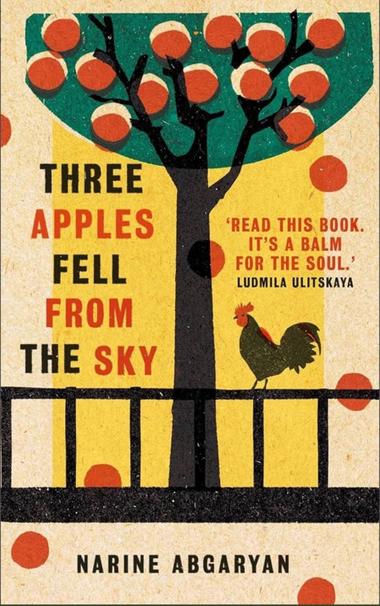
Three Apples Fell from the Sky by Narine Abgaryan

And three apples fell from heaven:

one for the storyteller,

one for the listener,

and one for the eavesdropper.”

This traditional Armenian phrase appears at the end of many folktales. It is both a blessing and an invitation. It reminds us that stories belong not only to those who tell them, but also to those who listen and quietly carry them forward. It is also the perfect doorway into Narine Abgaryan’s novel Three Apples Fell from the Sky, a book that celebrates storytelling, mythology, community, and the quiet resilience of ordinary people.

The novel begins in a way few readers expect. On a Friday afternoon, after the sun has passed its highest point and begins its gentle descent across the valley, an elderly woman named Anatolia Sevoyants calmly prepares for her death.

Before lying down, she carefully completes the small duties of the household. She waters the kitchen garden. She scatters food for the chickens and leaves a little extra, just in case the neighbours do not discover her body immediately. She stores the remaining food in the cellar. She lays out her burial clothes and places an envelope of money on the table to cover funeral expenses.

Only then does she open the window wide so that her soul will not become trapped in the room after it leaves her body. Finally she lies down on her bed, folds her arms across her chest, and prepares to breathe her last. It is a scene that is solemn, practical, and deeply human. What struck me most when I first encountered this opening was not despair, but the quiet dignity with which life and death are woven into the daily rhythms of the village.

From this remarkable beginning, the novel slowly opens outward to reveal the people who inhabit this small Armenian mountain village. Their lives are shaped by shared memories, neighbourly disputes, long standing friendships, and the quiet understanding that survival often depends on community. Life has not been easy for them. Yet the villagers endure with humour, stubborn hope, and a deep sense of belonging to one another. In this way, the village itself becomes the heart of the story.

What stayed with me most when I read the book several years ago was the resilience of Anatolia and her neighbours, particularly the way the village responds to hardship and conflict.

The title of the novel comes from a centuries old Armenian storytelling tradition. At the end of many Armenian folktales, storytellers conclude with the blessing: “And three apples fell from heaven: one for the storyteller, one for the listener, and one for the one who overheard the tale.” The apples symbolize the shared nature of storytelling. A story does not belong only to the teller. It also belongs to those who listen and to those who carry the story forward.

Narine Abgaryan’s novel draws deeply from this tradition. Like a tale passed through generations, the story unfolds through many voices, each adding its own memory, humour, and sorrow to the larger tapestry of village life.

When I first read this novel, I became fascinated with the role of the translator, Lisa C. Hayden, and the translation itself. Stories such as this carry the rhythms of their homeland. They hold the humour, the proverbs, and the emotional cadences of a culture. Translating them into another language requires great care so that the spirit of the original story is not lost. Through translation, readers far beyond Armenia are invited into this mountain village and into the lives of the people who inhabit it. In many ways, translation becomes another act of storytelling. It allows a story rooted in one place to travel across cultures and generations.

My Takeaways

Stories have always been the thread that holds communities together. Long before modern media, storytelling preserved memory, wisdom, and identity. In Narine Abgaryan’s novel, every villager carries a fragment of the collective story, and together those fragments form the living memory of the village.

Resilience in this novel does not appear as grand heroism. Instead it is found in small acts of care, patience, and humour. The villagers endure hardship not through dramatic gestures, but through their quiet determination to continue living together.

Conflict also exists within the village, as it does in any community. Yet disagreement does not destroy the deeper bonds that connect the people who live there. The novel gently reminds us that belonging often grows stronger when people learn to navigate their differences.

Finally, the novel reveals the extraordinary power of translation. Through the careful work of translators, readers across the world are invited into a small Armenian village and into a cultural tradition that might otherwise remain unknown to them. Three Apples Fell from the Sky reminds us that stories, like the apples in the old Armenian saying, are meant to be shared.

Rebecca

#FictionSalon #FolkloricFiction #RebeccaSReadingRoom #ThreeApplesFellFromTheSky #Translation

How Authenticity Lives

We live in an era of extraordinary expression. Moments can be shared instantly. Conversations can travel across the world in seconds. We are able to witness one another’s lives in ways that were once unimaginable. And within all of this, authenticity continues to find its place.

Not as a statement, but as a way of being. In the way we listen without interruption. In the way we tell a story without polishing it into perfection. In the willingness to share something still unfolding, rather than something already resolved.

James Bay, Victoria, British Columbia (Rebecca Budd Photos March 23, 2026)

It moves through small, steady gestures. A photograph taken because something felt meaningful, not because it would be admired. A conversation shaped by curiosity, not performance. A moment allowed to exist fully before it is shared.

We recognize and celebrate authenticity. We feel it in conversations that leave room for silence. In ideas that are offered, not imposed. In movements that grow from care rather than urgency.

It does not require us to withdraw from the world we are living in. It asks something more of us. It asks us to remain present, to make choices, and to take part. Because authenticity is not something we construct once and set aside. It is something we build, moment by moment. Something we choose, again and again, in how we listen, how we speak, and how we show up.

And when we do, even in small ways, it changes the quality of everything around us.

Authenticity is not found. It is lived.

Rebecca

#Authenticity #JamesBay #MorningReflection #RebeccaSReadingRoom #Victoria

In April

April is National Poetry Month. It is a time set aside to read poetry, to hear it, and to speak it aloud. Not to analyze it too quickly, but to let it move as it was meant to move through voice, through rhythm, through the quiet spaces between words.

Spring brings with it a natural turning toward poetry. The light changes, the air softens, and language seems to follow. This April, I return to Rainer Maria Rilke and his poem, “In April”.

https://youtu.be/Lysu57MuRug?si=3qrRY_VNihv1lNtk

In April


by Rainer Maria Rilke (1875-1926)

Again the woods are odorous, the lark
Lifts on upsoaring wings the heaven gray
That hung above the tree-tops, veiled and dark,
Where branches bare disclosed the empty day.

After long rainy afternoons an hour
Comes with its shafts of golden light and flings
Them at the windows in a radiant shower,
And rain drops beat the panes like timorous wings.

Then all is still. The stones are crooned to sleep
By the soft sound of rain that slowly dies;
And cradled in the branches, hidden deep
In each bright bud, a slumbering silence lies.

Kergord Woods, Shetland (Rebecca Budd Photo Archives April 28, 2018

Kergord Woods in April

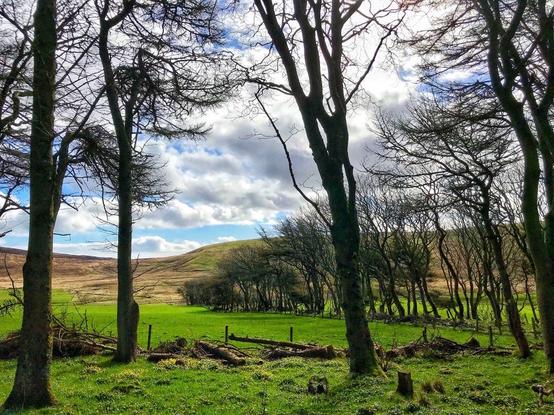
Amidst the wild and deeply indented coasts of the Shetland Islands, with their enclosed, steep hills and shifting skies, there stands a solitary forest. Kergord Woods is the only substantial woodland in the islands. Planted between 1909 and 1921, the trees have endured harsh winters and persistent winds, yet they thrive offering shelter to birds and a place of quiet gathering within an otherwise open landscape.

During my first visit to Shetland in 2018, I walked through these woods. There is something about Kergord that feels deeply aligned with Rilke’s poem. The air carries the scent of damp earth and awakening growth. Rain lingers, not as storm, but as presence soft against branches and leaves. Light arrives in brief, golden intervals, filtering through the trees before retreating again.

It is a place of transition. Not fully winter, not yet spring but held in that delicate in-between. And in that space, Rilke’s words seem not only descriptive, but present. The “odorous woods”, the rain against the panes, the hush that follows. All of it can be felt here.

Kergord Woods, Shetland (Rebecca Budd Photo Archives April 28, 2018

Since that first walk, this poem returned to me each April, carried on the same quiet awakening that stirs in the trees. Poetry does not belong to a single moment. It returns. In seasons. In memory. In places that hold something we cannot quite name. We do not always go looking for it. Sometimes, it finds its way back to us as April returns, as the woods awaken, as a poem waits quietly to be spoken once more.

Until the next poem,

Rebecca

https://anchor.fm/s/4e4af350/podcast/rss

#InApril #NationalPoetryMonth #PoetryInTheMorning #PoetrySalon #RainerMariaRilke #RebeccaSReadingRoom #Spring

What Was on Reading Lists a Century Ago?

What Was on Reading Lists a Century Ago?

I have often wondered what people chose to read a hundred years ago. Not what they were assigned or instructed to read, but what they carried with them throughout 1926. The books tucked under an arm, slipped into a bag, opened again and again.

In 1926 books were companions. They were read on porches and verandas, in boarding houses by the sea, on park benches and in shaded libraries where the air barely moved. Reading was not hurried. A book was allowed to linger, to unfold slowly, to keep company with a reader over days or even weeks.

The world those readers inhabited was unsettled and newly alive. The Great War had ended less than a decade earlier. Its losses were still present, though no longer always spoken aloud. At the same time, life was accelerating. Jazz filled rooms, cities expanded, women stepped more fully into public life, and modernity announced itself with confidence. Reading reflected that tension, between longing and hope, disillusionment and beauty, escape and understanding.

One slender novel published in 1925 would eventually come to define that uneasy brightness: The Great Gatsby by F. Scott Fitzgerald. Readers encountered its glittering parties and quiet heartbreak not yet knowing it would become iconic. It was simply a story of longing and illusion, perfectly suited to evenings when glamour and melancholy often share the same hour.

That same year, readers willing to turn inward found themselves absorbed by Virginia Woolf’s Mrs Dalloway, a novel that unfolds over the course of a single June day yet opens into a vast interior world. It was not light reading, but it was deeply attuned to memory, grief, and consciousness, subjects many readers knew intimately, whether or not they named them.

Others gravitated toward larger, weightier narratives. An American Tragedy by Theodore Dreiser was widely read, its moral questions mirroring anxieties beneath the promise of success. Arrowsmith by Sinclair Lewis spoke to a society grappling with progress, science, and idealism, asking whether advancement always meant improvement.

Not all reading in 1926 sought reflection. Adventure and romance were equally welcome companions. Beau Geste by Percival Christopher Wren offered distant landscapes, loyalty, and courage, stories that transported readers far from their daily concerns. Romantic novels such as The Sheik by E.M. Hull still widely read years after publication, provided emotional intensity and imaginative escape, especially for women readers who recognized the power of private reading lives.

Mysteries, too, found their place in 1926. Agatha Christie’s reputation was growing, and novels like The Secret of Chimneys offered readers absorption without heaviness, stories that held attention without demanding too much of a warm afternoon.

Poetry, meanwhile, continued to speak quietly but profoundly. In 1926, The Weary Blues by Langston Hughes appeared, bringing rhythm, music, and lived experience into the literary conversation. Alongside poets such as Edna St. Vincent Millay, it reminded readers that poetry could be both modern and rooted, both intimate and expansive.

What lingers for me, looking back, is not simply what was popular, but why these books mattered. Reading a century ago was not frivolous. It was restorative. People turned to books to make sense of change, to sit with sorrow without being overwhelmed by it, and to find beauty where they could.

If I imagine myself stepping into that year, perhaps settling into a chair as the light shifts across the page, I know I would not have chosen just one kind of book. Poetry in the early hours. A novel in the heat of the day. A mystery as evening gathered. Not to finish them quickly, but to live alongside them for a while.

And I can’t help but wonder what someone, a hundred years from now, will make of our own reading lists. What will still be opened? What will be forgotten? What quiet book, scarcely noticed in its own time, will continue to speak?

Perhaps that, too, is part of the enduring comfort of reading. That is, the sense that when we open a book, we are never entirely alone in time.

Until the next page turns,

Rebecca

#1926 #BookLists #Milestones #RebeccaSReadingRoom