 Svenja Hagenhoff
#LestDochWasIhrWollt
🙂
#ReadingResearch
#Leseforschung
#TheArtOfReading
RE: https://bsky.app/profile/did:plc:lvn3hzsaelgfmqeon2uq4f3x/post/3mgjurum7d22h
 Cadernos de Linguística
Bruna Alexandra Franzen investigates how readers process cohesive structures in text.
In her new article in Cadernos de Linguística, she presents experimental evidence showing that using “o mesmo” as a coreferential anaphor does not increase processing costs during reading.
Read: https://doi.org/10.25189/2675-4916.2025.v6.n3.id751
#Linguistics #Psycholinguistics #ReadingResearch #OpenScience
 PsyPost
New neuroscience research upends traditional cognitive models of reading https://www.psypost.org/new-neuroscience-research-upends-traditional-cognitive-models-of-reading/?utm_source=dlvr.it&utm_medium=mastodon #Neuroscience #CognitiveScience #ReadingResearch #BrainActivation #SpeechProcessing
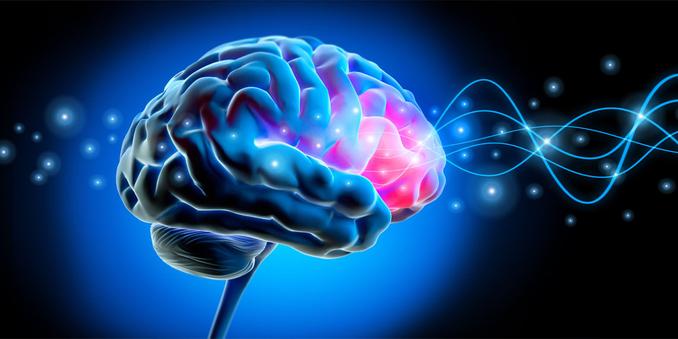

New neuroscience research upends traditional cognitive models of reading
A new study finds that the left posterior inferior frontal cortex activates within 100 milliseconds during reading, playing a critical, early role in turning text into speech, challenging traditional models that assumed a slower, step-by-step process.
 Ayşegül Özkan
A theoretical study, not dataset this time. #eyetracking #oculomotorcontrol #readingresearch
Refixation Strategies in Sentential Word Reading: An Exploration by Linked Linear Mixed Models
https://escholarship.org/uc/item/7m11b8t7
https://osf.io/t3g7d/
Refixation Strategies in Sentential Word Reading: An Exploration by Linked Linear Mixed Models
https://escholarship.org/uc/item/7m11b8t7
https://osf.io/t3g7d/

Refixation Strategies in Sentential Word Reading: An Exploration by Linked Linear Mixed Models
Author(s): Ōzkan, Ay≈üegül; Acarturk, Cengiz | Abstract: The current study undertakes refixation patterns on words in sentential reading. Utilizing a Linked Linear Mixed Model approach, the analysis focused on words with a single fixation and the first fixation from words with a double fixation. The model findings revealed a relationship between refixation probability and fixation locations, with initial fixations tending to occur closer to the beginning of a word in instances of higher refixation likelihood. Incorporating predicted and residual values of the fixation location models into the fixation duration models resulted in congruence in the observed fixation locations, durations, and residual values. Finally, the models revealed differences between progressive and regressive second fixations.
 Pauliina Vuorinen
Very excited to share my first paper! 🥳🎉 We assessed adults' e-reading behaviour with a novel method to study how motivation, electronic experience and task-context are connected to reading behaviour outside of the lab. Go check it out here: https://doi.org/10.3389/feduc.2023.1302701
#newpaper #readingresearch #psychology #education #readingbehavior #phdchat #AcademiaChat #publishedtoday
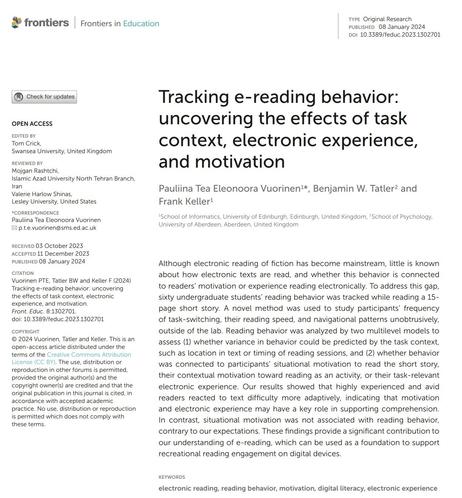

Tracking e-reading behavior: uncovering the effects of task context, electronic experience, and motivation
Although electronic reading of fiction has become mainstream, little is known about how electronic texts are read, and whether this behavior is connected to readers’ motivation or experience reading electronically. To address this gap, sixty undergraduate students’ reading behavior was tracked while reading a 15-page short story. A novel method was used to study participants’ frequency of task-switching, their reading speed, and navigational patterns unobtrusively, outside of the lab. Reading behavior was analyzed by two multilevel models to assess (1) whether variance in behavior could be predicted by the task context, such as location in text or timing of reading sessions, and (2) whether behavior was connected to participants’ situational motivation to read the short story, their contextual motivation toward reading as an activity, or their task-relevant electronic experience. Our results showed that highly experienced and avid readers reacted to text difficulty more adaptively, indicating that motivation and electronic experience may have a key role in supporting comprehension. In contrast, situational motivation was not associated with reading behavior, contrary to our expectations. These findings provide a significant contribution to our understanding of e-reading, which can be used as a foundation to support recreational reading engagement on digital devices.
 Xenia Schmalz
Twitter (is it even called that way anymore?) keeps getting weirder and weirder (to put it mildly). Yet, everytime I log on, determined to delete my account, I discover another reading researcher whom I'd really like to follow and who isn't on Mastodon. I'm still 90% decided to delete my account soon. To make the transition easier, I also created an Instagram account. Is anyone (especially from the #readingresearch community) active on Instagram? Please feel free to follow "xenia_the_wordnerd".
I've learned from my friend that the first post needs to introduce myself. But I'll promote our recent article on #readingresearch, which I'm so excited about. We have published an #eyemovement dataset of Turkish reading: https://doi.org/10.3758/s13428-023-02120-6. I hope it contributes to reading research and helps Turkish to be represented more. (I forgot to add the OSF link. Here it is: https://osf.io/w53cz/)

TURead: An eye movement dataset of Turkish reading - Behavior Research Methods
In this study, we present TURead, an eye movement dataset of silent and oral sentence reading in Turkish, an agglutinative language with a shallow orthography understudied in reading research. TURead provides empirical data to investigate the relationship between morphology and oculomotor control. We employ a target-word approach in which target words are manipulated by word length and by the addition of two commonly used suffixes in Turkish. The dataset contains well-established eye movement variables; prelexical characteristics such as vowel harmony and bigram-trigram frequencies and word features, such as word length, predictability, frequency, eye voice span measures, Cloze test scores of the root word and suffix predictabilities, as well as the scores obtained from two working memory tests. Our findings on fixation parameters and word characteristics are in line with the patterns reported in the relevant literature.