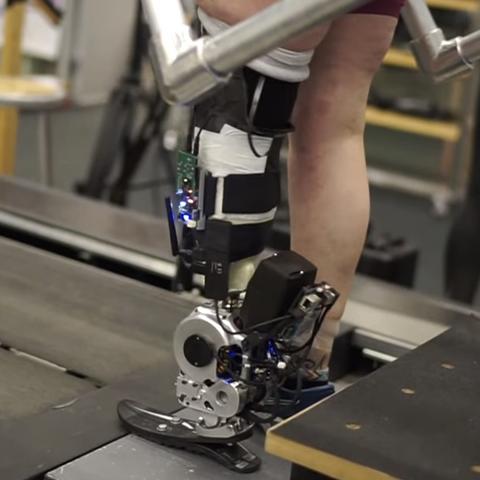
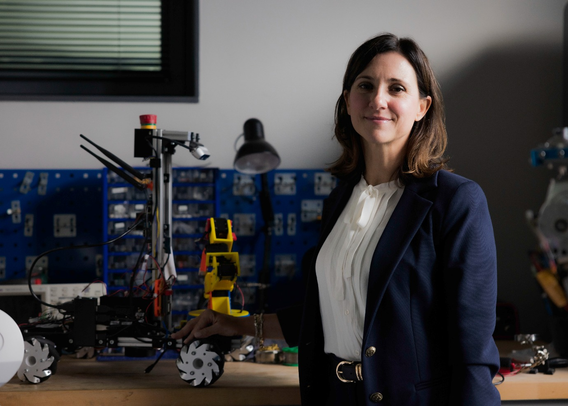
‘I am fascinated by robotics and dream of replicating the remarkable abilities of the human body,’ says Raffaella Carloni, Prof. of Robotics at the UG. 🤖

Carloni develops artificial limbs, such as the #bionicleg, and studies how #AI can help to make #prostheses 'smarter'. 🦿

Curious? Read more 👇
🔗 https://www.rug.nl/fse/news/digital-society/prostheses-with-a-human-centered-approach

🧪 #SciComm #ScienceNewsroom #design #engineering #prosthetics #robotics #mechanics #artificialintelligence #research #ScientistsOnMastodon @universityofgroningen
@cybathlon : arm 🦾 #prostheses are becoming more precise and versatile https://www.youtube.com/watch?v=PCydWvzKijU

#cyborg

Prosthetic arms are becoming smarter and more customised

YouTube

WRITER FUEL: A first-of-its-kind study demonstrated that a new nervous system-controlled bionic leg helps leg amputees walk more naturally than traditional prosthesis.

https://www.limfic.com/2024/09/26/writer-fuel-bionic-legs-plugged-into-the-nervous-system/

#LimFic #LiminalFiction #WriterFuel #Writers #Authors #WritersofMastodon #StoryIdeas @Bionic #BinicLeg #Prostheses

Writer Fuel: Bionic Legs Plugged Into the Nervous System

A pioneering surgical procedure provides amputees with bionic limbs that are directly controlled by the nervous system, enabling patients to sense the limb's position in space. Scientists demonstrated the success of this technique in a new study of seven people who received bionic legs, which was published Monday (July 1) in the journal Nature Medicine....

Liminal Fiction

Claire talked to Dr. Josh Caputo about robotic #prostheses, #exoskeletons and prototyping. Josh is President & CEO of Humotech, a robotics innovation platform supporting clinical trials, commercialisation and research and development efforts in #wearable robotics.

https://www.robottalk.org/2024/01/26/episode-70-josh-caputo/

Episode 70 – Josh Caputo - Robot Talk

Claire chatted to Josh Caputo from Humotech all about robotic prostheses, exoskeletons and prototyping.

Robot Talk - The podcast exploring the exciting world of robotics, artificial intelligence and autonomous machines.

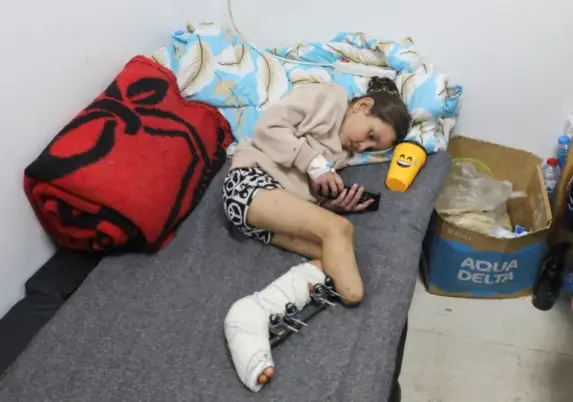
Colombia’s Foreign Minister Luis Gilberto Murillo said his government is planning to help up to 50 Palestinian children from Gaza who have lost limbs by bringing them to Colombia and providing them with #prostheses.

Under the programme, the children, aged between 12 and 15 years, would be flown from Egypt to #Colombia alongside a family member or guardian, where they would spend six months in treatment and rehabilitation.

@palestine
#Gaza
#children
#amputation

Gartner Hype Cycle Research Methodology | Gartner

Gartner Hype Cycle methodology gives you a view of how a technology or application will evolve over time, providing a sound source of insight to manage its deployment within the context of your specific business goals.

Gartner
Human-in-the-loop optimization for deep stimulus encoding in #visual #prostheses https://arxiv.org/abs/2306.13104 Still lacks #sensory #substitution in the loop for human learning with veridical and undistorted visual sensory feedback; blind humans can learn too; #blind #blindness
Human-in-the-Loop Optimization for Deep Stimulus Encoding in Visual Prostheses

Neuroprostheses show potential in restoring lost sensory function and enhancing human capabilities, but the sensations produced by current devices often seem unnatural or distorted. Exact placement of implants and differences in individual perception lead to significant variations in stimulus response, making personalized stimulus optimization a key challenge. Bayesian optimization could be used to optimize patient-specific stimulation parameters with limited noisy observations, but is not feasible for high-dimensional stimuli. Alternatively, deep learning models can optimize stimulus encoding strategies, but typically assume perfect knowledge of patient-specific variations. Here we propose a novel, practically feasible approach that overcomes both of these fundamental limitations. First, a deep encoder network is trained to produce optimal stimuli for any individual patient by inverting a forward model mapping electrical stimuli to visual percepts. Second, a preferential Bayesian optimization strategy utilizes this encoder to optimize patient-specific parameters for a new patient, using a minimal number of pairwise comparisons between candidate stimuli. We demonstrate the viability of this approach on a novel, state-of-the-art visual prosthesis model. We show that our approach quickly learns a personalized stimulus encoder, leads to dramatic improvements in the quality of restored vision, and is robust to noisy patient feedback and misspecifications in the underlying forward model. Overall, our results suggest that combining the strengths of deep learning and Bayesian optimization could significantly improve the perceptual experience of patients fitted with visual prostheses and may prove a viable solution for a range of neuroprosthetic technologies.

arXiv.org
#SpikeSEE: An energy-efficient dynamic scenes processing framework for #retinal #prostheses https://www.sciencedirect.com/science/article/abs/pii/S0893608023002332 "predicts the response of ganglion cells more accurately with lower energy consumption"; "retinal "implants
Retinal #ganglion cells undergo cell type-specific functional changes in a biophysically detailed model of #retinal #degeneration https://www.biorxiv.org/content/10.1101/2023.01.13.523982v1 may "inform the design and application of retinal #prostheses"
Artificial intelligence techniques for #retinal #prostheses: A comprehensive review and future direction https://iopscience.iop.org/article/10.1088/1741-2552/acb295 on retinal #implants, #AI