Jacquemus creates surrealist interpretation of his own bathroom for Selfridges pop-up

French fashion designer Simon Jacquemus has opened a series of surrealist pop-up installations at London department store Selfridges, including a luxury-bag vending machine and a swimming-pool changing room.

Titled Le Bleu, the installation occupies a number of locations across the store, including its creative retail space The Corner Shop and the Old Selfridges Hotel, a former hotel space that is now being used as a pop-up venue.

The pop-up installations are located in and around Selfridges on Oxford Street

The Corner Shop, which functions as the installation's main retail space, features pale blue tiles blanketed across its interior. In its window, a large transparent tube of toothpaste spills ribbons of red and white gel.

An oversized bathtub, sponges, shower facilities and sinks were also installed in the space, where they function as display areas for a selection of exclusive Jacquemus products and pieces from the brand's Spring Summer 2022 collection.

An oversized glass with a fizzing tablet is among the designs

The pop-up spaces were designed as a "surrealist reimagining of Jacquemus founder Simon Jacquemus' very own bathroom," Selfridges said.

"I wanted to create crazy and unrealistic installations, all related to water and bathroom imagery," said Jacquemus, founder of the eponymous brand.

The designer was inspired to create one of the installations, an oversized glass, after seeing a tablet fizzing in a glass of water.

"I also love how the giant tablet glass would also be very 'eye calming', a kind of visual ASMR installation in the middle of the Corner Shop," he said.

A 24-hour vending titled 24/24 is located behind the store

On Edwards Mews behind Selfridges, a life-sized vending machine stocked with exclusive editions of the brand's Chiquito and Bambino bags can be accessed for shopping 24 hours a day.

A large circular opening marks the entrance to the space, a square room lined with five-by-five rows of bags and accessories displayed in oversized, deep blue-hued vending machines.

Le Bleu includes three installations

At the Old Selfridges Hotel, the final pop-up – a sensory installation titled Le Vestiaire – references swimming-pool changing rooms.

Visitors are greeted by the now-familiar blue tiles, which cover the walls, floor and furniture of the space.

[

Read:

Balenciaga wraps London store in pink faux fur to celebrate its Le Cagole "it-bag"

](https://www.dezeen.com/2022/04/28/balenciaga-store-pink-faux-fur-celebrate-le-cagole-it-bag/)

A curved welcome desk was positioned in front of a tile-clad wall that holds a collection of rolled-up towels.

Blue lockers and changing cubicles line the walls at the rear of the space and include "3D experiences" that draw on the iconography of surrealist French filmmaker Jacques Tati.

It follows a number of installations that have taken place across Europe's fashion capitals

"Each experience is very different and playful, but my favourite would be Le Vestiaire, as it's the first time we have invested in a space like this, with 3D experiences and crazy installations with our Jacquemus products," said Jacquemus.

"I wanted to recreate an accumulation of lockers with different 3D experiences inside, inspired by Jacques Tati movies."

Smaller installations were incorporated within the interior of lockers and behind cubicle doors

The three pop-up installations are open from 3 May until 4 June 2022.

The installation is the latest edition of a series of Jacquemus' vending machine pop-ups located across Europe's fashion capitals, including Milan and Paris.

It was inspired by Jacques Tati films

In 2019, Jacquemus designed a Parisian restaurant named Oursin that featured whitewashed walls, colourful ceramics and rattan furnishings in an effort to "perpetuate summer".

French fashion brand Balenciaga recently transformed its Mount Street store into a temporary faux fur lined pop-up dedicated to its Le Cagole line.

Images are courtesy of Selfridges.

The post Jacquemus creates surrealist interpretation of his own bathroom for Selfridges pop-up appeared first on Dezeen.

#all #fashion #interiors #design #installations #london #retail #popupshops #selfridges

Nifemi Marcus-Bello creates bamboo pavilion for Nigerian skateboarding brand

Nigerian designer Nifemi Marcus-Bello has created a modular kiosk made from bamboo for Lagos-based skateboarding company Wafflesncream.

Called Waf Kiosk, the six-piece structure is currently located at the Wafflesncream (Waf) store in the Nigerian city, where it houses the brand's collection of skateboarding apparel.

Nifemi Marcus-Bello designed Waf Kiosk for a skateboarding clothing company

Marcus-Bello's design pays homage to Lagos' local streetwear sellers and the ways in which independent retailers have devised their own stores from which they sell.

"Leaning toward the evolution of the brand and its use of natural materials and tones, the idea was to design a space that would embrace a singular and humble material, in this case, bamboo," Marcus-Bello told Dezeen.

"While the kiosk is in use, clothes are hung above eye level to pay homage to 'Okrika' – Lagos' streetwear vendors who have created an architectural archetype to the selling of bootleg and secondhand clothing across Lagos," he added.

The modular pavilion can be arranged in different configurations

Waf Kiosk is built from tubular steel and bamboo – a sustainable plant that is known for its natural lightness and flexibility as well as its strength. The tubular steel was used to construct the frame of each modular structure, while the bamboo was used to wrap around the final design.

Marcus-Bello sourced the bamboo from Badagry, a coastal town that straddles the outskirts of Lagos and the northern bank of the creek stretching to Porto-Novo, in neighbouring Benin.

Marcus-Bello used bamboo for its lightweight qualities

The designer became interested in the material following a research trip to the Beninese captial where he saw that many shop and home frontages featured bamboo blinds called kosinlé.

He was particularly attracted to the "beautiful silhouette effects" the blinds had on the people behind them.

[

Read:

Nifemi Marcus-Bello's Tebur table is carried like a suitcase

](https://www.dezeen.com/2016/10/26/nifemi-marcus-bello-tebur-flat-pack-table-desk-furniture-design/)

"During a research trip to the Benin Republic, I was driving from the capital city Porto-Novo to Cotonou," Marcus-Bello explained.

"As we drove to the main road leading to Cotonou I noticed these locally made blinds used to cover the front of wooden kiosks that sold confectioneries and windows of the homeowners as well."

"I tracked down a local maker and bought two of the blinds and brought them to Lagos with me" he continued.

The kiosk can be carried to different locations in Lagos

The use of bamboo strips also means that the structure can easily be transported to different locations.

The six triangular structures can also be assembled into multiple variations, creating what Marcus-Bello calls "a variety of experiences" for shoppers.

Marcus-Bellow drew on Beninese blinds for the kiosk

"One thing that stood out to me in our conversation was the necessity for modularity for both form and functionality," the designer said.

"Using one, two or three pieces you can create different setups, which allows the brand to have two or three activations across the city during busy seasons."

"The final design is able to create a variety of setups allowing modularity in not just its form but its experience," he added.

The slatted bamboo is designed to create interesting silhouettes

Due to the bamboo's versatility, the material has been used to create pavilions all over the world.

Architecture studio Kengo Kuma and Associates built a pavilion with a textile roof supported by bamboo stalks at a temple in Kyoto, Japan, while artist Morag Myerscough installed a colourful bamboo structure in a park in London.

The photography is byJide Ayeni.

The post Nifemi Marcus-Bello creates bamboo pavilion for Nigerian skateboarding brand appeared first on Dezeen.

#all #design #highlights #installations #retail #bamboo #pavilions #kiosks #nigeria #lagos #popupshops #shops #nifemimarcusbello

Commenter questions why Burberry designed "a building that could destroy thousands of birds"

In this week's comments update, readers are irritated by Burberry's design for a reflective pop-up store in South Korea and discussing other top stories.

British fashion brand Burberry has installed a pop-up store that reflects a surrounding mountain range on Jeju Island, South Korea, for its latest outerwear clothing collection.

The Imagined Landscapes Jeju installation is made from plywood, timber and a reflective polycarbonate mirror material.

"Out of touch in pretty much every way possible"

Commenters are annoyed. "Oh, the poor birds!" said Stefanos S. "Why are architects allowed to design reflective buildings? The design is great but the reflecting material is plain wrong."

Apsco Radiales agreed: "I can even get over the shape, the design, the location, but why in God's name are you building such a highly reflective building that will destroy thousands of birds?"

"Tomorrow's trash today!" continued Alexis Harrison. "Hopefully, South Korea has plenty of landfill space for all that non-circular polycarbonate and plywood once this gets discarded after a pitifully short life pleasuring a select few."

"Out of touch in pretty much every way possible," concluded Steve Leo.

Dezeen has asked Burberry if the building poses a risk for birds but hasn't yet had a response.

Are readers being harsh? Join the discussion ›

Demountable stadium built with shipping containers reaches completion in Qatar

Commenter says "if buildings could virtue-signal," shipping container stadium "would be a role model"

Readers are debating a demountable stadium built with shipping containers, which is nearing completion in Qatar ahead of the FIFA 2022 World Cup.

"If this building actually gets disassembled and built somewhere else, it will be the architecture story of the decade," said Puzzello.

"From what I can see the stadium is not 'built with shipping containers,'" replied Walter Astor. "The stadium is built with steel and concrete and then some repurposed shipping containers were tacked on to allow a feeble claim to sustainability. If buildings could virtue-signal, this would be a role model."

Garlic agreed: "In what way is this sustainable? A few tokenistic shipping containers plonked on for aesthetics doesn't make it sustainable. And what happens to those after the World Cup?"

Is Stadium 974 a clever idea? Join the discussion ›

Ten projects by Virgil Abloh that demonstrate his versatility as a designer

Readers believe Virgil Abloh "showed the world everything is possible"

Commenters, designers and creatives have paid their respects to Virgil Abloh following his death from cancer this week. We also rounded up 10 projects that illustrate the designer's boundary-pushing approach.

"Sad day," said Nir. "Rest in peace icon!"

"The legacy you left behind will always be remembered," added Lek. "You've shown the world everything is possible."

Haokip concluded: "Never a fan of his work, but sad that he passed away so young. God bless his family."

What was your most memorable project by Abloh? Join the discussion ›

Zinc-clad hikers' cabin perches on a cliff edge in the Dolomites

Commenter calls hikers' cabin "superb in all aspects"

Readers are discussing a small cabin that Demogo has perched on the dramatic Marmarole mountain range in Northern Italy's Dolomites. It is meant as a refuge for hikers.

"This project is superb in all aspects," said Sheets. "Beautifully scaled, shaped, and sited – conscientiously and responsibly designed, expertly executed."

"Mixed feelings about this being an emergency shelter," continued JZ. "The last thing one probably requires is being perched in a wind-rattled box that appears to be intent on funneling off the edge of the mountain."

DY disagreed: "I do a tonne of multi-day mountaineering and in my opinion, this is fit for purpose. Beautifully designed and well located for visibility purposes. If you're worried about 'funneling off the edge' after a five-hour hike in steep terrain, then you shouldn't be up that high in the first place."

What do you think of the cabin? Join the discussion ›

Read more Dezeen comments

Dezeen is the world's most commented architecture and design magazine, receiving thousands of comments each month from readers. Keep up to date on the latest discussions on our comments page.

The post Commenter questions why Burberry designed "a building that could destroy thousands of birds" appeared first on Dezeen.

#all #architecture #comments #retail #installations #southkorea #popupshops #commentsupdate #burberry

Burberry's building "could destroy thousands of birds" says commenter

In this week's comments update, readers are irritated by Burberry's design for a reflective pop-up store in South Korea and discussing other top stories.

Burberry creates mirrored pop-up store on Jeju Island

British fashion brand Burberry has installed a pop-up store that reflects a surrounding mountain range on Jeju Island, South Korea, for its latest outerwear clothing collection.

Nestled at the foot of the Halla mountains on Jeju Island, The Imagined Landscapes Jeju is part of a series of Burberry outerwear pop-ups around the globe.

Burberry has created a series of pop-up shops for its outerwear collection

Made from plywood, timber and a reflective polycarbonate mirror material, the design is intended to marry nature with modernity and with the brand's contemporary identity.

The structure's undulating facade reflects the sky above and the nearby rolling hills, and also resembles the contour lines drawn to indicate elevation on topographic maps.

The South Korean store reflects the surrounding Jeju Island countryside

"Its shape and reflective surfaces seamlessly merge with the beautiful natural surroundings, sitting at the foot of the majestic Halla mountain," the brand told Dezeen.

"Mountainous terrain is reinterpreted with modernity, as this imaginative structure is sculpted by architectural contour lines inspired by maps."

Visitors enter into an immersive space where clothes are displayed

Once inside, customers step into a room that displays the brand's outerwear campaign and features an introduction to the work of three digital artists: Maotik, Cao Yuxi and Jiayu Liu.

A second room hosts the fashion house's collection of seasonal coats and jackets. Items include woollen coats, hooded puffer jackets and trench coats in Burberry's signature beige and black colours.

[

Read:

Vincenzo De Cotiis pays homage to Burberry check in brand's London flagship

](https://www.dezeen.com/2021/08/10/burberry-london-flagship-vincenzo-de-cotiis/)

In the final room, visitors are surrounded by screens showing interactive films about the outdoors by the three artists. Maotik's film Infinite Landscapes tracks the audience's movements, using their behaviour to inform the computer-generated landscapes projected onto the screen.

Shoppers can also walk up to a viewing deck at the top of The Imagined Landscapes building via an external staircase that cuts through the structure.

The viewing platform offers panoramic views over the Sanbang Mountain, which is also located on the island, and of the surrounding seas.

A cafe with matching mirrored surfaces is in an adjacent building

A separate, smaller building a short walk from the mirrored structure houses a cafe where guests can indulge in local pastries.

Here, the interior is coloured in the same beige tones synonymous with the Burberry brand, including on a fabric with a deer print. Customers sit on chairs and tables covered in the same mirrored material found on the building's exterior.

Burberry has several other stores that allow customers to experience its products in unusual ways. Its Shenzhen flagship store lets customers use Tencent's WeChat app to interact with the window display and play their own music in the fitting rooms.

In one of its central London stores, a robot by artist Graham Hudson appeared to mill three-dimensional sculptures from inside a scaffolding structure.

The Imagined Landscapes Jeju is open until 12 December 2021.

The photographs are courtesy of Burberry.

The post Burberry creates mirrored pop-up store on Jeju Island appeared first on Dezeen.

#all #installations #architecture #design #retail #southkorea #popupshops #shops #jejuisland #burberry

Burberry creates mirrored pop-up store on Jeju Island

British fashion brand Burberry has installed a pop-up store that reflects the surrounding mountain range on Jeju Island for its latest outerwear collection.

Sarah Coleman puts a psychedelic twist on the brand's logo at the Fendi Caffe

Artist Sarah Coleman has added a psychedelic twist to Fendi's distinctive double-F logo for a pop-up cafe she designed for the brand in the Miami Design District.

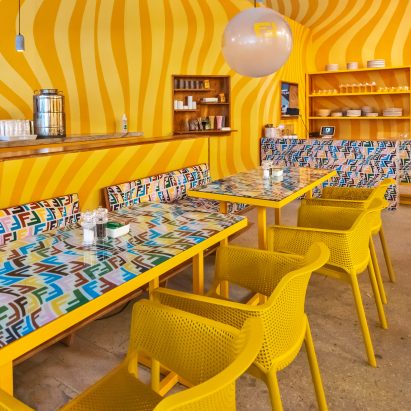
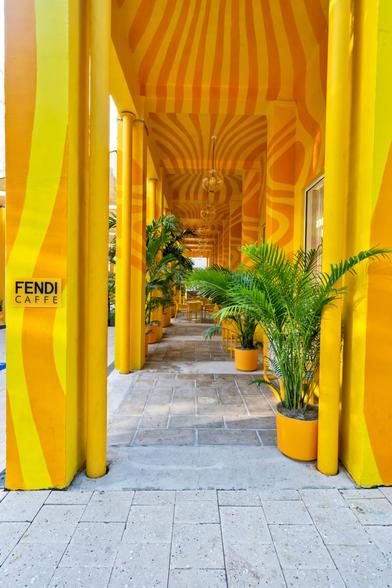
Stylised as the Fendi Caffe, the cafe designed for the Italian fashion house was located on the outdoor corridor of OTL restaurant in the heart of Miami's Design District from May to early July.

Coleman manipulated the traditional Fendi logo

The cafe was informed by the brand's Summer Vertigo capsule collection, which New York artist Sarah Coleman designed in collaboration with Fendi's creative director Silvia Venturini Fendi.

Defined by yellow and blue tones, the ready-to-wear collection features 90s streetwear references as well as shapes borrowed from 70s psychedelia.

The entrance to the cafe was on an outdoor corridor

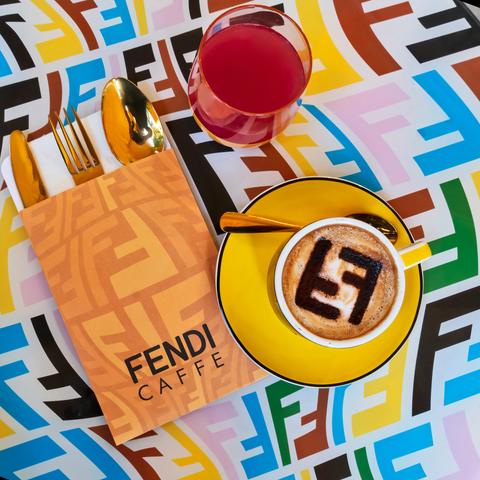
Central to the cafe's bold design was FF Vertigo, Fendi's iconic FF logo that Coleman and Venturini Fendi warped for the capsule collection and repeated throughout the cafe in a series of bold colours.

The artist explained the influences that prompted her to explore the 70s in her design process.

"When I first began brainstorming, I went straight to my bookshelf and dove into everything I have about the 1970s, a period of spontaneity and extreme self-expression," Coleman told Dezeen.

"I think the 70s are the greatest fashion era of the 20th century. The spirit of disco, the flowing post-psychedelic art," she added. "There were so many inspiring aesthetic references to draw upon."

FF Vertigo was repeated throughout the space

Visitors to the cafe were greeted with an expanse of bright yellow canopy that contrasted with green potted plants lining the permanent Fendi boutique that is located opposite the pop-up's site.

FF Vertigo featured as a bold motif throughout, topping the space's various tables and barstools while more abstract swirly shapes tumbled over the cafe's yellow walls.

A permanent Fendi boutique is opposite where the pop-up was

Orb-style pendant lights and menus also included FF Vertigo in their design, while a more traditional version of the Fendi logo featured on the cafe's edible items such as cappuccinos and toast.

Fendi is a luxury fashion house founded in 1925 by Adele and Edoardo Fendi.

Other previous projects by the brand that are informed by the past include a travelling installation for an edition of Design Miami featuring pastel 50s furniture.

The images are courtesy of Fendi.

The post Sarah Coleman puts a psychedelic twist on the brand's logo at the Fendi Caffe appeared first on Dezeen.

#restaurantsandbars #all #interiors #usa #miami #cafes #logos #fendi #florida #popupshops #miamidesigndistrict #retrodesign

The Fendi Caffe features the brand's iconic logo with a psychedelic twist

Sarah Coleman added a stretchy psychedelic twist to Fendi's distinctive double-F logo for a pop-up cafe constructed for the brand in Miami Design District.

Snøhetta references libraries for Oslo pop-up store A Better Place to Think

Architecture firm Snøhetta has created a library-informed respite from the digital world with A Better Place to Think, an Oslo pop-up shop for tablet brand reMarkable.

Located just off the city's main shopping street, the temporary store was made to showcase the brand's tablet, which has a paper-like surface.

The reMarkable pop-up store is informed by libraries

Snøhetta looked to libraries for the design, which features divided timber desks, leather banquets and small domed reading lamps.

The Norwegian studio wanted to encourage contemplation and concentration through the spatial qualities of the pop-up.

It features bespoke oak furniture in a quiet environment

"In today's fast-paced and digitalised society, finding places for focused thinking can be a challenge," Snøhetta founder Kjetil Trædal Thorsen told Dezeen.

"For the reMarkable pop-up store, we wanted to echo the serene environments of libraries – the clean and open spaces, somber aesthetics, tidy structures, and focused reading zones."

The central light installation is inspired by a handwritten line

A Better Place to Think features two concentric rings of desks and seating, with the inner ring made up entirely of standing desks and the outer ring featuring blocks of seated desks, benches and sofas.

A handmade light installation overhead was inspired by the energy and movement of a line of handwriting.

The walls and ceiling are painted in a "calm and sober" dark blue, with white acoustic panels and shelving covering most of the wall space.

The matt finishes across the walls, panels and on the bespoke oak furniture are meant to echo the material qualities of paper.

The store features matt finishes inspired by the feel of paper

The design of the pop-up aims to emphasise the enduring value of bricks-and-mortar shopping.

"Although consumers are becoming increasingly digital in their shopping habits, especially during the pandemic, we see the value of letting our customers experience that 'wow' moment of writing on one of our paper tablets for the very first time," said reMarkable founder and CEO Magnus Wanberg.

White pulp acoustic panels line the walls

Founded in 1989, Snøhetta has offices around the world.

Its recently completed buildings include the shimmering Le Monde Group Headquarters in Paris and the El Paso Children's Museum, which has a barrel-vaulted roof resembling a cloud.

Photography is by Calle Huth.

The post Snøhetta references libraries for Oslo pop-up store A Better Place to Think appeared first on Dezeen.

#retail #all #interiors #snøhetta #popupshops #shops

Snøhetta references libraries for pop-up store A Better Place to Think

Architecture firm Snøhetta has created a library-informed respite from the digital world with A Better Place to Think, an Oslo pop-up shop for tablet brand reMarkable.