#PhysRevLett Search for Extremely-High-Energy Neutrinos and First Constraints on the Ultrahigh-Energy Cosmic-Ray Proton Fraction with IceCube
https://journals.aps.org/prl/abstract/10.1103/PhysRevLett.135.031001 The missing ingredient in cosmic rays
https://www.nature.com/articles/d41586-025-02227-0 #PhysRevLett Search for Extremely-High-Energy Neutrinos and First Constraints on the Ultrahigh-Energy Cosmic-Ray Proton Fraction with IceCube
https://journals.aps.org/prl/abstract/10.1103/PhysRevLett.135.031001 The mysterious missing ingredient in the highest-energy cosmic rays
https://www.nature.com/articles/d41586-025-02227-0 🌀 Neutron Airy beams just dropped. No lens, no potential, just pure cubic-phase holographic witchcraft. Self-accelerating quantum ghosts curving through spacetime. Welcome to diffractionless neutronpunk. 🧬🛠️
#physrevlett #neutronoptics #AiryBeamshttps://journals.aps.org/prl/abstract/10.1103/PhysRevLett.134.153401#PhysRevLett Quantum Simulation of SU(3) Lattice Yang-Mills Theory at Leading Order in Large-𝑁𝑐 Expansion
https://journals.aps.org/prl/abstract/10.1103/PhysRevLett.133.111901 #PhysRevLett Quantum Simulation of SU(3) Lattice Yang-Mills Theory at Leading Order in Large-𝑁𝑐 Expansion
https://journals.aps.org/prl/abstract/10.1103/PhysRevLett.133.111901 #PhysRevLett Quantum Simulation of SU(3) Lattice Yang-Mills Theory at Leading Order in Large-𝑁𝑐 Expansion
https://journals.aps.org/prl/abstract/10.1103/PhysRevLett.133.111901 #NaturePhysics Simulating two-dimensional lattice gauge theories on a qudit quantum computer
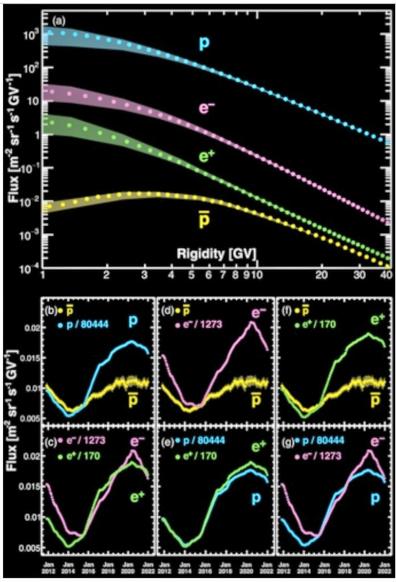
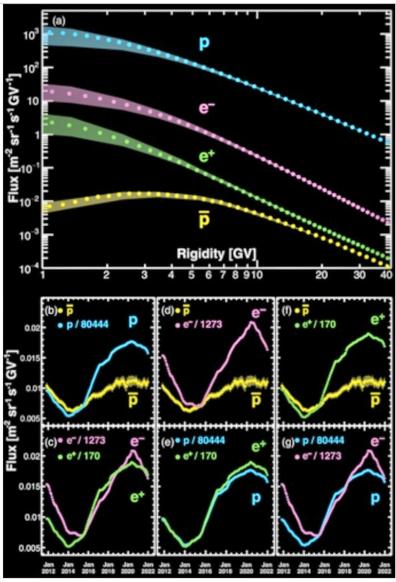
https://www.nature.com/articles/s41567-025-02797-w #PhysRevLett Antiprotons and Elementary Particles over a Solar Cycle: Results from the Alpha Magnetic Spectrometer
https://journals.aps.org/prl/abstract/10.1103/PhysRevLett.134.051002 #PhysRevLett Antiprotons and Elementary Particles over a Solar Cycle: Results from the Alpha Magnetic Spectrometer
journals.aps.org/prl/abstract... Our new paper to appear in
#PhysRevLett soon revisits Hawking radiation: The surprising result is that the event horizon is not actually needed - in contrast to the popular explanation we usually read (and Hawking used himself). It is the tidal force of the gravitational field that rip pairs out of the vacuum and makes black holes decay. However, then everything should produce this radiation and decay …
#astrodon #physics #quantumphysics #blackholes #hawking https://ui.adsabs.harvard.edu/abs/2023arXiv230518521W/abstract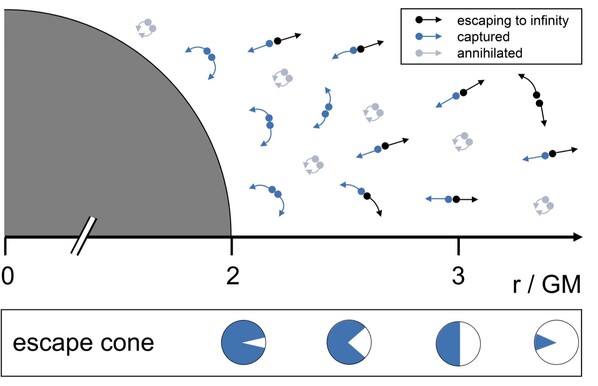
Gravitational Pair Production and Black Hole Evaporation
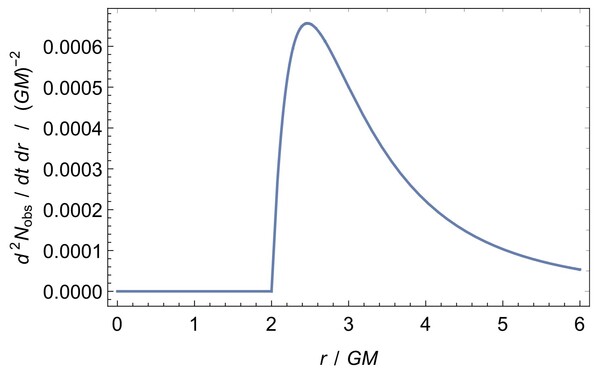
We present a new avenue to black hole evaporation using a heat-kernel approach analogous as for the Schwinger effect. Applying this method to an uncharged massless scalar field in a Schwarzschild spacetime, we show that spacetime curvature takes a similar role as the electric field strength in the Schwinger effect. We interpret our results as local pair production in a gravitational field and derive a radial production profile. The resulting emission peaks near the unstable photon orbit. Comparing the particle number and energy flux to the Hawking case, we find both effects to be of similar order. However, our pair production mechanism itself does not explicitly make use of the presence of a black hole event horizon.
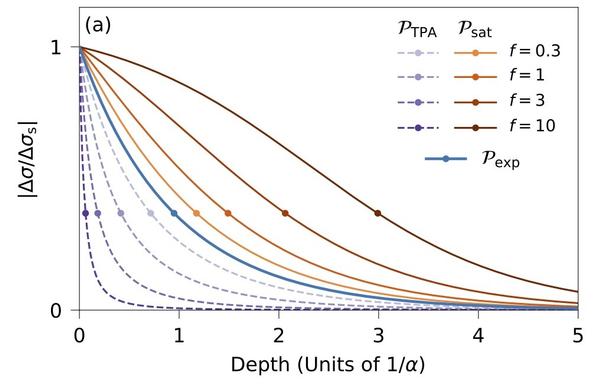
My students at #SFU and I have a new paper out in #PhysRevLett! We show that a faulty analysis procedure has exaggerated the experimental evidence for photoinduced #superconductivity in K3C60 and other materials, and we show how to correct for it. Thanks to #NSERC-CRSNG for financial support.
https://doi.org/10.1103/PhysRevLett.130.146002
Optical Saturation Produces Spurious Evidence for Photoinduced Superconductivity in ${\mathrm{K}}_{3}{\mathrm{C}}_{60}$
We discuss a systematic error in time-resolved optical conductivity measurements that becomes important at high pump intensities. We show that common optical nonlinearities can distort the photoconductivity depth profile, and by extension distort the photoconductivity spectrum. We show evidence that this distortion is present in existing measurements on ${\mathrm{K}}_{3}{\mathrm{C}}_{60}$, and describe how it may create the appearance of photoinduced superconductivity where none exists. Similar errors may emerge in other pump-probe spectroscopy measurements, and we discuss how to correct for them.
 Francis Villatoro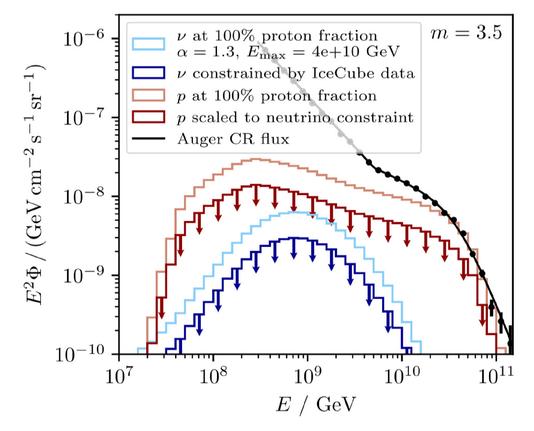
 Francisco R. Villatoro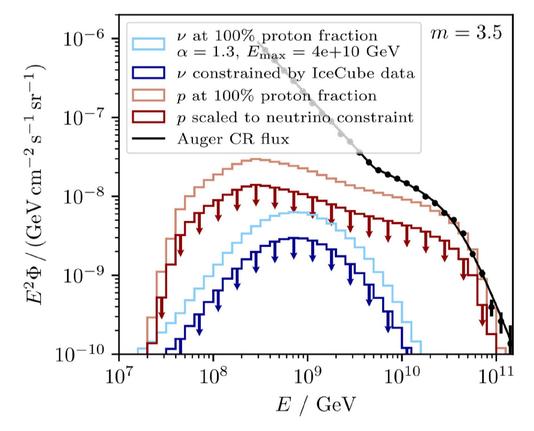
 geeknik
 Prof Heino Falcke
 Steve Dodge