Cross Bar chair by Pearson Lloyd for Takt

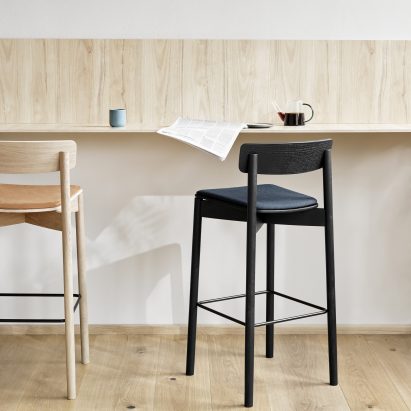
Dezeen Showroom: London-based design studio Pearson Lloyd aimed to bring the ethos of replaceability to an overlooked furniture type with the Cross Bar chair, created for Takt.

"The Cross Bar chair extends Takt's commitment to full replaceability and repairability to a new furniture category, delivering an efficient solution to the bar-stool market," said Pearson Loyd co-founder Luke Pearson.

The Cross Bar chair is repairable with replaceable components

Its repairable nature makes the stool particularly good for hospitality and workplace settings, although aesthetically it is just as suited to the home.

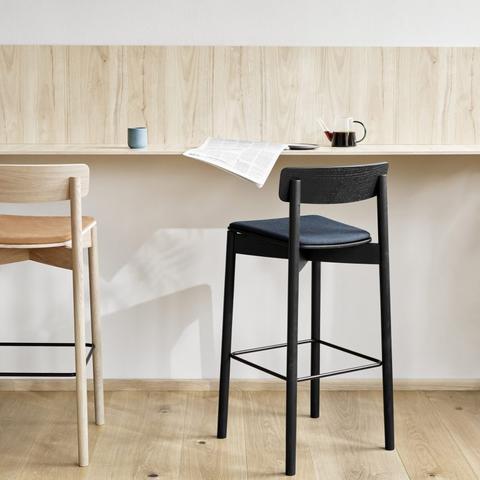
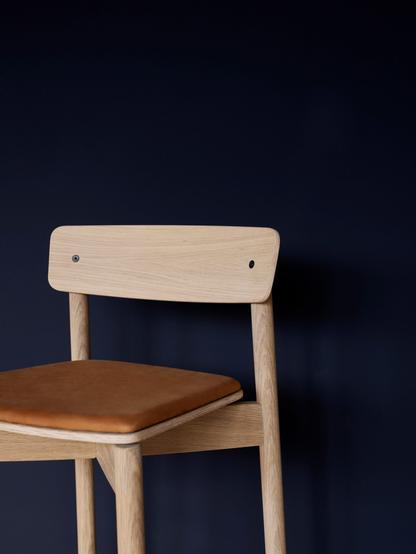
The Cross Bar chair comes in two heights and is made of timber that is available in three different finishes: oiled oak, smoked oak and black-lacquered oak.

It is made of timber with an optionally upholstered seat

The chair is designed to prioritise comfort and has a backrest that Pearson Lloyd also favours because it gives the stool a "definite orientation".

The seat can be optionally upholstered in a choice of three eco-labelled textile colours including sand grey, dark petrol or golden ochre or in cognac or black leather that has the Nordic Swan Ecolabel.

Product: Cross Bar chair
Designer: PearsonLloyd
Brand: Takt
Contact: [email protected]

Dezeen Showroom

Dezeen Showroom offers an affordable space for brands to launch new products and showcase their designers and projects to Dezeen's huge global audience. For more details [email protected].

Dezeen Showroom is an example of partnership content on Dezeen. Find out more about partnership contenthere.

The post Cross Bar chair by Pearson Lloyd for Takt appeared first on Dezeen.

#furniture #all #chairs #design #stools #donotshowonthehomepage #dezeenshowroom #seating #takt #pearsonlloyd #barstools

Pearson Lloyd designs 3D-printed desk accessories made from recycled bioplastic waste

London studio Pearson Lloyd has worked with design and 3D-manufacturing studio Batch.Works to create pen pots, trays and a mobile-phone stand made from discarded food packaging for office brand Bene.

The collection, called bFRIENDS by Bene, was 3D-printed from recycled polylactic acid (PLA) sourced from food packagings by Batch.Works.

The collection has five different designs in multiple colourways

It marks the first time that Pearson Lloyd has designed a 3D-printed product, though the studio has long used the technique to envision other projects.

"Up to now, we have always used 3D printing as a development tool for our projects," Pearson Lloyd co-founder Tom Lloyd told Dezeen.

The products are 3D-printed from recycled bioplastics

"The technology has changed in nearly 20 years from an exotic and expensive tool that we used to replace hand-carved form models, to an engineering tool to test physical parts, and now to an affordable way of prototyping rapidly with the studio," he added.

"We run two desktop printers that cover most of our needs, and go out to more specialist companies for larger or more precise parts."

Pearson Lloyd worked with Batch.Works to produce bFRIENDS

The studio's designs for the bFRIENDS collection, which features organic, undulating shapes reminiscent of corals, came about because it wanted to eliminate the hand-finishing aspect and reduce the 3D printing time.

"To achieve this, we chose to develop a formal language where the print head never needs to lift off and relocate during the print," Lloyd said.

All products were designed as one single line, including the squiggly pen holders

"This led us to design each product as a single line that traces all functional elements within its perimeter," he continued.

"The challenge of creating individual pen holders led in turn to the squiggle line that weaves in and out around each pen. Once we had developed this idea, the language for the whole range quickly followed."

[

Read:

Pearson Lloyd unveils own east London studio designed with Cassion Castle Architects

](https://www.dezeen.com/2020/12/03/yorkton-workshops-pearson-lloyd-cassion-castle-architects-london-studio/)

The collection comprises five items – two pen pots, a stand and two trays – and is made from 100 per cent recycled PLA by Batch.Works, which sources the bioplastic material from Europe.

"Our PLA is made from consistent sources of food packaging waste collected in the Benelux region and turned into filament by our material partners Reflow who are based in Amsterdam," Batch.Works founder and CEO Julien Vaissieres told Dezeen.

The desk accessories can be recycled as PLA

The studio says the production of the desk accessories, which are made from materials diverted from landfills, is close to net-zero and represents a step towards more circular production.

"We are really proud of the fact that the products made at our new Amsterdam site are as close to net-zero as you can imagine," Vaissieres said.

"Our factory is powered by electricity derived from wind power, our machines are literally steps away from where our raw material is produced, and our staff get to work by bicycle."

The collection was made for office brand Bene

PLA is a bioplastic that is derived from cornstarch rather than petroleum, making it a more eco-friendly alternative to regular plastics.

"In terms of material we are fully aware that even when using a biomaterial like PLA, there is a huge amount of energy and water that goes into the production process," Vaissieres said.

"That is why we work so closely with our material supplier to only use material that is already in its second cycle. Intercepting waste that was bound for landfill and transforming it into valuable products."

A take-back scheme is in development for the products' end-of-life

Once the products have been used, they can be recycled again as PLA. Batch.Works is also working with Bene to create a take-back scheme, allowing users to either send the products back to Bene or drop them off at a Bene showroom.

"Everything in the range has been designed with end of life in mind from the offset," Vaissieres said.

"Each product is mono-material and mono-colour, enabling us to utilise the material to produce new products further down the line."

The PLA bioplastic used for the line is developed from cornstarch

The recycled translucent PLA is coloured, but the colour accounts for just two per cent of the makeup of the material, according to Vaissieres.

"When we collect products back as part of the circular scheme they will be separated into their colours before being reprocessed into new material," he added.

Pearson Lloyd has previously designed the multifunctional PORTS Storage shelf and various other products for Bene, while Batch Works also used recycled plastic for its collection of lampshades for lighting brand Plumen.

The post Pearson Lloyd designs 3D-printed desk accessories made from recycled bioplastic waste appeared first on Dezeen.

#products #all #design #sustainabledesign #pearsonlloyd #deskequipment #3dprinting #bioplastic #recycledplastic #batchworks

Pearson Lloyd designs 3D-printed desk accessories made from recycled bioplastic waste

London studio Pearson Lloyd has worked with design and 3D-manufacturing studio Batch Works to create pen pots, trays and a mobile-phone stand made from discarded food packaging for office brand Bene.

Pearson Lloyd attempts to shift stigma around stairlifts with Flow X

London studio Pearson Lloyd has called on designers to take on more medical and accessible design projects, as it revealed its design for an aesthetically appealing stairlift, the Flow X.

Created for British mobility specialists Access BDD, Flow X is meant to not only be useful and technologically advanced but also to look attractive in the home.

Pearson Lloyd took on the project as it saw an opportunity to reinvent an overlooked and even stigmatised product – one that, according to the studio, people actively avoid installing even though this is detrimental to their health.

The Flow X stairlift was designed by Pearson Lloyd

The studio is challenging the design industry to do more in this sector.

"Although medical products are essential to those in need, they are by their nature not aspirational," studio co-founder Luke Pearson told Dezeen.

"A large proportion of design press has historically focused on glamorous, seductive projects with mass appeal simply because they are fashionable or new."

Its footrest, seat and armrests can be folded away to save space

He said that this, in combination with the fact that medical products are often complex and require lots of testing and expertise, made design studios reluctant to take on such projects.

"There is also the cliche that they often end up looking like medical products because the market finds comfort with this approach as a way to convince users of their purpose," he explained.

"Ironically this is often exactly what the users don't want. They want to be treated fairly like all members of society."

The stairlift was designed to blend into modern homes

"In our view, products in this category require the very best design efforts to make them really effective and enjoyable," Pearson continued.

"Now that the world has shifted on its axis, we cannot allow our natural instinct for the new to drive our creative ambitions."

180-degree folding arms help to support the user

Pearson Lloyd incorporated several innovative features into the Flow X design, such as the 180-degree folding arms.

These perform several functions: they allow the chair to take up less space on the stairs when not in use, they cradle the user to give a natural sense of safety, and they rotate forwards to create a good surface for users to push up from or steady themselves on when sitting down.

The arms open fully outwards on either side, so wheelchair users can slide across into the chair. The folding mechanism is either manual or automatic, depending on the model.

There is also a patented swivel mechanism that makes the chair and footrest rotate together, maintaining the optimal distance between the chair and the staircase and keeping the user from twisting their body.

An emergency call button on the armrest can be linked to up to three phone numbers

Another feature of Pearson Lloyd's design is its use of materials that are suited to the home. The chair has a laminated timber backrest that should complement 20th-century furnishings.

Built into the folding arms, Flow X's controls are meant to be simple and intuitive to use. These include a joystick that can be easily manipulated by either the hand or wrist, and an emergency call button that can be linked to up to three phone numbers.

Users are also able to answer calls from the chair.

The footrest is textured for added grip

Pearson Lloyd's past work includes the Cross flat-pack chair for Takt, a research project into roomier aeroplane seating, and a hospital signage system that was found to reduce incidences of violence and aggression.

The studio was founded in 1997 by Pearson and Tom Lloyd and is based in East London.

The post Pearson Lloyd attempts to shift stigma around stairlifts with Flow X appeared first on Dezeen.

#all #products #design #technology #pearsonlloyd #accessibledesign #designfortheelderly #technologyanddesign #healthproducts

Pearson Lloyd attempts to shift stigma around stairlifts with Flow X

London studio Pearson Lloyd has called on designers to take on more medical and accessible design projects, as it revealed its design for an aesthetically appealing stairlift, the Flow X.