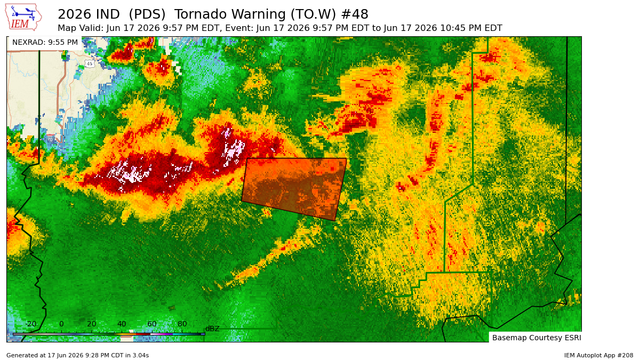
https://mesonet.agron.iastate.edu/vtec/?year=2026&wfo=KJAN&phenomena=TO&significance=W&eventid=35&tab=info&radar=USCOMP&radar_product=N0Q&radar_time=202605070010
Severe Weather Statement
National Weather Service Jackson MS
700 PM CDT Wed May 6 2026
MSC037-070015-
/O.CON.KJAN.TO.W.0032.000000T0000Z-260507T0015Z/
Franklin MS-
700 PM CDT Wed May 6 2026
...TORNADO EMERGENCY FOR Meadeville, Bude...
...A TORNADO WARNING REMAINS IN EFFECT UNTIL 715 PM CDT FOR CENTRAL
FRANKLIN COUNTY...
At 700 PM CDT, a confirmed large and destructive tornado was located
near Bude, or near Meadville, moving east at 50 mph.
TORNADO EMERGENCY for Meadeville, Bude. This is a PARTICULARLY
DANGEROUS SITUATION. TAKE COVER NOW!
HAZARD...Deadly tornado.
SOURCE...Radar confirmed tornado.
IMPACT...You are in a life-threatening situation. Flying debris may
be deadly to those caught without shelter. Mobile homes
will be destroyed. Considerable damage to homes,
businesses, and vehicles is likely and complete destruction
is possible.
This tornadic thunderstorm will remain over mainly rural areas of
central Franklin County.
PRECAUTIONARY/PREPAREDNESS ACTIONS...
To repeat, a large, extremely dangerous, and potentially deadly
tornado is on the ground. To protect your life, TAKE COVER NOW! Move
to an interior room on the lowest floor of a sturdy building. Avoid
windows. If in a mobile home, a vehicle or outdoors, move to the
closest substantial shelter and protect yourself from flying debris.

Digging a bit deeper into the PC ISA card for the PDS.
https://emalliab.wordpress.com/2026/05/06/pds-the-programmers-development-system-part-2/
PDS – the Programmers Development System – Part 2
This series of posts looks at the Programmers Development System (PDS).
Having now got a bit of an idea of how the PDS appears to work in my previous post (PDS – the Programmers Development System) I’m now taking another look at the PC interface and starting to think about the possibility of recreating the system.
The PC Interface
Having decided I couldn’t rely on the schematic on the CPC wiki, I’ve taken the printout-versions of the PCB traces and started tracing them through to see what is really going on. It was greatly helped by the PCB view that can be found here: https://lemmings.info/pds-programmers-development-system/
Of course, I am assuming here that the remade PC card does actually work.
It turns out the ISA to Intel 8255 part was fine, including the address decoding, but the three 8255 IO ports, through the octal line buffers, to the two PDS links are fundamentally missing some key links.
Essentially the three 74LS244s are configured for half in A->Y form and half in Y->A. The three IO ports (PORT A, B, C) are also split in half. This means that most of this circuit is working in 4-bit chunks.
The high level linkages are shown below.
So here we can see how the A halves of each of the 244s handles OUTPUT and the B halves handle INPUT. We can also see that U5 (sticking with the original schematic numbering for now) handles the control signals, U4 is D4-7 and U3 is D0-3. PORTC drives U5 and thus also handles all control signals.
We can also see that the data lines are now fully bidirectionally connected so that each can be connected to an OUTPUT or an INPUT depending on the state of the PC2 line. PORTB handles the OUTPUT and PORTA is the input.
The control signals are still mirrored as determined in the first part, but now we can see that some are OUTPUTs and some are INPUTs. The mappings from PC0-7 through to the link pins is shown below (note I’ve reverted to using the same PDS connector pin numbers as the ZX Spectrum schematic in the diagram above and table below).
PIODirectionLink 1 PinLink 2 PinPC0OUT313PC1OUT133PC2OUT1111PC3OUT99PC4IN515PC5IN155PC6IN7N/CPC7INN/C7There are two swapped pairs of connections, two common, and one unique to each.
As mentioned previously, the ZX Spectrum interface does not connect to pins 9,11,13,15 so that implies to me that it would not work out of link 2 without remapping in the software for the alternative pinout.
From working through the ZX Spectrum monitor code in part 1, we can infer the following functions:
We can also note the following:
From this point I can now fully recreate the schematic and start to think about recreating the PCB.
The PC Hardware
One slight sticking point in remaking the PCB was getting useful dimensions for an XT era ISA card. Two useful references I found were:
The actual spec wasn’t massively useful to me. I don’t know if the ends of cards was slightly different in PC XT systems, but it doesn’t seem to match the photos of the PDS PC card. The second link was very well researched and complete however, so I went with that.
One compromise though was trying to keep the card within a 100x100mm footprint, so I’ve not extended completely to what I believe will be long enough to have an end plate.
The Schematic
The updated schematic is shown above. I’ve added a few things I’d expect to see on a modern design – additional 100nF capacitors (one for each IC), and a resistor network to pull up all unused inputs to the 74LS04.
I originally went with the ZX Spectrum version of the 16-way connector, but then when it came to assigning footprints, to get a right-angled IDC connector meant pin one was now in the wrong place, so I had to revert to the alternative pin numbering as per the original schematic.
The PCB
I’ve followed the original layout used on the PC card remake as far as possible, reasoning that the person who did this almost certainly knows a lot more about electronics than I do.
One thing I wasn’t sure about was a GND fill. I initially created a fill zone, but then decided I’d follow the original lead and use explicit GND connections. If someone advises that a fill will be better then it is pretty trivial to add in.
Other points to note:
This will do for now, but I think it is highly likely there will need to be some physical adjustments for this to be usable.
Conclusion
I believe I’ve got an accurate schematic for the board based on the photos available and I now have design for a candidate PCB. The problem is that I don’t know anything about what the software is expecting when it drives the Intel 8255 to work the PDS interface.
There is also the small matter of needing an ISA bus in a PC…
I’m hoping to get these boards published somewhere but right now, I’m not clear what the licensing issues would be. These boards are not available anymore, but at some point this was a company’s IPR.
For now, I’ll keep blogging observations and see what the interest is.
Next up will be some remake of the target PCBs.
Kevin
#intel8255 #ISA #pcXt #pds #programmersDevelopmentSystem