The article explains how the brain processes the passage of time through three distinct processing stages across different cortical areas, from initial visual encoding to higher level time categorization and subjective perception.

The findings highlight a layered view of time processing, showing how physical duration becomes a subjective experience through spatially organized neural maps and stage-specific functions, which is of interest to psychology due to insights into perception, cognition, and decision making.

Article Title: The human brain processes the passage of time across three distinct stages

Link to PsyPost Article: https://nolinkpreview.com/www.psypost.org/the-human-brain-processes-the-passage-of-time-across-three-distinct-stages/

#timeperception #neuroscience #cognition #neuralcoding #visualperception #subjectiveexperience #frontallobe #parietalcortex #premotor #neuralmaps

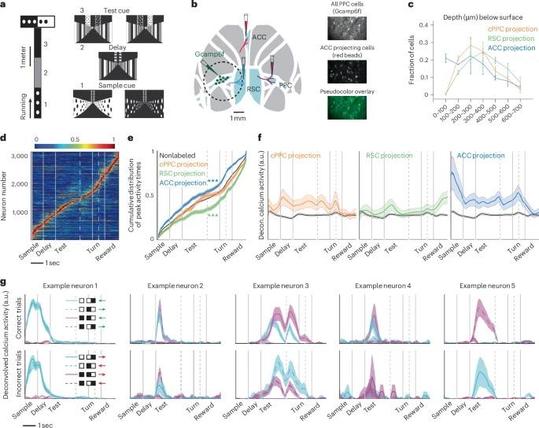
🧠 New paper by Safaai et al. (2025): parietal #cortex output populations show highly structured, task-dependent population geometry. Using multi-area recordings and circuit modeling, they show that #parietal populations display organized task-related patterns rather than uniform mixed coding, and that distinct output groups shape how decisions are routed to downstream targets:

🌍 https://doi.org/10.1038/s41593-025-02095-x

#Neuroscience #NeuralCoding #ParietalCortex #PopulationDynamics #DecisionMaking

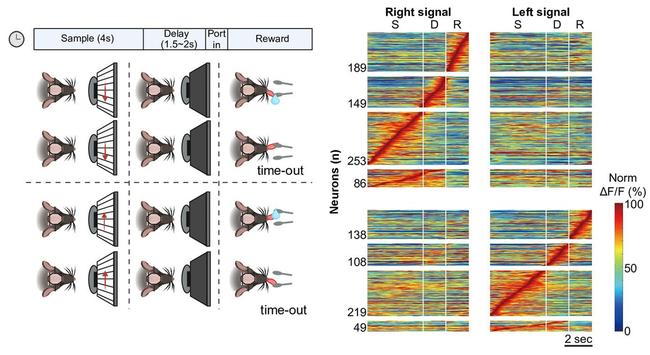
What are the neural mechanisms behind short-term #memory errors? This study shows that they are primarily linked to a drift in neural activity in posterior #ParietalCortex, highlighting a need for stable neural representations to support accurate memory performance @PLOSBiology https://plos.io/4p85IzD
How does sensory information construct representations in the human brain? This study shows that a network including prefrontal & posterior #ParietalCortex & anterior #insula has a key role in translating perceptual information to concepts, semantics & action plans #plosbiology https://plos.io/4lbXN2b
Neural mechanisms for the attention-mediated propagation of conceptual information in the human brain

How does sensory information activate and construct representations in the human brain? This study shows that a neuronal network including the prefrontal and posterior parietal cortex and the anterior insula has a key role in the translation of perceptual information to concepts, semantics, and action plans.

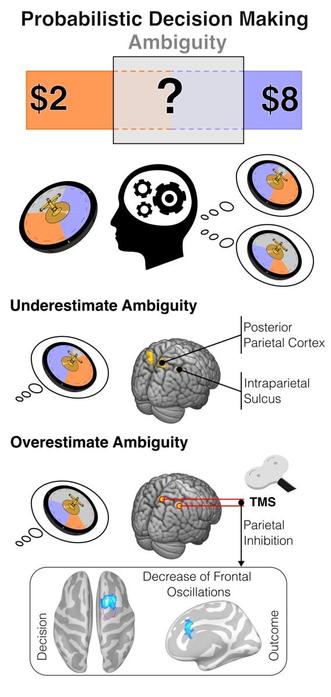
How do we decide between ambiguous options? @gvaldebenitoo @pablobilleke &co use fMRI & TMS-EEG to show that #ParietalCortex is causally involved in computational processes that underestimate uncertainty during #DecisionMaking under ambiguity. #PLOSBiology https://plos.io/3Heobpr
The parietal cortex has a causal role in ambiguity computations in humans

Humans often face the challenge of making decisions between ambiguous options. The level of ambiguity in decision-making has been linked to activity in the parietal cortex, but what is its actual role? This study uses fMRI and TMS-EEG to show that the parietal cortex is causally involved in a computational processes that underestimate uncertainty during decision-making under ambiguity.