#ScientificAmerican

Opinion

#Fossil #Fuels Are Not Essential

We Can Live without Fossil Fuels

The fossil-fuel industry argues that we can’t live without its deadly products. It is wrong

By Naomi #Oreskes
https://www.scientificamerican.com/article/fossil-fuels-are-not-essential/

We Can Live without Fossil Fuels

The fossil-fuel industry argues that we can’t live without its deadly products. It is wrong

Scientific American

""Sie werden nicht kampflos untergehen"

Bereits vor fünf Jahrzehnten sahen die #Ölkonzerne den #Klimawandel voraus. Die Wissenschaftshistorikerin Naomi #Oreskes hat erforscht, was die Branche wusste und wie sie es öffentlich leugnete. Was hält sie vom #Klimagipfel im Öl-Emirat #Dubai?"

https://www.zeit.de/2023/51/naomi-oreskes-klimagipfel-klimakonferenz-cop28-oelkonzerne/komplettansicht

Naomi Oreskes: "Die fossile Industrie wird notfalls alle mit in den Abgrund reißen"

Ölkonzerne sahen den Klimawandel früh voraus. Die Wissenschaftshistorikerin Naomi Oreskes hat erforscht, wie die Branche es leugnete. Wie sieht sie die COP28 in Dubai?

ZEIT ONLINE
Sehr interessantes Interview in der ZEIT mit Naomi #Oreskes - der Frau, die wohl am längsten zum Thema #Konzernlobbyismus forscht.
Und ich habe etwas dabei gelernt!
⬇️
https://www.zeit.de/2023/51/naomi-oreskes-klimagipfel-klimakonferenz-cop28-oelkonzerne/komplettansicht
Naomi Oreskes: "Die fossile Industrie wird notfalls alle mit in den Abgrund reißen"

Ölkonzerne sahen den Klimawandel früh voraus. Die Wissenschaftshistorikerin Naomi Oreskes hat erforscht, wie die Branche es leugnete. Wie sieht sie die COP28 in Dubai?

ZEIT ONLINE

Senate examines role of ‘dark money’ in delaying climate action

The #Senate #budget #committee held a hearing on Wednesday morning to scrutinize the role of oil- and gas-linked “#dark #money” in delaying climate action – and tearing through local and federal budgets.

The hearing was led by #Senator #Sheldon #Whitehouse of Rhode Island, who has held 10 #climate #crisis-focused hearings since he took the helm of the budget committee this past February

Committee Democrats invited three witnesses. First to the stand was the Harvard history of science professor #Naomi #Oreskes. “Climate change is a market failure, and market failures require government action to address,” she testified.

Fossil fuel interests’ efforts to disrupt climate policy had come at great expense to the US, including not only financial costs, but also human suffering and lives lost, said Oreskes, who has written several books on oil industry misinformation.

#Christine #Arena, former public relations executive at the firm Edelman who now works in social impact film-making, and who was also invited by Senate Democrats, drew comparisons between the fossil fuel industry’s decades-long misinformation campaign and how the tobacco industry tried to cover up the harms of smoking.

“Just like the tobacco executives before them, [fossil fuel executives] characterize peer-reviewed science and investigative journalism that illustrates the extent of their deceptions as biased or inconclusive,” said Arena, who is now the founder of Generous Films.

#Richard #Painter, professor of corporate law at the University of Minnesota Law School who was chief White House ethics lawyer under George W Bush, was third to testify. A political independent, Painter said Americans should get on board with the push to end climate misinformation no matter where they fall on the political spectrum.

“This is not a partisan issue,” said Painter, who was also invited by Whitehouse. “This is about caring, and doing something about a grave threat to the human race.”

https://www.theguardian.com/us-news/2023/jun/21/senate-budget-committee-dark-money-climate-action?CMP=Share_iOSApp_Other

Senate examines role of ‘dark money’ in delaying climate action

The budget committee hearing looked into alleged misinformation from big oil that covered up ‘massive’ risks of the climate crisis

The Guardian
In the Fight Over Gas Stoves, Meet the Industry’s Go-To Scientist

Longstanding research shows the health dangers of gas-burning ranges. Utilities are turning to Julie Goodman, a toxicologist with a firm whose work raises questions about the science.

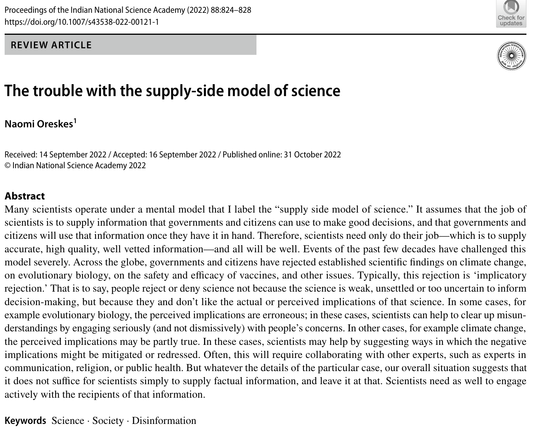
Brilliant new paper by Naomi #Oreskes, concluding that "our overall situation suggests that it does not suffice for scientists simply to supply #factual #information, and leave it at that. Scientists need as well to engage actively with the recipients of that information." https://link.springer.com/article/10.1007/s43538-022-00121-1
The trouble with the supply-side model of science - Proceedings of the Indian National Science Academy

Many scientists operate under a mental model that I label the “supply side model of science.” It assumes that the job of scientists is to supply information that governments and citizens can use to make good decisions, and that governments and citizens will use that information once they have it in hand. Therefore, scientists need only do their job—which is to supply accurate, high quality, well vetted information—and all will be well. Events of the past few decades have challenged this model severely. Across the globe, governments and citizens have rejected established scientific findings on climate change, on evolutionary biology, on the safety and efficacy of vaccines, and other issues. Typically, this rejection is ‘implicatory rejection.’ That is to say, people reject or deny science not because the science is weak, unsettled or too uncertain to inform decision-making, but because they and don’t like the actual or perceived implications of that science. In some cases, for example evolutionary biology, the perceived implications are erroneous; in these cases, scientists can help to clear up misunderstandings by engaging seriously (and not dismissively) with people’s concerns. In other cases, for example climate change, the perceived implications may be partly true. In these cases, scientists may help by suggesting ways in which the negative implications might be mitigated or redressed. Often, this will require collaborating with other experts, such as experts in communication, religion, or public health. But whatever the details of the particular case, our overall situation suggests that it does not suffice for scientists simply to supply factual information, and leave it at that. Scientists need as well to engage actively with the recipients of that information.

SpringerLink
NPR top news editor accused of sexual harassment by multiple women

NPR top news editor accused of sexual harassment by multiple women

Boing Boing