 War Fantasy
Short History of Artillery -Antiquity to 19th Century
Artillery is the king of the battlefield. Even today, with air power, smart ammunition and drones, most of the damage is still being done by the artillery. In July 2024, Ukrainians were firing 2 000 rounds per day while Russians were firing 10 000. From at least the Crimean war until today, most of the damage and casualties was typically caused by the artillery.
Yet it wasn’t always this way. History of artillery goes back a long way indeed, and early artillery generally wasn’t suitable for battlefield usage.
Origin of artillery really lies in prehistory. First human weapons were simple melee weapons such as clubs – Greek hero Hercules is a prominent user of the weapon. Yet clubs, relying solely on blunt damage, required a lot of strength to use and were hardly efficient. Next evolution was spear. Spear was far superior as it penetrated the skin, causing internal injuries and bleeding, which could kill the animal even if it survived the initial attack. And once spears were designed so they could be thrown, killing animals with spears also became far safer.
But as larger animals became less numerous due to hunting, it was necessary to switch to the smaller, fast-moving prey. By utilizing elasticity of wood, humans created bow and arrow. This allowed even more efficient hunting. And in order to create a more reliable food supply, humans began to domesticate animals – starting with wolves, whom they hunted with, but then also domesticating herbivores to serve as a food source. Over time, this created modern domesticated animals.
In order to better feed these animals, humans eventually began to grow plants – and also began eating said plants themselves. This new grain- and vegetable- -based diet, utterly different from previous diet of meat and occasional berries, allowed massive expansion in population at the cost of making us all metabolically unhealthy. But what all of this meant was that humans settled down in one place for prolonged periods of time.
It also meant less food security. Animals were always there, and so long as one had safe territory to hunt in, survival was basically guaranteed. But crops could easily fail – and when one group lost their food, easiest recourse was stealing food from their neighbours. Thus settling down led not just to population expansion and failing health, but also to constant warfare.
Demographics were not the only thing that had changed. New materials were also discovered – copper, then bronze and eventually iron were used to make tools and weapons.
For defense, people also built walls. And in order to overcome the walls, attackers had to build devices to overcome them. This then leads to artillery.
Physical Artillery – Antiquity
Matter of the fact is that artillery has not changed much. Comparing Roman ballista or medieval trebuchet with the 18th century cannon and mortar, the only difference is in the type of energy that sends projectile on its way.
Artillery had existed literally since the Biblical times – the Scripture records the usage of siege engines against Jerusalem eight centuries BC.
Catapult
While “catapult” in Middle Ages was used for basically all stone-throwing siege engines, and today is used for a giant rock-slinging spoon, original catapult was something very different.
Catapulta is, in essence, a giant bow. Equally massive arrow was placed on a wooden guide, and then the bow would be pulled back with a mechanical device (such as a wench). Bow would then be released with a trigger, shooting an arrow. These devices could have a range of up to 800 meters.
While medieval catapults could have tension bows (similar to infantry bows), in ancient devices the device was typically torsion. Arms of the bow were set into twisted ropes made of hair, hide or sinew. Bowstring fixed to the arms fired arrows, darts and stones.
It is unknown when the catapult was first invented. First known evidence is the mention of its usage during Dionysius I preparations for war with Carthage in 399 BC. Greek historian Diodoros claimed that the catapult was invented during this time in Syracuse, being finally unveiled during the Siege of Miotya in 397 BC where it “caused great consternation”. Yet Diodoros himself was writing during the 1st century BC. Roman historian Pliny the Elder however gives a completely different assessment: “Hunting spears and, among the artillery, the scorpion (were invented by) the Cretans, the catapult (by) the Syrians, the ballista and the sling (by) the Phoenicians.”.
Historian Livy believed that C Lucius Camillus considered catapults during the siege of Antium in 386 BC, for “such a powerful town could not be captured without great preparation of artillery and machinery.”.Late Roman writer Vegetius even mentions catapults in the context of Gallic siege of Capitol in 390 BC. Yet elsewhere Livy himself makes it clear that the catapults only entered Roman consciousness during the Punic Wars. While Diodoros makes it clear that catapult appeared in 399 BC, it is almost certain that at this stage it was merely a simple tension crossbow-style machine. And if it did appear then, its spread was slow. Neither Tuchydides nor Xenophon mention catapults.
Another problem is the exact date of invention of the torsion principle. Heron of Alexandria states that dissatisfaction with the hand bow led to invention of the gastraphetes while dissatisfaction with that led to invention of the torsion catapult. Gastraphetes and catapulta were then used side-by-side for some time, with gastraphetes remaining in use at least until 155 BC. Catapult appeared at latest by 306 BC as that is when they are attested as being in storage at Athens, and may have been present already by 330 BC. But these may have been tension catapults as well. The earliest certain date for appearance of the torsion catapult is in 306 BC, though they may have been used during the siege of Tyre by Alexander of Macedon.
Hellenistic torsion catapult was called excursus. Torsion catapult replaced the wooden bow with the torsion machine consisting of a frame, two wound rope vertical springs and arms. This machine was fixed to the front of the stock with wench at the rear. Atop the stock was a grooved slider which held the arrow. Upon drawing the bow, it was automatically locked in place and released on command via a trigger mechanism, much like a later crossbow.
Springs themselves were contained within metallic containers – modiolus or washer. Fitted over the holes in the peritreon, the washers held the springs in place. Rope went multiple rounds through both washers, and the wooden bow arm then went through a hole in the rope.
Each catapult was tailored to a missile of particular size – stone of a certain weight or an arrow of certain length. The basic measure was the thickness of the torsion spring, which could be expressed through the inner diameter of the washer through which the spring was fed. Thus size and caliber of the catapult could be calculated from diameter of the washer, and vice-versa.
Torsion springs were installed under extreme stress, but slackened through the process of tension and relaxation while shooting. Because of this, they had to be periodically tightened again. This could be achieved by simply twisting them. Twisting the springs was done by turning the washer, which had a series of pinholes in it for purposes of this calibration. Fact that the springs were stressed also meant that they had to be protected as a single shot could destroy the assembly; for this reason, catapults typically had face plates.
During the Early Principate at least, Romans still predominantly utilized catapults of Hellenistic types. Unfortunately, Roman writers usually used general terms such as tormenta (term for torsion machines) or even mechanai (machines) when describing artillery. Nevertheless, scorpio and catapulta are euthytones while ballista was a palintone
Last euthytones appeared in the 1st century AD. By the mid-4th century AD, one-armed onager was the only stone-throwing machine, while ballista was used exclusively as an arrow-shooter. At least from the time of Trajan onwards, palintones supplanted euthytones as preferred arrow-shooters.
Process of shooting involved catching the string with the trigger assembly, which itself is connected to the winch by the ropes. Assembly itself is drawn back by rotating the winch by a lever until the tension is achieved, and then the trigger is released by pulling the cord.
Scorpio
Scorpio is the catapult used to shoot arrows (bolts), basicalyl a one-span version of the catapulta. Greek name for it was oxibeles. Whereas ballista was an euthytone, scorpio was a palinthone design. What these terms really mean is unclear, but one of the more likely interpretations is that ballista’s arms were set inside the frame, facing inwards (inswinging – palinthone), while those of a scorpio were facing outwards and protruding outside the frame (outswinging – euthytone). Yet design of the palintone allowed it to shoot both arrows and stones. A 10-mina palintone could handle arrows four cubits (6 feet, 185 cm) long.
Arrow was placed on the diostra (slider), which had a groove serving as an arrow guide. Two torsion springs were placed at each side of the slider.
Ballista
Ballista is a catapult used to throw stones. In Greek Orient, it was called petrobolis or litobolis. Even the smallest stone projectors were larger than the largest of arrow shooters. The smallest model was the 10-mina shooter, designed to shoot stones weighting cca 4,4 kg. Philon lists machines designed to shoot projectiles weighting 10, 15, 20, 30 and 50 minae, as well as 1, 2 and 2,5 talents. Even the 10-mina ballistae were large machines, with 4 meter long stock and washer diameter of 11 dactyls (21,2 cm).
As seen from discussion on the scorpio, ballista likely had inswinging (palintone) arms, with the springs installed at the ends of a long frame.
Both ballista and scorpio were used as direct-fire artillery. Whereas scorpio would be used directly against personnel, acting essentially as a giant sniper rifle, purpose of the ballista was suppression and decrennelation of the wall.
Onager
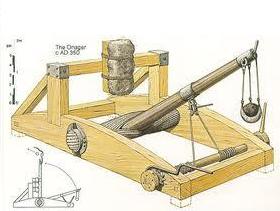
Onager is based on the principle of rope tension, but the main part is a giant spoon which rotates around the tension rope. This weapon could launch a stone weighting 25 to 75 kg to a distance of 500 to 800 meters. Whereas catapults and ballistas were more-or-less direct-fire devices (although able to carry out indirect fire as well), onager was inherently an indirect fire artillery, similar in their effect to gunpowder howitzers.
In order to increase the range, spoon was replaced with a sling. It is essentially a giant, mechanized staff-sling, with the throwing arm placed into a single large skein. In later sources it usurped the name of scorpion, as seen from Tertullian in 210 AD: “rising up in an arching attack, draws its hooked sting up like a torsion machine; from this feature, they call the war machine a scorpion, that shoots its missiles by retracting”.
Its great weight – up to 4 tons – meant that it had to be assembled on site.
Physical Artillery – Middle Ages
Medieval ages saw a temporary step back in development of artillery as well as in available records. While artillery was already being used even during the Migration Period, records from this time and the following centuries are scarce. The first precise illustrations and descriptions of stone-throwing machines are found in the 1187 Arab treatise on military strategy written by Mardi ibn Ali al-Tarsusi. First such descriptions in (western) Europe are found in the French work by Villard de Honnecourt in the 13th century. At the beginning of the 15th century, Konrad Kyeser in his work Bellifortis depicted several counterweight trebuchets, the most modern siege engines that did not operate with gunpowder.
In the modern period the first to research medieval artillery was the French Emperor Napoleon III (1852 – 1870). The Emperor had a stone-throwing machine constructed, but its characteristics are not known. French architect Eugène Emmanuel Viollet-le-Duc made several reconstructions. In the 1900s, Ralph Payne-Gallwey researched ancient and medieval stone-throwing machines and crossbows while Ada Bruhn Hoffmeyer researched Byzantine siege technology and engines. American historial Paul E. Chevedden examined the stone-throwing machines utilized in the Middle East, the Iberian Peninsula and the Byzantine Empire.
While ancient torsion engines were still being used in the early Middle Ages, loss of logistical and organizational ability following the Arab expansions of the 7th century meant that the torsion engines – technically complex to make and logistically difficult to support – fell out of use, being instead replaced by the tension and rotational engines such as the tension ballista and the mangonel.
Medieval times also saw the appearance of traction stone throwers. These were first mentioned in descriptions of Avar siege of Thessaloniki in 597 AD, and were also used by Byzantines in the siege of Beneventum in 626 AD. Technology eventually spread to the western and northern Europe, as evidenced by Viking usage of trebuchets in the 885 – 886 siege of Paris.
In the Western and Central Europe however siege warfare was not very prevalent early on. During the early Middle Ages, stone castles were few and far between, with majority of castles being wooden motte-and-bailey and similar types. But from the second half of the 11th century AD the castle building really took off, and with spread of stone walls both the castles and the cities became extremely tough nuts to crack.
In the middle third of the 12th century another siege engine appeared – the counterweight trebuchet. It is however possible that the machine may have been used as early as the 1097 Siege of Nicea. At the end of the 12th century the counterweight trebuchets were regularly employed alongside other siege engines. Capable of throwing stones larger than 100 kilograms to a distance of over 200 meters, their existence led to development of concentric stone castles and the transformation of military architecture in the Holy Land and Europe alike.
Much like Romans, medieval siege engines also threw spherically-carved rocks. These however were not standardized into calibres, making medieval siege artillery somewhat less effective at destroying walls as targeting was made more difficult. Most knowledge about trebuchets and other medieval artillery was gained through experimental archaeology.
Ballista
Ballista was the mounted crossbow, similar to the Roman ballista or scorpio, but based instead on the tension principle instead of being a torsion device.
Mangonel
European mangonels were likely based on the Roman onager, but used traction instead of torsion principle. Similar siege engine had been used in China for much longer, having been invented there between 5th and 3rd century BC. While it can be often read that mangonel was a torsion device utilizing the tension of the twisted ropes, this is merely a misunderstanding caused by confusing it with its direct predecessor and inspiration, the onager.
Trebuchet
Trebuchets were a genuine medieval invention, with their first undeniable appearance being in Italy in the 12th century – specifically the siege of Castelnuovo Bocca d’Adda near Cremona in Italy in 1199.
Counterweight trebuchets used a weight to move a single arm and propel the projectile towards the enemy. Trebuchet could launch much heavier stones than a mangonel, and thus could bring down most of the medieval city walls. By the 14th century, trebuchets could have counterweights between 4,5 and 13 tons and could launch a stone weighting anywhere from 45 to 90 kg over a distance of 275 meters. Some trebuchets were indeed massive: during Edward I’s siege of Stirling castle in Scotland in 1304 AD, it took 54 carpenters three months to build the Warwolf trebuchet.
Gunpowder Artillery
History of the modern artillery began with discovery of gunpowder, a mix of calium nitrate (salitra), sulphur and the charcoal at a rate of 75:10:15 or else 75:12,5:12,5. Major aspect of gunpowder is the fact that it contains oxygen within it, which allows it to burn in a close-to-airtight space. Equally important is its expansion: one liter of benzin produces 32 litres of gasses, whereas one litre of gunpowder produces 1440 litres of hot gasses.
When burnt in an enclosed space, gunpowder produces a mechanical effect through pressure. If burnt in a wholly enclosed space, this causes an omnidirectional explosion. When one end is left open however, pressure can be directed to create propulsion – creating a rocket or else a cannon, depending on how exactly the principle is applied.
First mention of cannons comes from 1232 AD. In that year Mongols attacked Chinese city of Kai Feng Fu. Chinese defended themselves by using cannons and rockets. Usage of gunpowder in warfare is also mentioned in India around 1200 AD, from where traders took it to Arabia. Arabs developed the Arabian modfa, a primitive cannon shooting arrows.
Through Arabs and Mongols, gunpowder eventually entered Europe. First news of usage of guns in Europe come from early 14th century. Later chroniclers report that guns were used by the Germans at the siege of Metz in 1324 and by the Granadines at the siege of Baza in 1325. While these are not contemporary reports, later evidence does make them likely to be true at least in generalities.
Walter de Melemete wrote De Oficiis Regum, set of instructions for the English king Edward III. This book from 1326 has a drawing of a cannon with an arrow or a spear inside the barrel, with powder being ignited on the rear end of the cannon from above. Cannons had appeared at the same time in Firence (Florence), with two brass cannons being cast in 1326, along with orders for manufacture of balls and iron arrows for said cannons. Tower of London had its own cannons by 1338 AD. French town of Cambrai had incorporated guns into its defensive arrangements as early as 1339. In the same year, account books of Bruges mention a ribaudequin or ribaud, multi-barrelled cannons with 3 – 4 guns each. These “organ guns” continued being used until the late 15th century, as seen from the Burgundian wars. But cannons’ first active usage in war was recorded in 1342 AD during defense of the city of Algeciras in Spain (lasting 1342 – 1344), when defenders fired gunpowder bombards against the Spanish army. It is interesting to note that during this period, many cannons were made of wood with only core of metal; Petrarch refers to wooden cannon in 1343.
ribaudequinSoon after, English used cannons against the French during the Battle of Crecy in 1346, which marked the first usage of field artillery in Europe. These cannons were few in number – English had only five 12-barrel ribauldequins at Crecy, which managed to fire three volleys each. Nevertheless, due to their novelty these guns were the key to English victory, as cannons disrupted the Genoese crossbowmen and caused them to engage from a far greater distance than they normally would have. Cannons also caused significant casualties among both the Genoese crossbowmen and the French knights that attacked later. Even larger number of guns was used at English victory at Calais.
French used large number of cannon in the siege of Saint-Sauveur-le-Vicomte in 1375, the first time they had ever fielded a large battery of cannons – a total of 32 weapons.
Around 1370 the first iron cannons appeared in Europe. These were made from iron strips forged into cylinders and fired small balls or bolts. In 1378 Republic of Dubrovnik gifted two cannons to its ally Genoa. It also is interesting to note that the word pistol comes from Pistoa, an Italian city that was major producer of gunpowder artillery. Word artillery itself comes from Italian “arte di tirare” – “art of targeting”. For comparison, Roman artillery was termed tormenta – due to it being based around torsion devices.
14th century also saw the first appearance of the wheeled carriages for cannons, first applied to ribaudequins. Heavier cannons followed soon after, an Italian source mentioning 2-wheeled gun-carriages being used at the siege of Quero in 1376. They remained rare until the mid-15th century however, having been further developed during the Hussite wars of 1420s and 1430s.
Usage of gunpowder artillery, as late as the late 15th century, was limited by the available supply of forges, gunpowder, skilled crews and transport.
These early cannons fired fired either small iron balls or else heavy quarrels such as that depicted in Milemete’s picture. Such quarrels or garrots were used by Philip van Artevelde’s guns at Roosebeke in 1382. Garrots normally had an oak shaft, iron head and an iron, steel or brass flight and could weight 15 – 30 lbs. Quarrels were the most common type of artillery projectile all the way until the early 1340s, and continued being in use all the way until the late 16th century.
Smallest guns used lead pellets while larger guns used iron cannon balls such as recorded in the Florentine account of 1326 and at Crecy in 1346. Both were gradually replaced by stone shot as guns increased in calibre in the second half of the 14th century. Stone shot began to be used in Italy in 1364 or so, soon after in France, and in Germany by 1377 while in England it only started appearing in 1380s. Such stones were made by professional stone-cutters and were covered by a thin layer of lead to protect the gun barrel. They could be very heavy: in 1451 the accounts of Phillip the Good of Burdgundy mention stones up to 900 lbs in weight.
The First Cannon at Crecy, 1902. A major engagement of the Hundred Years War between England and France (1337-1453). Edward III of England and his son Edward, the Black Prince, led their army of some 12,000 men to victory over Philip VI of France and his army of 30,000-40,000. After a work by Patten Wilson (1869-1934). From A Child’s History of England by Charles Dickens (J. M. Dent and Co., New York, 1902). (Colorised black and white print).Transport of guns and projectiles was a major question for 14th and 15th century commanders. A Burgundian source from 1470s states that a large bombard required 24 horses to draw it, a courtaut (crappaude) 8 horses, a medium-sized serpentine or a mortar 4 horses and a small serpentine 2 horses. In 1388 a single German bombard belonging to the city of Nuremburg required for its transport 12 horses to draw the barrel, 10 for the tiller, 4 for the winch, 6 for the hoarding, 20 horses to draw ammunition wagons each containing three 560 lb stone balls and the appropriate gunpowder, a horse for the master gunner, and a final wagon for his 6 assistants and their various tools. In 1477 two Italian bombards of no exceptional size required a support train of 48 wagons, each drawn by 2 or 4 horses, to transport their tillers, gunpowder, stone shot, quarrels and other equipment. It was not an unusual occurence that roads and especially bridges which the army passed had to be strenghtened to take the weight of the artillery. It is thus unsurprising that the guns were transported by ships whenever possible.
During both 14th and 15th centuries, older types of artillery – particularly trebuchets – continued to be used alongside the cannon for logistical reasons. The French army besieging Rennes in 1370 made extensive use of them. Gunpowder artillery of the 14th and 15th centuries was also of limited effectiveness. Heavy cannons of the 14th and 15th centuries could fire at most once every one to two hours, and the heaviest guns – such as the one made by Orban for siege of Constantinople – could only fire once or twice a day. Hussite guns at the siege of Karlstyn fired only 7 times a day. Range was also short: less than that of a crossbow in 1370, though reaching 2 500 paces by 1429. Ottoman Basilic siege cannon could reach the range of 1 mile (1 600 meters / 2 100 paces). This naturally limited effectiveness of the artillery. At St Jacob-en-Birs in 1444, only about 200 men were killed by the Dauphin’s guns, while at Morat Charles the Bold’s guns killed just 250 men in the Swiss Vorhut. At Nancy, Charles’ artillery killed only one man. Early artillery was also incapable of firing if the day was wet, and was prone to exploding when it did fire: during the French siege of Cherbourg in 1450, as many as 3 cannons and a bombard were lost this way.
XV Century
By the early 15th century, gunpowder artillery is a key part of all armies in Europe. Cannons had now significantly diversified, with various types being referred to. These included bombards, guns, serpentines, fowlers, coveys, crappaudes, culverines, mortars and others. Bombards were by far the largest, weighting up to five tons and capable of firing stones weighting hundreds of kilograms. Second largest was the fowler or veuglaire, which had appeared in the Low Countries and could weight between 300 and several thousand pounds with length up to 8 feet. Crappaude or crappaudine was smaller still with length of 4 – 8 feet. Culverines and serpentines were the smallest in calibre but could have the longest barrels, up to 30 feet (hence the name: culverine comes from colubra, meaning the snake).
According to an eyewitness account of Sieur de St Remy, French had had serpentines at Agincourt in 1415., while Monstrelet refers to ‘un grand nombre de chars et charettes, canons et ribaudequins’ as being there. Mortars had made an appearance towards the end of the 14th century, and the English at Orleans in 1428 had 15 breech-loading mortars in their siege-train.
But main development happened on the sea. Genoese Admiral Andrea Doria (1466 – 1560) introduced modern rudder on ships, making them more maneuverable. Over time, rowers were replaced by sail-only propulsion, allowing cannons to be placed alongside the sides of the ship. Henry V used the artillery to great effect at the Siege of Harfleur, and later also in successful captures of Caen, Falaise and Rouen.
After burning of Czech reformator Jan Hus, his followers rose to defend his ideas with weapons. Hussite wars lasted from 1419 until 1436, and in this war howitzers appeared. Howitzers removed one major weakness of cannons – inability to shoot over physical obstacles (indirect fire). Heavier projectile, smaller quantity of gunpowder and higher elevation of barrel allowed howitzers to overcome this issue. Hussite wars also saw further development of wheeled gun carriages, which nevertheless remained rare.
Cannons were also the key to French victory over the English in the Hundred Year War. Joanne of Arc stated that on her side “were French cannons”. Where at Crecy, Poitiers and Agincourt the French basically ignored any possibility of combined arms approach, in the beginning of the 15th century the French king Charles VII reorganized the army under Ordonnance sur le Gendarmerie. Charles formed Compagnies d’Ordonnance sur Roi, essentially a standing army of full-time professionals and the first fully professional field army in the Western Europe since the Roman Empire. Alongside the Ordonnances however, Charles also reformed the artillery.
In 1450, Henry VI attempted to preserve the Calais for the English by dispatching the force of 3 000 men under Sir Thomas Kyriell to Cherbourg. On 15 April 1450, French commander in the area, Comte de Clermont managed to catch the English at Formigny; he had 3 000 men to 4 200 English (1 200 men-at-arms and 3 000 archers). English managed to beat off two French attacks – a frontal infantry attack and a flank probe by the cavalry. Clermont responded by bringing in two culverins which he used to pound the English archers at each flank. The results were devastating – psychologically if not physically – and the English archers broke ranks to attack, capturing two guns. But the sounds of the battle had drawn Constable de Richemont to the battlefield, forcing the English to split their forces to face a new flanking attack. English force was obliterated, with 2 500 killed or wounded and 900 captured.
English response came in 1452. Henry dispatched the 65-year-old John Talbot, Earl of Shrewsbury, at the head of 3 000 men. Talbot was a professional soldier since his teenage years, and was a shrewd and ruthless fighter, earning titles such as the “Terror of the French” and the “English Achilles”. Charles VII had concentrated the French forces around Calais, but Talbot came ashore just north-west of Bordeaux – some 560 miles away from Calais. By the end of the year, bulk of Gascony was again under English control.
Having learned of the French approach, Talbot requested and received reinforcements of 3 000 men, and decided to attack the French force (one of three), commanded by Bureau. Bureau had 7 000 men to Talbot’s 8 000, but was defending as Talbot was being forced to releive Bureau’s siege of Castillon. Talbot managed to dislodge the French covering force of 1 000 men, but his attack against Bureau’s main camp was met by hail of artillery fire and turned into a disaster. As one French defender recalled, “The artillery caused grievous harm to the English, for each shot knocked down five or six men, killing them.”. Talbot continued the attack to no effect, until another French force emerged from the woods, hitting the English in the flank and scattering them. By the end, the French had inflicted 4 000 casualties on the English and the Gascogns, themselves losing as few as 100 men. By October of that year Bayeux too had been captured by the French, ending the 100 Years War.
But the biggest news were yet to come.
In the autumn of 1452, Hungarian cannon maker Orban contacted sultan Mehmed II in Adrianople, then the capital of the Ottoman Empire. Orban proceeded to make a gun capable of firing a projectile that was 12 spans and 12 cents (805 cm) in diameter, weighting 680 kg. At first firing, projectile reached the distance of over 1 000 yards and upon landing made indentation in the ground an entire fathom (1,8 meters) deep. Cannon was prepared for transport to Constantinople in February 1453. It was towed by 50 pairs of oxen, and followed by 200 men of cannon’s own crew, 200 cartwrights and 200 engineers. It took 60 days for cannon to be towed 120 kilometers to Constantinople. It was set up near the st.Roman gate, where sultan expected the stiffest resistance. Two smaller cannons, firing 140 kg projectiles, were also made. In response to danger from gunpowder artillery, defenders of Constantinople had reinforced the walls with a mixture of lime and broken bricks, limiting the effect of Ottoman cannons.
Big gun took two hours to load, and after firing a single shot had to be left to cool down for the entire day. It fired seven shots towards the gate, causing massive damage. But because the Ottomans did not know how to aim it left and right, defenders were able to fix the damage. At eight firing, gun cracked and a fragment killed Orban. Cannon however was fixed, and soon another Hungarian arrived who showed the Ottomans how to aim left and right. This, and the arrival of Serbian miners from Novo Brdo, allowed the Ottomans to destroy Constantinople’s walls. Constantinople fell on 6th April 1453, three days after Easter.
Early cannons were almost as dangerous to their users as they were to the enemy. Mistakes in barrel manufacture or measuring the correct amount of gunpowder could end up in disaster for the crew and anyone else nearby, as seen from Orban’s death. Another well-known example comes from 1460, when Scottish king James II was killed by cannon barrel exploding during the siege of Roxburgh Castle. James II was a fan of artillery, and had ordered the Mons Meg cannon. This cannon was one of the largest ever produced, and was able to fire stone balls measuring 48 cm (19 inches) across and weighing 180 kilos (400 lbs) over a distance of around 250 metres (275 yards).
Gunpowder artillery was not however quick to spread, and for a long time trebuchets coexisted with the cannons. Trebuchets were used by both sides in the siege of Constantinople in 1453, and also by Matthias Corvinus (1458 – 1490). Ottomans were using trebuchets against their enemies as late as the siege of Rhodes in 1480.
Inventory of Caister castle in England, done in 1461, shows weapons of various calibres. These included four breach-loading guns with eight chambers. Two of the guns could fire 15 cm (7 in) stone balls, and the other two fired 12 cm (5 in) stone balls. Also present was a serpentine cannon which was loaded with 25 cm (10 in) stone and a smaller one fired a 15 cm stone. There were three fowlers which fired 30 cm stones, six smaller cannons which fired lead pellets, and seven handguns.
By the late 15th century, artillery became rulers’ preoccupation. French king Charles VIII formed the field artillery corps in 1494, during his invasion of Italy and especially the Kingdom of Napoli. Superior organization of the French artillery as well as the newer, lighter and more mobile wheeled carriages allowed Charles to move far more quickly than any traditional siege train. And the new guns’ ability to quickly switch targets – moving barrel left, right, up and down far more easily than older models’ – meant that concentrated fire from newer, lighter and very mobile guns could destroy city walls in a way that until now only massive siege cannons could have. At Mordano, Neapolitans expected to hold out for maybe a few weeks, allowing the rest of the country to mobilize. Instead, Charles broke the castle’s medieval walls in three hours. Fortified cities and castles fell one after another, and soon Charles reached territory of Naples. His way was barred by the fortress at Monte San Giovanni – which had once withstood a seven-year siege. Now, Charles’ cannons breached the fortress’ walls in eight hours. Seven hundred Neapolitans were killed for only ten French casualties.
Charles entered Naples in February 1495, after less than six months. Era where city states and small polities could remain vialble was now definitely over.
Technical science of artillery had advanced as well, and rulers often invited scientists to help solve practical problems. Leonardo da Vinci (1452 – 1459) studied the effects of gun barrel elevation, devices to achieve elevation, gas pressure during firing, effect of projectile on target, targeting and destroying fortresses. V Biringuccio (1480 – 1539) studied relationship of projectile size, quantity of gunpowder, and range. His book De La Pirotechnica was published in Venice in 1540.
XVI Century
Mediterranean trade cities such as Venice, Genova and Dubrovnik had massive trade navies – and these needed protection from omnipresent Berber pirates. This meant artillery. Typical Dubrovnik carrack in 1529 had one bow cannon firing stone projectiles 237 mm in diamater weighting 17,4 kg, and one stern cannon firing lead projectiles 82 mm in diameter weighting 3,3 kg. For reloads it had 25 stone and 50 lead projectiles.
First person to approach artillery scientifically was Nicolo Tartaglia (1500 – 1557) from Brescia, who died in Venice. He invested himself in theory and practice of artillery both, researching the relationship of angle, projectile and range. He also studied construction of the barrel and effect of the gases.
Guns also began to be standardized, with caliber measured in weight of the spherical projectiles. This is in fact where term “caliber” comes from – Italy measured weight in libras (“qua libra” = calibra = caliber; depending on the city state, libra could vary from 0,3 to 0,4 kg). Costs of artillery increased, cannons began to be produced in series, and state invested every more in it. Large production centres were established, and all of this was assisted by appearance of major capital outside the feudal system. New bronze shots are smaller in diameter, but achieve much greater velocities (300 m/s). Artillery schools were also established (Venice 1506, Spain 1513). English queen Elizabeth I (1533 – 1603) established serial production of cannons, and these high-velocity long ranged weapons allowed the English navy to defeat the Invincible Armada in 1588.
XVII Century
Major person in development of theory of artillery was French philosopher, mathematician and physicist Rene Descartes (1596 – 1650). In his work La geometrie (1637) he discussed new mathematical developments in analytical geometry. Another important character was Spanish gun manufacturer Diego Ufano, who wrote book Trattado della artigleria in 1613, with particular attention to relationship of construction of the cannon, the lafette (gun carriage) and munitions. Indirect fire also became more developed, and special weapons with larger calibre and lower muzzle velocity were produced.
Explosive shells were first used in 1634 during the siege of Lamot. Alongside the solid shot and the explosive shell filled with powder, also were developed the incendiary projectile (filled with resins) and the grapeshot.
Swedish king Gustavus Adolphus (1594 – 1632) created excellently organized artillery arm with advanced cannons, which brought him many victories. Each infantry regiment in his army had four light 4-pound (cca 75 mm) field guns.
Gustavus AdolphusDevelopments continued at a relatively rapid pace. Between 1631 and 1648, Sweden and England began using only iron projectiles for their cannons. England established the Woolwich Royal Arsenal which worked on perfecting artillery (between 1672 and 1682).
These developments brought with them need for organized education and study of phenomena such as ballistics, pyroballistics, mechanics, weapons construction and others. Thus Republic of Dubrovnik established an artillery school in 1655 AD (first such school in the world), with first class having 14 apprentices for cannon training and 8 for rifle training. This school was followed by France, where Louis XIV established an artillery school in 1671. Louis XIV also established a dedicated artillery regiment. In 1692, Venetian government allowed Mate Bojčić, Fran Kurtović and Mate Piličić to open the artillery school (Scuola de Bombardieri) in the city of Drniš.
As number of people in the world increased, so did the cities. And cities were the main target of war, which meant that developments in artillery also meant that they had to be defended in new ways – leading to developments in fortification. First person to systematically approach urban fortifications was German painter Albrecht Durer (1471 – 1528), but the best known was French military engineer Sebastien Vauban (1633 – 1707). He significantly improved siege science, building over 30 new fortifications and modernizing over 300 with new advancements.
Following the Galileo and Torricel, Frenchman Marin Mersenne writes a book Ballistica, while French mathematician Nicolas Francois Blondel in 1863 published the book L’art de Jeter Les Bombes. Major advance was made by Isaac Newton who in 1687 published the Philosophiae naturalis principia mathematica. He introduced the theory of universal gravity. For artillery purposes was significant his observation that movement of projectile is a complex phenomena, with ambient providing resistance that is square of the projectile’s velocity.
XVIII Century
Swedish king Charles XII defeated the Russian army of Peter I the Great which was besieging fortified city of Narva primarily through far superior artillery. Peter I, being no fool, answered by founding the School of Mathematical and Navigation Sciences in 1701, which educated the first schooled artillery cadres of the Russian army. By 1702 the emperor already had 382 cannons of 3, 6, 8 and 12 pounds for infantry and 18 and 24 pounds for fortification along with 80, 200 and 230 pound mortars. When Peter faced Charles again at Poltava in 1709, Swedish army was defeated through mass usage of grapeshot by Russian artillery.
Emperor Peter the Great of RussiaThe Emperor published Instructions for Artillery Usage which for long remained the official ruleset of the Russian army.
Benjamin Robins (1667 – 1748) published the work New Principles of Gunnery in 1742, in which he described burning of powder and creation of the gasses, initial velocity as well as the relation of weight of the projectile and volume in the burning chamber. He also discovered two laws of ballistics:
- gasses created by burning the powder have a tendency to expand, increasing pressure even before the projectile starts to move
- this effect ceases upon the projectile leaving the barrel
Leonard Euler, Swiss mathemathician and physician (1707 – 1783) acted as an university professor of universities in Berlin and Petersburg. For artillery are significant his works on differential equations on movement of a solid body under influence of external forces, creating context for creation of theories of variability and probability.
Increasingly frequent and destructive wars led to development of artillery in theory, technology and tactics. During the Seven Years War of 1756 – 1763, Prussian artillery of Friedrich II was well organized by general Tempelhof. From 1759 onwards he introduced horse drawn artillery as well as pack animals carrying parts of taken-apart artillery pieces. This innovation was a key, as all the way until the start of the Second World War, all of the world’s armies relied primarily on horse transport for artillery.
Seven Years War, a colonial war between Britain and France which drew in numerous other countries led to England defeating France overseas, thanks primarily to its navy but also artillery. This is a lesson other states would not forget.
French general Jean-Baptiste Vaquette de Gribeauval (1715 – 1789) participated in the Seven Years War in the Austrian army as an artillery advisor. After the war he returned to France and became the main artillery inspector. He introduced massive inovations into artillery, all of which were accepted. These innovations made the French artillery the most advanced and powerful artillery in Europe – just in time for the French Revolution to turn this artillery against the rest of the continent. Several major improvements were:
- standardization of cannon construction, simplifying logistics
- reduction of the weight of cannon mounting, making artillery more mobile
- standardization of gunpowder – to – projectile weight ratio for every type of cannon
- standardization of the explosive filling in explosive projectiles (1/3 of the weight of projectile)
- introduction of two four-pound (75 mm) cannons to each infantry battalion
- solving fire control in artillery
- separation of siege and coastal artillery from the field artillery
- technical innovations: barrel elevation via screw, rangefinder, forward and aft iron sights, iron axle of carriage wheels, two-wheeled ammunition carriage
Building upon the works of Boyle, Euler and B Robins, English mathematician and physicist C Hutton constructed the ballistic pendulum for measuring muzzle velocity of projectile.
German general Scharnhorst wrote Tactical Manual for Artillery Officers in 1789, which concerned selection of targets, weapons, ammunitions, order of targeting and number of guns. Soon after, in 1797, San Remi published Artillery Science Manual in France.
XIX Century
Person to utilize these innovations to their full extent was Napoleon Bonaparte, future French Emperor and one of the greatest generals and possibly the greatest artillery officer in history. Napoleon had inherited the artillery built by Gribevaul, already the best in Europe, and only improved upon it. Napoleon almost never had advantage in number of artillery pieces over his enemies. What he did have was the ability to correctly judge the key pressure points of the enemy army and rapidly concentrate the artillery where needed to achieve the decisive effect. Napoleon would tactically form the Grande Batterie of some 80 – 100 cannon and use it in the decisive place and moment.
Napoleon himself was an educated artillery officer. His first success was as artillery captain at Siege of Toulon, where his artillery secured victory. Next year he became a general and commander of artillery during the Italian campaign. He eventually became an Emperor of France, and would proceed to win three, as he called them, “artillery battles”: Friedland 1807, Wagram 1809 and Borodino 1812. But his enemies had also improved artillery, largely by copying Napoleon himself. Borodino was devastating for both sides. Russians had 120 000 soldiers and 640 cannons, to French 130 000 soldiers and 587 cannons. Some 50 000 Russians and 40 000 French were left dead on the field – full half of them killed by artillery. Both sides had concentrated artillery into grand batteries. Russian Grand Battery was commanded by Rajevski, and it fought a furious duel with the French Grand Battery. Most casualties were caused by grapeshot.
Russian artillery at BorodinoLast large counterbattery battle happened during the Crimean War of 1853 – 1856, when Turkish, English and French navies attacked the Russian navy and then the fortified city of Sevastopolis on Crimea. Fighting lasted for 11 months, and through this period the English, French and Turkish artillery fired 1 350 000 projectiles while the Russian artillery fired 1 027 000 projectiles. Artillery here caused some 50% of all casualties.
Further reading
https://www.academia.edu/13097084/Euthytones_and_Palintones_What_did_the_ballista_really_look_like
https://www.academia.edu/1141718/Ancient_catapults_Some_hypotheses_reexamined
#artillery #ballista #cannon #catabult #mangonel #onager #scorpio #siegeEngines #trebuchet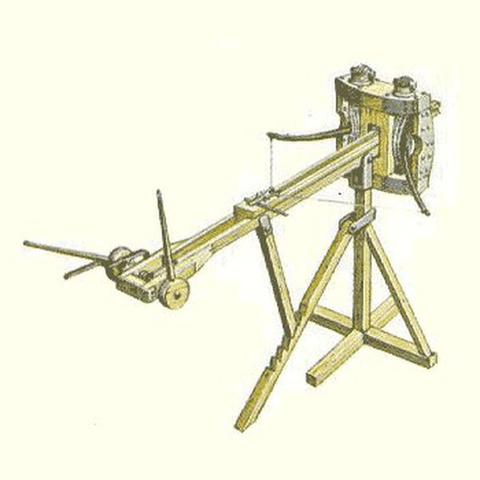

 Devriese
 Rüdiger Benninghaus
 Rüdiger Benninghaus