#PlasticPatrol: the #CitizenScientists tackling #litter in #Australian #waterways

#Plastics make up the majority of litter across the country. In the absence of regulation, the public are taking matters into their own hands

by James Norman, Fri 30 Jan 2026

"Neil Blake weighs a paper bag of fake grass fragments he has collected from a stormwater gutter near #DarebinCreek in #Melbourne’s north.

"Over the past three years Blake has conducted 56 collections of synthetic turf in the waterway alongside the KP Hardiman Reserve hockey pitch.

" 'I noticed that a local hockey pitch was being replaced and the plastic surface was running off into the local environment,' he says. Strong northerly winds and #LeafBlowers had helped shed the turf fragments into the local #environment.

"In addition to impacts on #AquaticEcosystems, scientific analysis suggests #PlasticPollution is exacerbating #ClimateChange, #biodiversity loss and #OceanAcidification.

"Australians produce more than 3m tonnes of plastic waste each year, and according to Clean Up’s annual survey of parks, beaches, creeks and other public spaces, plastics make up more than 80% of litter across the country. A review by the New South Wales chief scientist found that one #SyntheticTurf field could transport between 10kg and 100kg of plastic fragments into the #stormwater system or local waterways.

"Blake has taken advantage of the electronic scales provided by the newly opened community science laboratory in the Port Phillip #EcoCentre in #StKilda, to quantify his samples to present to the local council and the Environment Protection Authority. The lab hosts facilities including microscopes, measuring equipment, safety gear and access to advice from trained scientists.

"It’s one example of citizen scientists tackling the growing problem of plastics in #waterways, including #beaches, #rivers and dive sites around the country."

Read more:
https://www.theguardian.com/australia-news/2026/jan/31/australia-litter-picking-beaches-waterways-plastic-pollution

Archived version:
https://archive.ph/okVtk

#SolarPunkSunday #LitterCleanup #NewSouthWales #Australia #PlasticTurf #PlasticPollution #CitizenScience #WaterIsLife #Astroturf #PlasticPollution #Microplastics


Plastic patrol: the citizen scientists tackling litter in Australian waterways

Plastics make up the majority of litter across the country. In the absence of regulation, the public are taking matters into their own hands

The Guardian

In this year’s #PlanetaryHealthCheck (https://www.pik-potsdam.de/en/news/latest-news/seven-of-nine-planetary-boundaries-now-breached-2013-ocean-acidification-joins-the-danger-zone), the #OceanAcidification boundary has been assessed as breached for the first time. What does this mean? Nice explanatory piece in “Dialogue Earth”, with input from PIK researcher Levke Caesar.

https://dialogue.earth/en/ocean/explainer-the-latest-science-on-ocean-acidification/

Seven of nine planetary boundaries now breached – ocean acidification joins the danger zone

24.09.2025 - A new report from the Planetary Boundaries Science Lab at the Potsdam Institute for Climate Impact Research (PIK) reveals that 7 of the 9 critical Earth system boundaries have now been breached, one more than last year.

Potsdam Institute for Climate Impact Research

We often discuss the threat of #OceanAcidification (and #Climate Change ) on shallow reefs, but it does not spare deep reefs. As the #ocean acidifies, the aragonite saturation horizon shallows, and with it the zone many #reef builders can inhabit.

Link: https://agupubs.onlinelibrary.wiley.com/doi/10.1029/2024JC021750

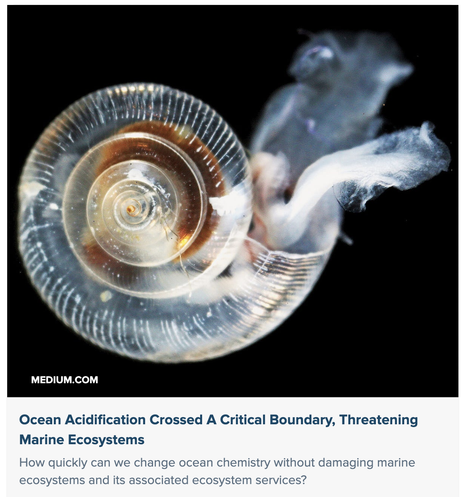
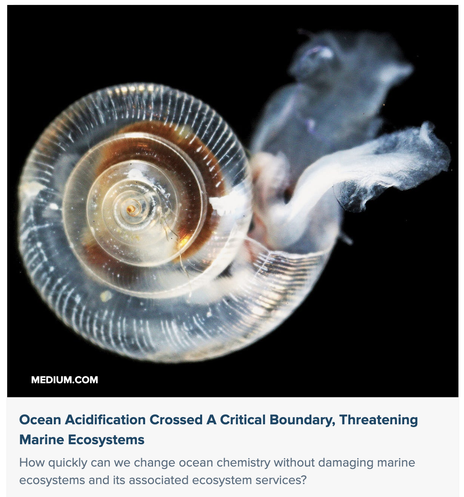
Ocean Acidification Crossed A Critical Boundary, Threatening Marine Ecosystems

"How quickly can we change ocean chemistry without damaging marine ecosystems and its associated ecosystem services?"

#SciComm by @GrrlScientist

#CriticalBoundary #Ocean #OceanAcidification #marine #MarineBiology #Ecosystem https://medium.com/grrlscientist/ocean-acidification-crossed-a-critical-boundary-threatening-marine-ecosystems-ad8463cd3350

Ocean Acidification Crossed A Critical Boundary, Threatening Marine Ecosystems

"How quickly can we change ocean chemistry without damaging marine ecosystems and its associated ecosystem services?"

#SciComm by @grrlscientist

#CriticalBoundary #Ocean #OceanAcidification #marine #MarineBiology #Ecosystem https://medium.com/grrlscientist/ocean-acidification-crossed-a-critical-boundary-threatening-marine-ecosystems-ad8463cd3350

Ocean Acidification Crossed A Critical Boundary, Threatening Marine Ecosystems

"How quickly can we change ocean chemistry without damaging marine ecosystems and its associated ecosystem services?"

#SciComm by @GrrlScientist

#CriticalBoundary #Ocean #OceanAcidification #marine #MarineBiology #Ecosystem #conservation https://medium.com/grrlscientist/ocean-acidification-crossed-a-critical-boundary-threatening-marine-ecosystems-ad8463cd3350

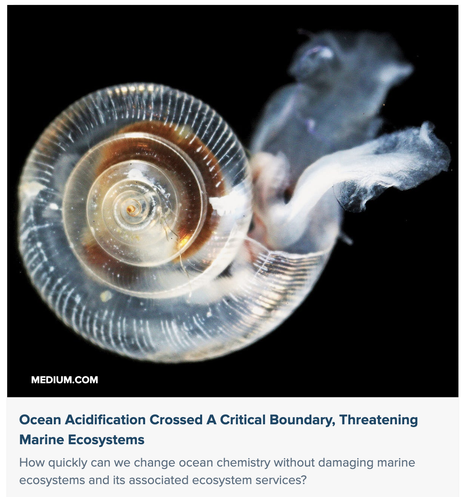
Ocean Acidification Crossed A Critical Boundary, Threatening Marine Ecosystems

"How quickly can we change ocean chemistry without damaging marine ecosystems and its associated ecosystem services?"

#SciComm by @grrlscientist

#CriticalBoundary #Ocean #OceanAcidification #marine #MarineBiology #Ecosystem #conservation https://medium.com/grrlscientist/ocean-acidification-crossed-a-critical-boundary-threatening-marine-ecosystems-ad8463cd3350

The Planetary Health check has now diagnosed ocean acidification to be outside the safe operating space:
https://www.planetaryhealthcheck.org
PIK press release:
https://www.pik-potsdam.de/en/news/latest-news/seven-of-nine-planetary-boundaries-now-breached-2013-ocean-acidification-joins-the-danger-zone

Short article quotes one of the researchers, Levke Caesar, with "I am afraid. This really scares me." https://www.theguardian.com/environment/2025/sep/24/worlds-oceans-fail-key-health-check-as-acidity-crosses-critical-threshold-for-marine-life

I have questions.
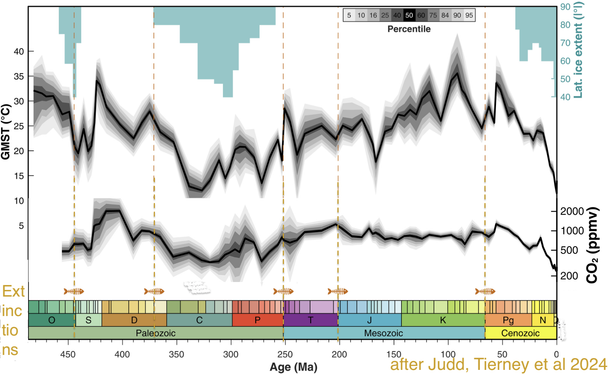
For all of the previous 200 million years, CO2 was at a stable 1000ppm. Far higher than our goal-apparent of 600ppm, see picture of temperature and CO2 evolution after Judd, Tierney et al 2024 https://www.science.org/doi/abs/10.1126/science.adk3705

If those little snails from the PIK press release are already negatively affected from today's 430ppm, does that mean, their DNA only evolved during the last 2-3 million years, and rather suddenly, once CO2 dropped below this magical threshold?

Note also how CO2=ocean acidification never caused an extinction, only temperature did.
Surely, if the dying of the little critters were a precursor for an impending marine extinction event, it would have happened before? From 350 to 300 million years ago for example. Ample time for low-acidity-DNA like snails to evolve, and go extinct again when CO2 rose.

Whales have been around for 54mio years, in very high-CO2 times as well. What did they eat if snails weren't on the menu [of their prey]?
What did sharks eat at 1000ppm? They are truly old beings, 350 million years and more.
#PlanetaryBoundaries #climateChange #OceanAcidification #marinelife

1-Oct-2025
#Corals might be adapting to #climateChange
((but probably not fast enough I would suspect?))
specifically this is about #oceanAcidification

https://www.eurekalert.org/news-releases/1100489

#science #ClimateCatastrophe #environment #ecology #MarineBiology

Corals might be adapting to climate change

A new study of corals up to 200 years old suggests that the organisms are showing signs of resilience to the impacts of an increasingly acidic ocean.

EurekAlert!