
New Laser Camera Can See an Entire Room Through a Tiny Keyhole

Researchers from Stanford University's Computational Imaging Lab have developed a novel method of non-line-of-sight imaging. They call it keyhole imaging because the contents of a room can be captured from a single point as small as a keyhole.

Non-line-of-sight (NLOS) imaging as a concept isn't new and has been used to image objects in a closed room from a single point source for some time now. NLOS systems were designed to see around objects by bouncing a laser off a surface, off surrounding objects, and then back to the origin point.

"Existing NLOS approaches require the imaging system to scan a large area on a visible surface, where the indirect light paths of hidden objects are sampled," Stanford's researchers explain. "In many applications, such as robotic vision or autonomous driving, optical access to a large scanning area may not be available, which severely limits the practicality of existing NLOS techniques."

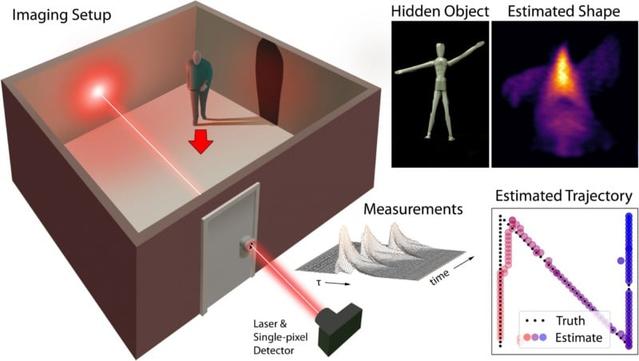
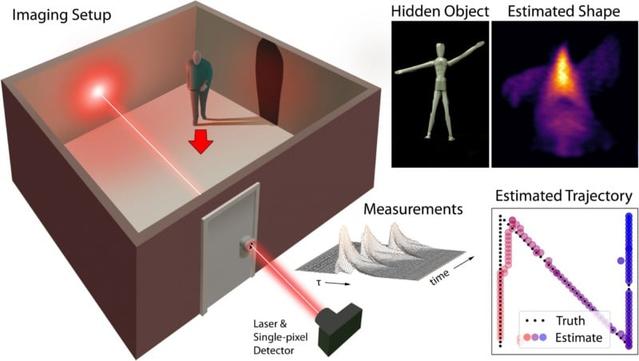
Keyhole imaging: A time-resolved detector and pulsed laser illuminate and image a point visible through a keyhole (left). As a hidden person moves, the detector captures a series of time-resolved measurements of the indirectly scattered light (center). From these measurements, we reconstruct both hidden object shape (e.g., for a hidden mannequin) and the time-resolved trajectory (right).

As InceptiveMind explains, there is one major downside to this method: the requirement for a large reflective surface inside the target area.

Stanford's researchers tried a different approach to solve this problem. Dubbing it "keyhole imaging," the method can capture a series of measurements along a tiny optical path in order to image a space on the other end. That path can be very small: even as tiny as a keyhole, hence the name.

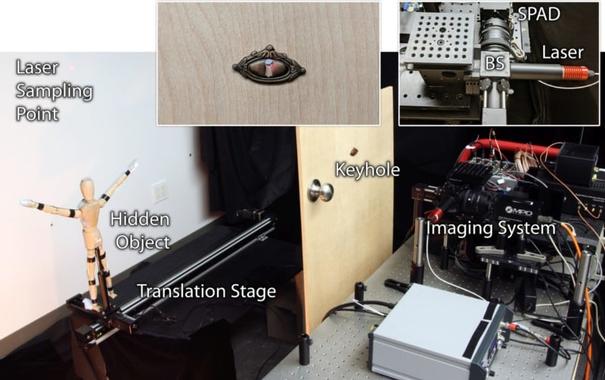
Experimental setup: Stanford's researchers' optical system sends a laser pulse through the keyhole of a closed door. On the other side of the door, the hidden object moves along a translation stage. When third-bounce photons return, they are recorded and time-stamped by a SPAD. Top-right inset: A beam splitter (BS) is used to place the laser and SPAD in a confocal configuration.

"Assuming that the hidden object of interest moves during the acquisition time, we effectively capture a series of time-resolved projections of the object’s shape from unknown viewpoints," the Stanford researchers explain.

"We derive inverse methods based on expectation-maximization to recover the object’s shape and location using these measurements. Then, with the help of long exposure times and retroreflective tape, we demonstrate successful experimental results with a prototype keyhole imaging system."

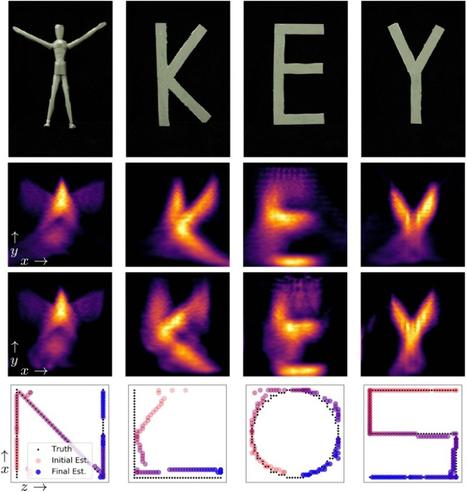
This new method solves the issues the researchers sought out to address but isn't without downsides. It results in significantly worse image quality than previous NLOS methods. In the image below, the objects that are imaged are shown to be murky, blurry outlines of their original forms.

Experimental results: First row: Images of the hidden objects. Second row: Reconstructions of the hidden objects using GD when their trajectories are known. Third row: EM reconstructions of the hidden objects when their trajectories are unknown. Fourth row: EM estimates of the trajectories of the hidden objects, each of which follows a different trajectory, where the dot color indicates position over time.

Despite this, the researchers argue that it still provides enough detail to make educated guesses on the shape of the hidden object, especially when using artificial intelligence recognition systems. The team believes this technology could be used by the military, for example, to determine the risks of entering a space before breaching.

The full research documentation can be read on Computational Imaging.

#news #technology #keyhole #keyholeimaging #laser #lasercamera #nlos #nonlineofsight #research #science #stanford
Scientists Invent a Camera That Can See Through or Around Anything

Researchers from Northwestern's Engineering department have invented a new high-resolution camera that can see around corners and through objects -- even skin, fog, or a human skull.

The process is called synthetic wavelength holography, and it's a new method that works by indirectly scattering light onto hidden objects, which then scatters again and travels back to the camera. An algorithm then reconstructs that scattered light signal in a way that reveals hidden objects. The team says that due to its high temporal resolution, the method also could potentially see fast-moving objects like cars speeding around corners or the human heart beating through a chest.

The idea of photographing or visualizing a subject around a corner versus seeing an organ inside a human body may sound like completely different challenges that would require different solutions, but the team says that they are actually closely related, since both deal with scattering media in which light hits an object and scatters in a manner that a direct image of the object can no longer be seen.

Synthetic wavelength holography is part of a new field of research called non-line-of-sight (NLoS) imaging. The method developed by the Northwestern researchers can rapidly photograph full-field images of large areas with what they describe as submillimeter precision.

"With this level of resolution, the computational camera could potentially image through the skin to see even the tiniest capillaries at work," Northwestern's Amanda Morris writes.

While the team says that the obvious use cases for the technology exist in medical imaging, they also argue that it could be used as an early-warning tool in car navigation systems or industrial inspection in small spaces. The team says that possible applications are "endless."

The SWH approach combines four key attributes highlighted in the following potential future NLoS application scenarios: in each example, a scattering surface or medium is used to indirectly illuminate, and intercept light scattered by the hidden objects. a) A small probing area allows to inspect defects in tightly confined spaces, e.g., in running aircraft engines. b) A wide angular FoV allows to measure/detect hidden objects without previous knowledge of their position as, e.g., important when navigating in degraded visual environments. c) High spatial resolution allows for the measurement of small structures, such as non-invasive imaging of brain vessels through the skull. d) High temporal resolution allows to image objects in motion, e.g., to discern cardiac arrhythmia through the chest. The integration of these attributes in a single approach to NLoS imaging distinguishes SWH from the current state of the art.

“Our technology will usher in a new wave of imaging capabilities,” says Florian Willomitzer from the McCormick School of Engineering and the first author of the study.

“Our current sensor prototypes use visible or infrared light, but the principle is universal and could be extended to other wavelengths. For example, the same method could be applied to radio waves for space exploration or underwater acoustic imaging. It can be applied to many areas, and we have only scratched the surface.”

A detailed breakdown of how the team designed and built the camera can be found on Northwestern University's website as well as on the full research paper published on Nature.

Image credits: Header image via Northwestern University, by Florian Willomitzer/Northwestern University

#news #technology #camera #engineering #nature #newcamera #newtechnology #nlos #nonlineofsight #northwesternuniversity #science #syntheticwavelengthholography

Scientists Invent a Camera That Can See Through or Around Anything

The researchers say the applications of the tech are endless.

PetaPixel
Forscher der kalifornischen Stanford Universität haben ein Laser-System entwickelt, das um die Ecke gucken und verdeckte Objekte rekonstruierten kann. Noch arbeitet die Hardware zu langsam, um sie in autonomen Autos einsetzen zu können. https://www.heise.de/newsticker/meldung/Autonome-Autos-Laser-System-und-Algorithmen-helfen-verdeckte-Objekte-zu-erkennen-3987149.html #LIDAR #Lasercutter #NLOS #Objekterkennung #autonomesFahren
Autonome Autos: Laser-System und Algorithmen helfen verdeckte Objekte zu erkennen

Forscher der kalifornischen Stanford Universität haben ein Laser-System entwickelt, das um die Ecke gucken und verdeckte Objekte rekonstruierten kann. Noch arbeitet die Hardware zu langsam, um sie in autonomen Autos einsetzen zu können.