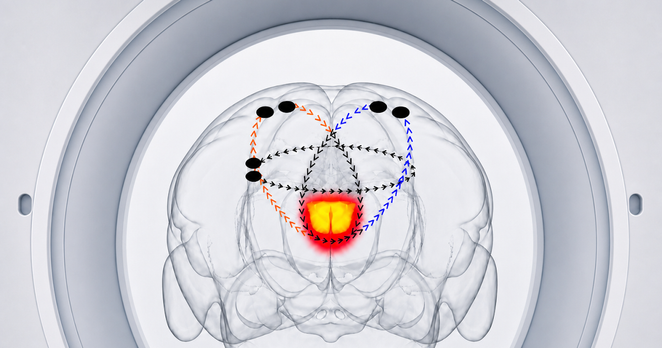
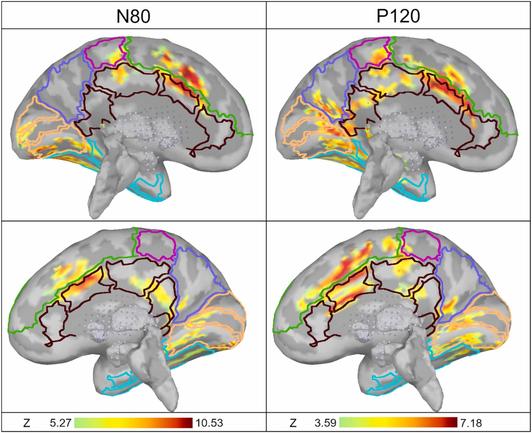
🧠 What if we could watch the brain’s real-time reaction to deep brain stimulation?

🔗 A method for analyzing the ERP associated with high frequency ANT DBS offset. Computational and Structural Biotechnology Journal, DOI: https://doi.org/10.1016/j.csbj.2025.09.042

📚 CSBJ Smart Hospital: https://www.csbj.org/smarthospital

#Neuroscience #DBS #EpilepsyResearch #EEG #BrainMapping #Neurotechnology #DeepBrainStimulation #Neuroengineering

Postdoc position in ultrasound neuromodulation at UCSF

Post a job in 3min, or find thousands of job offers like this one at jobRxiv!

jobRxiv

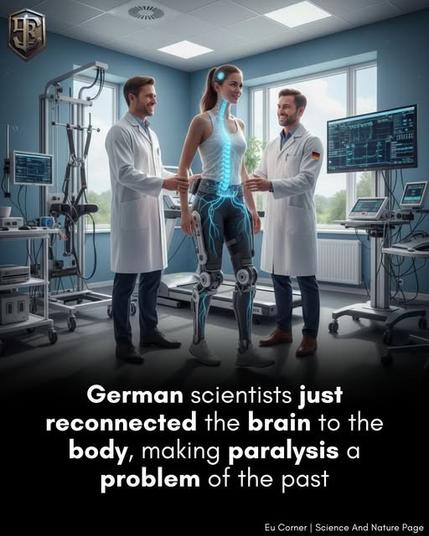
Germany builds brain-computer implant that lets paralyzed patients walk again
In Germany, neuroscientists at Charité University Hospital have successfully tested a brain-computer implant that restores mobility in patients with paralysis. The system bypasses damaged spinal connections by reading brain signals directly and transmitting them to implanted stimulators in the spinal cord.

Unlike older systems requiring bulky external computers, this new implant is fully wireless, implanted beneath the skull, and powered inductively. It translates a patient’s intent to move into electrical pulses, which are then delivered to the spinal cord, reactivating dormant neural pathways.

In initial clinical trials, patients who had lost movement due to spinal cord injury were able to stand, take steps, and even climb small stairs. This marks one of the first instances where brain-controlled walking is restored with natural fluidity, not just rigid robotic stepping.

The technology combines machine learning with neurobiology — the implant learns the user’s neural patterns, becoming more accurate the longer it’s used. Over time, the system strengthens natural neural reconnections, meaning patients may eventually recover partial mobility even without the implant.

This breakthrough represents hope for millions of spinal injury patients. While still experimental, it paves the way toward commercial devices that could be implanted within a decade.
For the first time, paralyzed individuals are not just dreaming of walking again — they are doing it with their own brain signals.

Neuroscience & Brain–Computer Interfaces
#BrainComputerInterface #BCI #Neurotech #Neuroscience #NeuroEngineering #BrainImplant #Neuroprosthetics #Neurotechnology #BrainMachineInterface

Spinal Injury & Mobility
#ParalysisRecovery #SpinalCordInjury #SCI #NeuroRehab #MobilityRestored #WalkAgain #SpinalRepair #NeuroRehabilitation #ParalyzedNoMore

Postdoc position in ultrasound neuromodulation at UCSF

Post a job in 3min, or find thousands of job offers like this one at jobRxiv!

jobRxiv

Zoomposium with Martin Bogdan: “When AI gets bored – paths to (artificial) consciousness”

What if a machine felt boredom?
And: How close are we to the vision of the digital self?

Prof. Martin Bogdan talks about brain-computer interfaces, artificial consciousness, spiking neural networks – and why boredom, of all things, could be a possible indicator of true intelligence.

What can AI teach us about consciousness?
And how do we assess risks when machines suddenly feel more than we would like?

💡 Listen now, think along, join the discussion at: https://open.spotify.com/episode/1R0JGTcinO22LKn9x7UvmK?si=6kgnZ_eoQISBKiJLZtRuig

or 📖 reading: https://philosophies.de/index.php/2025/05/30/wenn-sich-ki-langweilt/

#Zoomposium #MartinBogdan #ArtificialIntelligence #ArtificialConsciousness #BrainComputerInterface #NeuromorphicInformationProcessing #DigitalImmortality #Singularity #BoredomInAI #Transhumanism #SpikingNeuralNetworks #Neuroengineering #ConsciousnessResearch

Zoomposium mit Martin Bogdan: "Wenn KI sich langweilt – Wege zum (künstlichen) Bewusstsein"

Was wäre, wenn eine Maschine Langeweile empfindet?
Und: Wie nah sind wir der Vision vom digitalen Ich?

Prof. Martin Bogdan spricht über Brain-Computer-Interfaces, künstliches Bewusstsein, spikende neuronale Netze – und warum ausgerechnet Langeweile ein möglicher Indikator für echte Intelligenz sein könnte.

Was kann KI über Bewusstsein lehren?
Und wie bewerten wir Risiken, wenn Maschinen plötzlich mehr fühlen, als uns lieb ist?

💡 Jetzt reinhören, mitdenken, mitdiskutieren auf: https://open.spotify.com/episode/1R0JGTcinO22LKn9x7UvmK?si=6kgnZ_eoQISBKiJLZtRuig

oder 📖 lesen: https://philosophies.de/index.php/2025/05/30/wenn-sich-ki-langweilt/

#Zoomposium #MartinBogdan #KünstlicheIntelligenz #KünstlichesBewusstsein #BrainComputerInterface #NeuromorpheInformationsverarbeitung #DigitaleUnsterblichkeit #Singularität #BoredomInAI #Transhumanismus #SpikingNeuralNetworks #Neuroengineering #Bewusstseinsforschung

Postdoc position in ultrasound neuromodulation at UCSF

Post a job in 3min, or find thousands of job offers like this one at jobRxiv!

jobRxiv

PTSD flashbacks stopped with a neural implant that detects trauma before it starts. Welcome to the future of healing. #Neuroengineering #PTSDRelief #BrainTech

https://geekoo.news/rewiring-the-brain-to-heal-invisible-wounds/

Rewiring the Brain to Heal Invisible Wounds | Geekoo

Duke researchers are stopping PTSD flashbacks before they begin—using a brain implant that detects trauma signals in real time.

Geekoo
Durchbruch bei Gehirn-Computer-Schnittstellen: Ein einziges Implantat im Sprachzentrum reicht für Sprache und Maussteuerung. Patient mit Lähmung erreicht 93% Trefferquote bei Mausklicks. #Neuroengineering https://winfuture.de/news,150729.html?utm_source=Mastodon&utm_medium=ManualStatus&utm_campaign=SocialMedia
Gedankenklicks: Neue Gehirn-Computer-Schnittstelle setzt anders an

Ein neues Gehirn-Computer-System zeigt: Was bisher zwei Implantate brauchte, gelingt jetzt mit nur einem. Bewegungssignale werden direkt im Sprachzentrum abgegriffen - und ein Patient mit ALS steuert damit per Gedanken seinen Computer.

WinFuture.de

🧠🪰 Researchers at EPFL’s Neuroengineering Laboratory, led by Pavan Ramdya, aim to replicate the workings of the brain of the common fruit fly, Drosophila melanogaster. We spoke with Ramdya about the exciting prospects for robotics.

#Neuroengineering #Robotics #BrainResearch

Read more: https://go.epfl.ch/t3L-en

“Fruit flies are a major source of inspiration in robotics”

Researchers at EPFL’s Neuroengineering Laboratory, led by Pavan Ramdya, aim to replicate the workings of the brain of the common fruit fly, Drosophila melanogaster. We spoke with Ramdya about the exciting prospects for robotics.