Happy Space Science Saturday! Did you know that molecular clouds are the cold, dense birthplaces of stars?
The stunning region seen in this image, the Rho Ophiuchi molecular cloud, lies just a few hundred light-years away and gives us insight into how stars, including our Sun, form.
#MolecularCloud #RhoOphiuchi #SpaceScienceSaturday #YorkUObservatory #Astronomer #Telescope #AICO #Physics #Astronomy #AllanICarswellObservatory #Science #SpaceExploration #Research #ScienceOutreach
The Molecular Inventory of TMC-1 with GOTHAM Observations: https://iopscience.iop.org/article/10.3847/1538-4365/ae04e5 -> Astronomers Share Largest Molecular Survey To-date: GOTHAM Legacy Data Goes Public: https://greenbankobservatory.org/front-page-news/astronomers-share-largest-molecular-survey-to-date-gotham-legacy-data-goes-public/ - after 1,400+ hours on the NSF Green Bank Telescope, scientists unveil the largest, most sensitive dataset of molecules from deep space’s TMC-1 cloud. #MolecularCloud
Radware Bot Manager Captcha

Les astronomes du NRAO ne s’attendaient pas à découvrir ce nuage moléculaire géant | National Geographic

Giant Glowing Structure Near Solar System Stuns Astronomers

A giant glowing object has been discovered near the Solar System, and its mysterious nature could change everything we know about space.
Eos may be one of the closest molecular clouds to the Solar System, but it is also one of the largest and most active. As such, it offers a rare opportunity to study star formation in a detailed and precise way. The cloud’s proximity means that scientists can observe the molecular hydrogen in great detail, potentially unlocking secrets about how stars are born, and how planets form in the surrounding material.

#universe #starformation #Eos #molecularcloud

https://dailygalaxy.com/2025/04/giant-glowing-structure-near-solar-system/

Giant Glowing Structure Near Solar System Stuns Astronomers

A giant glowing object has been discovered near the Solar System, and its mysterious nature could change everything we know about space.

The Daily Galaxy - Great Discoveries Channel
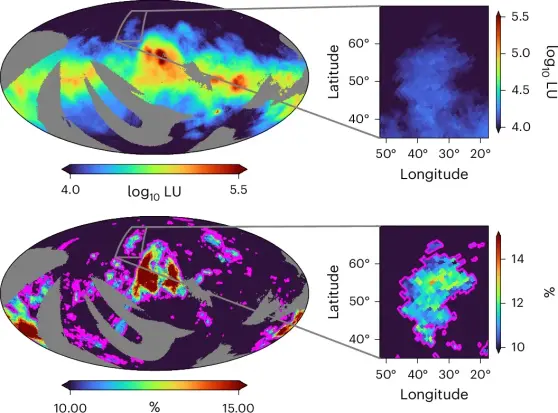
A nearby dark molecular cloud in the Local Bubble revealed via H2 fluorescence: https://www.nature.com/articles/s41550-025-02541-7 -> "We report the discovery of Eos, a dark #MolecularCloud located just 94 pc from the Sun. This cloud is identified using H2 far-ultraviolet fluorescent line emission, which traces molecular gas at the boundary layers of star-forming and supernova remnant regions. The cloud edge is outlined along the high-latitude side of the North Polar Spur, a prominent X-ray/radio structure."
A nearby dark molecular cloud in the Local Bubble revealed via H2 fluorescence - Nature Astronomy

Eos is a newly discovered molecular cloud sitting just 94 pc from the Sun. It was detected through the far-UV emission of its molecular hydrogen, having been missed in conventional molecular gas surveys due to a low abundance of common gas tracers.

Nature
APOD: 2025 January 25 - Stardust in the Perseus Molecular Cloud

A different astronomy and space science related image is featured each day, along with a brief explanation.

LBN 438, LRVB

LBN 438 is a not very often imaged molecular cloud.

Dates: 9 – 16 Aug 2024

Frames:
Baader Blue (B-CCD) 50 mm: 59×180″(2h 57′)
Baader Green (G-CCD) 50 mm: 65×180″(3h 15′)
Baader Red (R-CCD) 50 mm: 60×180″(3h)
Baader UV/IR CUT Luminance (CMOS Optimized) 50 mm: 144×180″(7h 12′)

Integration: 16h 24′

https://astrophotoni.st/2024/08/lbn-438-lrvb/

#Photography #Astronomy #AstroPhotography #Nebula #MolecularCloud
LBN 438, LRVB – astrophotoni.st

APOD: 2024 May 27 - Chamaeleon I Molecular Cloud

A different astronomy and space science related image is featured each day, along with a brief explanation.

I don't talk about astronomy nearly enough, so let's change that!

One of the most groundbreaking developments in astronomy has been the absolutely mind-blowing work the James Webb Space Telescope has been putting out in a fraction of the time it took the old Hubble Space Telescope to produce similar work. Here are a couple of recent images I find particularly remarkable.

S1 LMC N79 – Dorado

Honestly, this image is just beautiful to look at. It’s even more breathtaking when you consider that this is just one cloud within this star-forming region of the Large Magellanic Cloud, which itself is an irregular galaxy located about 163,000 light-years from Earth. If you live in the Southern Hemisphere and find yourself a suitably dark place, you can gaze up and see this whole other galaxy as a milky blotch in the night sky.

You can read more about this image here.

A gravitationally lensed supernova in MRG-M0138 – Cetus

It's pretty wild seeing the immense force of gravity contained within these galactic clusters warp distant points of light in these visually striking ways. Each arc is a galaxy far beyond the cluster itself that allow us to peer further back in time. Sometimes these warped images mirror themselves on the complete opposite side of the cluster, like ripples on a pond. In the case of this distant supernova, the light emanating from that cataclysmic event is being reflected in such a way that it's reappearing further down the length of the arc, making it seem as though there are two supernovae happening when in fact they are the same.

You can read more about this image here.

#astronomy #jameswebbspacetelescope #starcluster #stellarnursery #molecularcloud #largemagellaniccloud #supernova #gravitationallensing #galaxies
A massive cluster is born

A massive cluster is born

www.esawebb.org