new research paper: Simple, Fast and Convenient Magnetic Bead-Based Sample Preparation for Detecting Viruses via
#Raman-
#Spectroscopy https://mdpi.com/2319544 #mdpibiosensors via @Biosensors_MDPI
#diagnostics #Forschungscampus
Simple, Fast and Convenient Magnetic Bead-Based Sample Preparation for Detecting Viruses via Raman-Spectroscopy
We introduce a magnetic bead-based sample preparation scheme for enabling the Raman spectroscopic differentiation of severe acute respiratory syndrome coronavirus type 2 (SARS-CoV-2)-positive and -negative samples. The beads were functionalized with the angiotensin-converting enzyme 2 (ACE2) receptor protein, which is used as a recognition element to selectively enrich SARS-CoV-2 on the surface of the magnetic beads. The subsequent Raman measurements directly enable discriminating SARS-CoV-2-positive and -negative samples. The proposed approach is also applicable for other virus species when the specific recognition element is exchanged. A series of Raman spectra were measured on three types of samples, namely SARS-CoV-2, Influenza A H1N1 virus and a negative control. For each sample type, eight independent replicates were considered. All of the spectra are dominated by the magnetic bead substrate and no obvious differences between the sample types are apparent. In order to address the subtle differences in the spectra, we calculated different correlation coefficients, namely the Pearson coefficient and the Normalized cross correlation coefficient. By comparing the correlation with the negative control, differentiating between SARS-CoV-2 and Influenza A virus is possible. This study provides a first step towards the detection and potential classification of different viruses with the use of conventional Raman spectroscopy.
In the future, #wearables will take over the monitoring of body functions as well as record clinical symptoms. These parameters include #heartRate and variability, #bodyTemperature, #bloodOxygen levels, #respirationRate and the concentration of metabolites such as #glucose. Thus, health management of one's body becomes possible, as well as monitoring of endogenous infections. A new review on the topic has been published in #mdpiBiosensors.
https://doi.org/10.3390/bios13010062
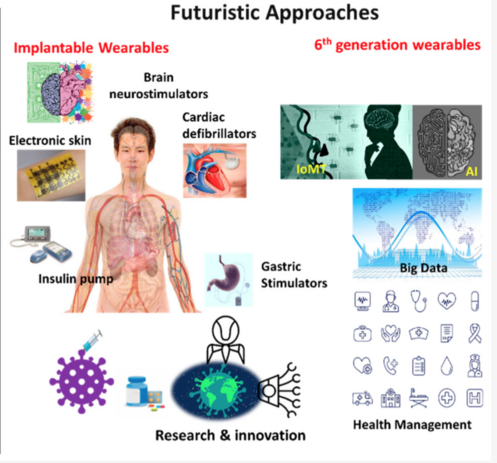

Role of Wearable Sensing Technology to Manage Long COVID
Long COVID consequences have changed the perception towards disease management, and it is moving towards personal healthcare monitoring. In this regard, wearable devices have revolutionized the personal healthcare sector to track and monitor physiological parameters of the human body continuously. This would be largely beneficial for early detection (asymptomatic and pre-symptomatic cases of COVID-19), live patient conditions, and long COVID monitoring (COVID recovered patients and healthy individuals) for better COVID-19 management. There are multitude of wearable devices that can observe various human body parameters for remotely monitoring patients and self-monitoring mode for individuals. Smart watches, smart tattoos, rings, smart facemasks, nano-patches, etc., have emerged as the monitoring devices for key physiological parameters, such as body temperature, respiration rate, heart rate, oxygen level, etc. This review includes long COVID challenges for frequent monitoring of biometrics and its possible solution with wearable device technologies for diagnosis and post-therapy of diseases.
Zukünftig werden #Wearables die Überwachungen von Körperfunktionen übernehmen sowie klinische Symptome erfassen. Zu diesen Parametern zählen #Herzfrequenz und Variabilität, #Körpertemperatur, #Sauerstoffgehalt des Blutes, #Respirationsrate und die Konzentration von Metaboliten wie #Glukose. Somit wird ein Gesundheitsmanagement des eigenen Körpers möglich, wie auch ein Monitoring von körpereigenen Infektionen. Ein neues Review dazu wurde veröffentlicht in #mdpiBiosensors.
https://doi.org/10.3390/bios13010062
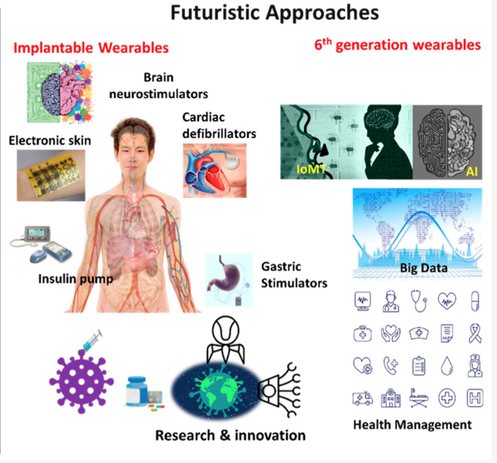
Role of Wearable Sensing Technology to Manage Long COVID
Long COVID consequences have changed the perception towards disease management, and it is moving towards personal healthcare monitoring. In this regard, wearable devices have revolutionized the personal healthcare sector to track and monitor physiological parameters of the human body continuously. This would be largely beneficial for early detection (asymptomatic and pre-symptomatic cases of COVID-19), live patient conditions, and long COVID monitoring (COVID recovered patients and healthy individuals) for better COVID-19 management. There are multitude of wearable devices that can observe various human body parameters for remotely monitoring patients and self-monitoring mode for individuals. Smart watches, smart tattoos, rings, smart facemasks, nano-patches, etc., have emerged as the monitoring devices for key physiological parameters, such as body temperature, respiration rate, heart rate, oxygen level, etc. This review includes long COVID challenges for frequent monitoring of biometrics and its possible solution with wearable device technologies for diagnosis and post-therapy of diseases.
 InfectoGnostics_Campus
 Joint Lab Bioelectronics
 Joint Lab Bioelectronics