 Henri
HenriA Teacher’s 12-year Journey: Marcus Elbel shares how curriculum and ideas from www.mathed.page helped improve his students’ engagement and learning.

Reaching Consensus on curricular and pedagogical matters can improve the effectiveness of a math department and improve student learning. I suggest a pathway in this post.

 foldworks
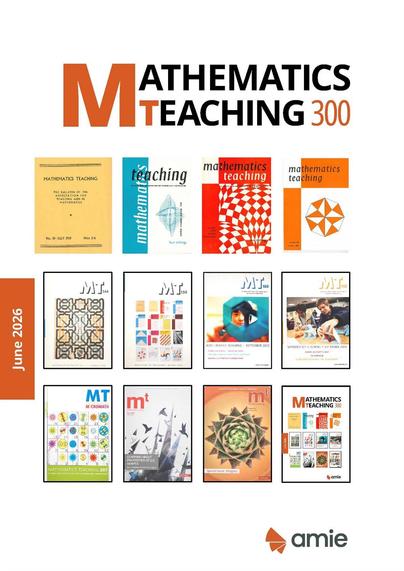
Mathematics Teaching 300 now available online https://atm.org.uk/Mathematics-Teaching-Journal-Archive/177735
A special edition celebrating 300 issues with a self-referential cover, like MT 150 (https://en.wikipedia.org/wiki/Droste_effect)
Design by me
Five free articles for non-members:
Understanding geometry proof what do students say to AI feedback? https://atm.org.uk/write/MediaUploads/Journals/MT300/06.pdf
Yuqian (Linda) Wang and Hanmin Song explore whether personalised AI feedback can support students’ understanding of geometry proof tasks.
An appreciation of Alison Parish (1951–2026) https://atm.org.uk/write/MediaUploads/Journals/MT300/07.pdf
Can pedagogy for problem solving promote equity in the classroom? https://atm.org.uk/write/MediaUploads/Journals/MT300/10.pdf
Laura King reflects on pedagogies to support equity in primary mathematics when teaching problem solving
Number a disinformation timeline https://atm.org.uk/write/MediaUploads/Journals/MT300/16.pdf
Micheál Ó Dúill traces history and cultures to argue for teaching zero to nine instead of one to ten.
If it hadn’t been for Dave… https://atm.org.uk/write/MediaUploads/Journals/MT300/18.pdf
Barbara Binns reflects on Dave Wilson (1947–2026) with contributions from Geoff Faux and Tony Brown.
#MathematicsTeaching #iTeachMath #MathEd #MathsEd #Math #Mathematics #teaching #pedagogy #didactics #education #design #GraphicDesign #AMiE #MT #MT300 #recursion #DrosteEffect #number
 Patrick Honner
Book Review: The Proof in the Code, by Kevin Hartnett
Math is changing, and more change is on the way. Kevin Hartnett's new book "The Proof in the Code" is a great entry point to the world of AI-assisted mathematics, especially for teachers and learners of mathematics.
More here: https://mrhonner.com/archives/21882
An OpenAI model has disproved a longstanding conjecture regarding what's known as the Unit Distance problem. Says Fields Medalist Sir Timothy Gowers: "This will I think be looked back on as the first time that AI solved a major mathematics problem."
https://openai.com/index/model-disproves-discrete-geometry-conjecture/

New issue of my newsletter: thinking classrooms, coaching, functions and rate of change.
https://www.mathed.page/newsletter/2026-05.html
 Catherine Manly
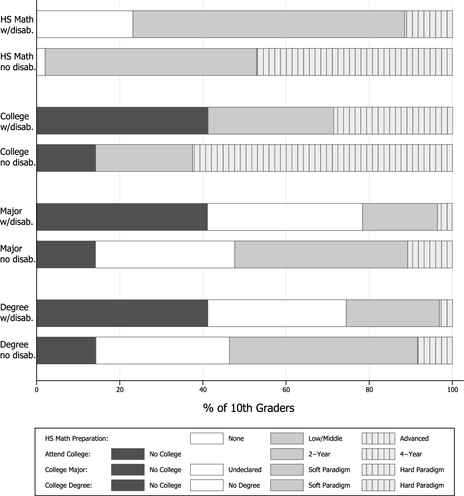
Excited to share my new article investigating the STEM pipeline for students with and without disabilities published open access in Research in Higher Education. High school math taking was a key factor! #StudentswithDisabilities #HigherEd #K12Ed #MathEd
https://link.springer.com/10.1007/s11162-026-09902-9
https://link.springer.com/10.1007/s11162-026-09902-9
Students with Disabilities Pursuing STEM: High School Math Preparation to Postsecondary Degree - Research in Higher Education
This study examines variations between students with and without disabilities as they progress from high school mathematics to a STEM college major and STEM degree. Analyzing data from the Education Longitudinal Study with multinomial logistic regression found 10th graders with disabilities take less advanced high school math than students without disabilities, creating a disparity that persists through college. This places what might otherwise seem equivalent STEM college opportunity into an already unequal context. This disparity underlying the STEM college pipeline means enhancing STEM career access for individuals with disabilities ought to begin in high school or earlier.
Until March 31, 20% off on my book (There Is No One Way to Teach Math). More info:
San Francisco stopped offering Algebra 1 in middle school a decade ago. "The number of students enrolled in advanced high school math declined". Shocking! Now the pendulum swings back.
Of course the high-profile people who supported this will never admit that this was a ridiculous idea to begin with. They'll just say it just wasn't implemented properly. And they'll move on to the next big thing in education.

 Doug Holton
* The Aftermath of DrawEduMath: Vision Language Models Underperform with Struggling Students and Misdiagnose Errors
https://arxiv.org/abs/2603.00925
* Benchmarking the Pedagogical Knowledge of Large Language Models
https://arxiv.org/abs/2506.18710v1
https://www.fab-ai.org/initiatives/ai-for-education/edtech-quality/resources/benchmarks/about-the-pedagogy-benchmark
* AI‑generated lesson plans fall short on inspiring students and promoting critical thinking
https://theconversation.com/ai-generated-lesson-plans-fall-short-on-inspiring-students-and-promoting-critical-thinking-265355
#AIEd #mathed #teaching #education
https://arxiv.org/abs/2603.00925
* Benchmarking the Pedagogical Knowledge of Large Language Models
https://arxiv.org/abs/2506.18710v1
https://www.fab-ai.org/initiatives/ai-for-education/edtech-quality/resources/benchmarks/about-the-pedagogy-benchmark
* AI‑generated lesson plans fall short on inspiring students and promoting critical thinking
https://theconversation.com/ai-generated-lesson-plans-fall-short-on-inspiring-students-and-promoting-critical-thinking-265355
#AIEd #mathed #teaching #education

The Aftermath of DrawEduMath: Vision Language Models Underperform with Struggling Students and Misdiagnose Errors
Effective mathematics education requires identifying and responding to students' mistakes. For AI to support pedagogical applications, models must perform well across different levels of student proficiency. Our work provides an extensive, year-long snapshot of how 11 vision-language models (VLMs) perform on DrawEduMath, a QA benchmark involving real students' handwritten, hand-drawn responses to math problems. We find that models' weaknesses concentrate on a core component of math education: student error. All evaluated VLMs underperform when describing work from students who require more pedagogical help, and across all QA, they struggle the most on questions related to assessing student error. Thus, while VLMs may be optimized to be math problem solving experts, our results suggest that they require alternative development incentives to adequately support educational use cases.