Electronic Lead Screws – Not Just for Threading Anymore

An electronic leadscrew is an increasingly popular project for small and mid-sized lathes. They do away with the need to swap gears in and out to achieve the proper ratio between spindle speed and tool carriage translation, and that makes threading a snap. But well-designed electronic leadscrews, like this one from [Hobby Machinist], offer so much more than just easy threading.

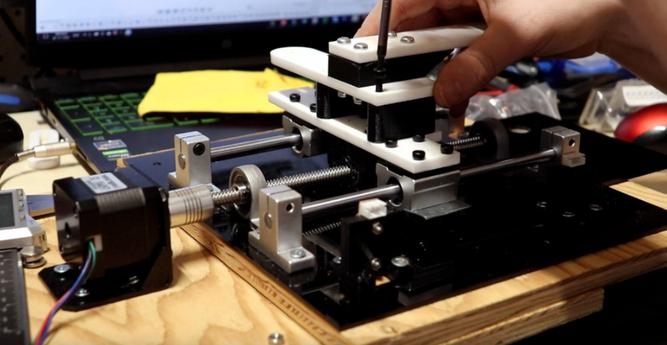
The first thing that struck us about this build was the polished, professional look of it. The enclosure for the Nucleo-64 dev board sports a nice TFT display and an IP65-rated keyboard, as well as a beefy-looking jog wheel. The spindle speed is monitored by a 600 pulses-per-revolution optical encoder, and the lathe's leadscrew is powered by a closed-loop NEMA 24 stepper. This combination allows for the basic threading operations, but the addition of a powered cross slide opens up a ton more functionality. Internal and external tapers are a few keypresses away, as are boring and turning and radius operations, both on the right and on the left. The video below shows radius-cutting operations combined to turn a sphere.

From [Hobby Machinist]'s to-do list, it looks like filleting and grooving will be added someday, as will a G-code parser and controller to make this into a bolt-on CNC controller. Inspiration for the build is said to have come in part from [Clough42]'s electronic leadscrew project from a few years back.

#toolhacks #cnc #electronicleadscrew #els #encoder #lathe #leadscrew #spindle #stepper #threading #turning

Electronic Lead Screws – Not Just For Threading Anymore

An electronic leadscrew is an increasingly popular project for small and mid-sized lathes. They do away with the need to swap gears in and out to achieve the proper ratio between spindle speed and …

Hackaday

Peek Behind the Curtain of this Robotic Mouse

At first glance, this little animatronic mouse might seem like a fairly simple affair. A door opens, our rodent friend pops its head out, looks around, and goes back in. But just like in The Wizard of Oz , a strategically placed curtain is hiding the impressive array of gadgetry that makes the trick possible.

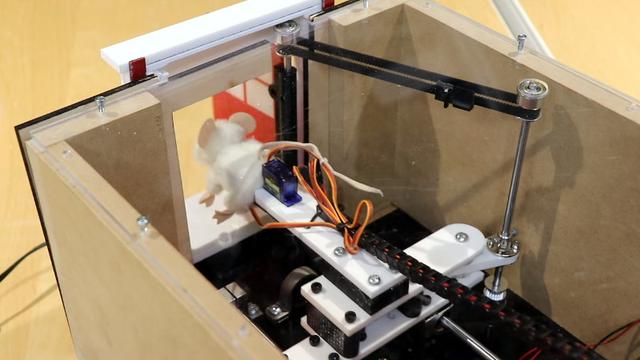
Creator [Will Donaldson] has put together a fantastic write-up of just what went into creating this little fellow, and we think you'll be surprised at just how serious the mechanics involved are. Take for example the rig that provides horizontal motion with a NEMA 17 stepper motor mated to a 200 mm leadscrew and dual 8 mm rail assembly that would like right at home as part of a 3D printer.

The star of the show rides atop a beefy sliding carriage assembly made of printed components and acrylic, which is linked to the door via a GT2 timing belt and pulley in such a way that it automatically opens and closes at the appropriate time. To inject some life into the puppet, [Will] stuffed it with a pair of SG90 servos in a sort of pan-and-tilt arrangement: the rear servo turns the mouse's body left and right, while the forward one moves the head up and down.

An Arduino Uno controls the servos, as well as the stepper motor by way of a TB6600 controller, and optical limit switches are used to make sure nothing moves out bounds. [Will] is keeping the CAD files and source code to himself for the time being, though we imagine a sufficiently dedicated mouseketeer could recreate the installation based on the available information.

This would appear to be the first animatronic mouse to grace the pages of Hackaday, but we're certainly no strangers to seeing folks imbue inanimate objects with lifelike motion.

#robotshacks #animatronic #arduinouno #gt2 #leadscrew #nema17 #puppet #sg90 #tb6600

Peek Behind The Curtain Of This Robotic Mouse

At first glance, this little animatronic mouse might seem like a fairly simple affair. A door opens, our rodent friend pops its head out, looks around, and goes back in. But just like in The Wizard…

Hackaday

Rock-A-Bye Baby, On the Mechatronic Crib Shaker

While an engineering mindset is a valuable tool most of the time, there are some situations where it just seems to be a bad fit. Solving problems within the family unit would seem to be one such area, but then again, this self-rocking mechatronic crib seems to be just the cure for sleepytime woes.

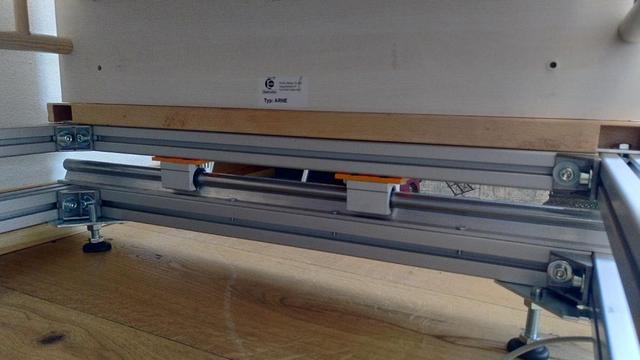
From the look of [Peter]'s creation, this has less of a rocking motion and more of a gentle back-and-forth swaying. Its purpose is plainly evident to anyone who has ever had to rock a child to sleep: putting a little gentle motion into the mix can help settle down a restless infant pretty quickly. Keeping the right rhythm can be a problem, though, as can endurance when a particularly truculent toddler is fighting the urge to sleep. [Peter]'s solution is a frame of aluminum extrusion with some nice linear bearings oriented across the short axis of the crib, which sits atop the whole thing.

A recirculating ball lead screw -- nothing but the best for [Junior] -- and a stepper drive the crib back and forth. [Peter] took care to mechanically isolate the drivetrain from the bed, and with the selection of the drive electronics and power supply, to make sure that noise would be minimal. Although thinking about it, we've been lulled to sleep by the whining steppers of our 3D printer more than once. Or perhaps it was the fumes.

Hats off to [Peter] for a setup that's sure to win back a little of the new parent's most precious and elusive commodity: sleep.

#lifehacks #mischacks #bed #child #crib #infant #leadscrew #mechatronics #parent #recirculatingball #sleep #stepper #toddler

Rock-A-Bye Baby, On The Mechatronic Crib Shaker

While an engineering mindset is a valuable tool most of the time, there are some situations where it just seems to be a bad fit. Solving problems within the family unit would seem to be one such ar…

Hackaday