10 of the Most Expensive Cameras Ever
We all love interesting and perhaps somewhat obscure facts and anyone reading this site has at least a moderate interest in cameras -- and hopefully, their history. Part of that history includes the unique, weird, one-of-a-kind, and (you guessed it) extremely expensive cameras which have, in one way or another, played a role in paving the way to where we are today.
With that said, here are ten of the most expensive cameras ever made. Please keep in mind, this is a list of ten of the most expensive , not the ten most expensive. If we kept strictly to the absolute most expensive, I would not be surprised if 7 or 8 of these 10 were Leicas. So, I have tried to add a bit more diversity by including some other choices -- though do not worry, they are all still very much bank drainers.
Apollo 15 Hasselblad Moon Camera
It is fairly well-known that the cameras used in the Apollo 11 mission -- which landed the first men on the moon on July 20, 1969 -- were Hasseblads. One stayed inside the Eagle, and another was strapped to Neil Armstrong to take photos on the moon’s surface. But neither camera returned to Earth, with the two cameras and the lenses having been left on the moon’s surface.
In 1971, a latter mission known as Apollo 15 sought to obtain an even greater variety and catalog of lunar photographs and therefore used significantly more photographic gear. Three 70mm Hasselblad Data Cameras (one LM1 and two LM2 bodies) were operated by astronauts David Scott, James Irwin, and Alfred Worden. The two LM2 cameras, fitted with 60mm lenses, were fixed to the astronauts’ suits to photograph the moon's surface. The cameras were semi-automatic and battery-powered, so the astronauts could easily fire the shutter via a trigger affixed to the camera’s handle.
The third camera, LM1, was fitted with a high-resolution 500mm lens.
One of the two LM2 cameras (with its lens) sold at auction in 2020 for $910,400.
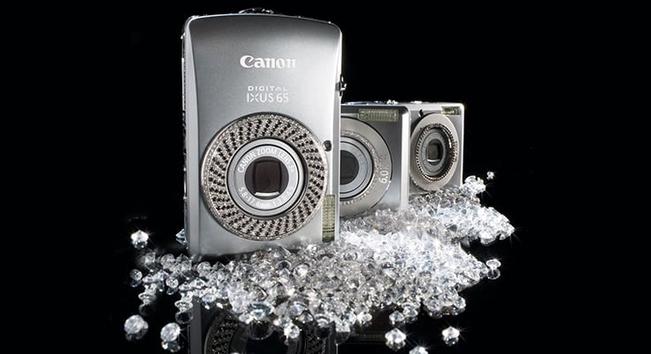
Canon IXUS 65 Diamond Edition
Holding the record for the most expensive Canon digital still camera ever made is 2006’s special edition Canon IXUS 65. Encrusted with 380 diamonds surrounding the lens, the camera itself is really nothing more than a blinged-out Powershot SD640 -- the kind of very tiny, cheap, and basic point-and-shoot digital camera that was extremely popular in the early to late 2000s.
Only ten were ever made, and all of them were auctioned off on eBay for about $40,000 each (equivalent to $54,000 today), making it not only one of the most expensive cameras ever but likely the most expensive digital point-and-shoot of all time.
Canon donated the proceeds to the Red Cross.
Jony Ive & Marc Newson Leica M Prototype
Leica is quite well-known for its limited-edition releases of both cameras and lenses, with some opening to more positive reception than others. Famed industrial design Marc Newson and former Apple Chief Design Officer Jony Ive came together to make this one.
Ive and Newson went through 561 models and nearly 1,000 parts over 85 days until finally settling on the design of the final prototype -- a laser machined aluminum body and anodized aluminum outer shell with almost zero lettering or markings of any kind to be found anywhere on the camera. Nor will you find any red dot, either.
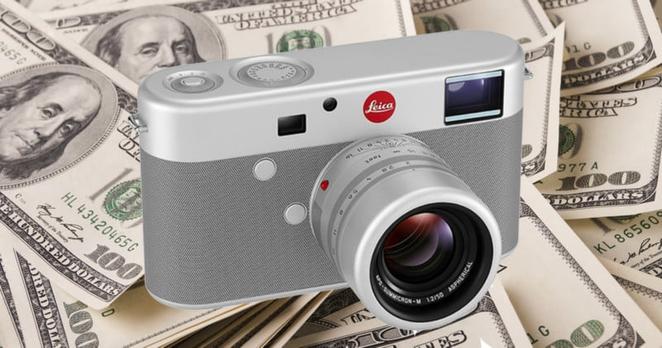
The prototype camera, built around the innards of the 24-megapixel Leica M240, was fitted with a matching APO-Summicron 2/50 ASPH lens and sold at auction for $1.8 million in 2013. The actual limited edition production run sold for much, much less, though still far from pocket-change. (You can see what the final public-release design looked like in the header photo at the top of this article -- it is significantly different than the prototype here)
Louis Daguerre’s Suisse Fréres Daguerreotype
The daguerreotype, invented by Louis Daguerre and introduced to the world in 1839, was the first publicly available photographic process. Arguably, the Daguerreotype represents the beginning of photographic history. Images were exposed on a silver-plated copper sheet that had been treated with fumes to make it light-sensitive. Exposure could vary from a few seconds in the brightest conditions up to several minutes or more, depending on the lighting conditions and artistic intent.
Along with Alphonse Giroux, French company Susse Fréres was granted exclusive rights to produce and sell daguerreotype cameras in 1839.
There is only one known surviving Susse Fréres daguerreotype. Made in 1839, it is also the oldest surviving camera in the world -- but it also fetched quite the price tag at auction.
Its 382mm meniscus achromatic doublet lens (with an effective working aperture of about f/14) was made by optional engineer Charles Chevalier and is only the third lens Chevalier made for a daguerreotype.
Considering not only its one-of-a-kind rarity but also its historical significance, the $740,000 sale in 2007 (equivalent to $940,000 today) does not seem unreasonable. But the best part? The camera had been lost for almost 170 years before being discovered in a dusty attic in Munich, Germany where it then went on to be auctioned.
Leica II Luxus
In 1932, Leica manufactured just four luxury versions of the Leica II -- a 35mm rangefinder camera designed by Oskar Barnack, typically paired with a 50mm f/3.5 Leitz Elmar lens.
The Luxus II featured the same design and functions as the standard Leica II but came adorned with gold-plating and a lizard skin covering. The copy sold at auction even included an original crocodile camera case. The camera had been gifted to a Welsh camera enthusiast after World War II -- he went on to use it for several decades after that. It made its first public appearance in 2001 when the owner brought it onto the BBC series Antiques Roadshow , though it did not go up for auction until 2013, after his death.
It sold for an enormous $620,000 at auction, which was actually significantly under expectations.
It is not known where the other three copies are or if they even still exist.
Leica M3D-2
While the record for the most expensive camera ever sold goes to the next one on this list, this black paint Leica M3D-2 holds the record as the most expensive non-prototype camera.
One of just four cameras that was customized by Leica for American photographer David Douglas Duncan, who most notably worked for Life Magazine, National Geographic, and covered World War II, the Korean War, and Vietnam as a combat photographer. He once even found himself going above and beyond the parameters of his job by fighting in actual combat against the Japanese in World War II.
The M3D-2 was accoutered with a black anodized aluminum 50/1.4 Summilux-M lens with a custom focusing lever. Leica also outfitted the camera with a Leicavit -- a rapid winder affixed to the camera’s underside, commonly used by photojournalists to aid them in fast-paced situations. The four cameras were used most notably for Duncan’s Vietnam work and his photographs of Pablo Picasso and Picasso’s second wife and muse, Jacqueline Roque.
The camera and lens were sold at the 2012 WestLicht auction and fetched a staggering $2.18 million.
Leica 0-Series
Another Leica. Shocker, I know.
Part of a prototype pre-production test run, the Leica O-series consisted of only 25 cameras, created by Ernst Leitz in 1923. Of the original 25, only twelve survive to this day, and only three of those are in original condition.
The O-series served as a prototype series for the Leica Standard, which was released two years later in 1925. Like the Standard, the camera does not have interchangeable lenses and instead sports a fixed 50mm f/3.5 known as the Leitz Anastigmat based on the design of the Cooke Triplet (Leica would later drop “Anastigmat” with the release of the Standard, calling the lens the Leitz Elmar instead).
In 2018, one of these cameras sold at auction for a whopping $2.97 million, breaking its own record from 2012 of $2.79 million. This makes it the most expensive camera ever sold.
LargeSense LS911
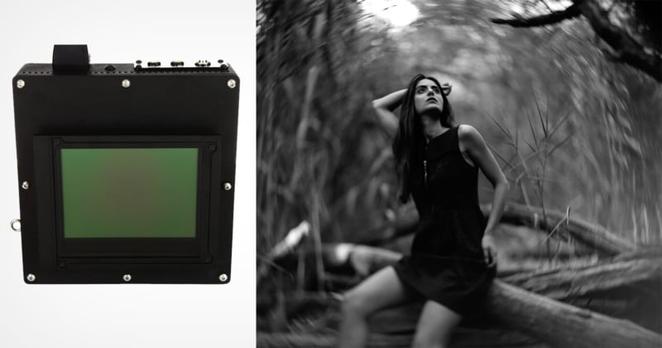
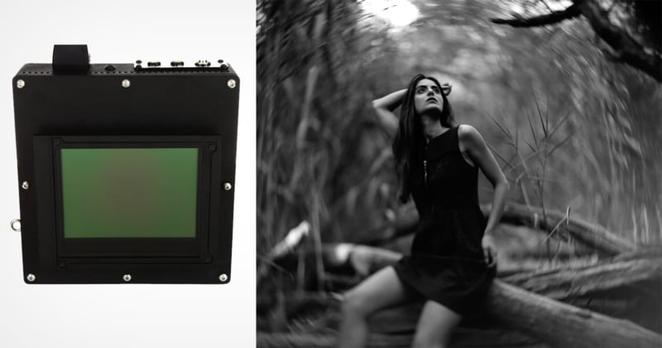
Holding the record for the most expensive camera currently on the market -- aside from even more specialized cameras for industrial, medical, etc. -- is the world’s first large format digital camera, the LargeSense LS911.
We recently covered this camera in a hands-on review and as you might expect from a camera with a sensor that’s even larger than 8×10 film, it isn’t exactly going to fit in your Tenba shoulder bag. I think it might even test the capacity limits of my Toyota Yaris.
The camera sports a 9×11-inch monochrome CMOS sensor (with pixels clocking in at an enormous 75-microns), dual native ISO values of 2100 and 6400, electronic shutter up to 1/30th of a second, 11.9-megapixel resolution, and quite amazingly, 14-bit CinemaDNG RAW video up to 30 frames per second.
Weighing in at forty pounds (without tripod, lens, and other accessories), requiring a 120V power source, and costing $106,000, it is not a camera for everyone, to say the least. But it is certainly one of a kind.
(Gen II is expected to cost less at $85,000)
Phase One XF IQ4 & IQ4 Achromatic
While it’s certainly still a niche product, Phase One’s XF IQ4 medium format camera is the most expensive camera currently on the market among mainstream manufacturers. The Danish company is widely known for its expensive, high-performance medium format digital cameras -- and for good reason.
With a massive 53.4x40mm, 150-megapixel CMOS sensor, the IQ4 cameras are the highest resolution, largest sensor bodies available today.
When you combine their extraordinary Schneider Kreuznach lenses, incredible dynamic range and resolution, and the ability to use both focal plane and leaf shutters, and you end up with cameras that are highly revered by high-end fashion and landscape photographers alike.
Phase One sells the regular IQ4, with a Bayer color filter array, as well as the IQ4 Achromatic, which is one of the few monochrome medium format cameras on the market. Both will drain $55,000 from your wallet.
Seitz 6×17 Digital
Photo by: newelly54 / CC 2.0
Super wide aspect ratio cameras have been around for a long time -- the Hasselblad XPan (aka Fujifilm TX-1), Fujifilm GX-617, Linhof Technorama 617 models, and the Widelux are just a few of the more modern examples. There are also 6×17 medium format backs for large format cameras.
The Seitz 6×17 Digital, however, is unusual in that it, well, is digital. Released in 2007, the camera is built around a massive 6×17 TDI (Time Delay Integration) Dalsa sensor and produces insane 160-megapixel, 48-bit files.
The high bit-depth and true color files are thanks to its scanning sensor -- however, this also means the camera is best suited to static or mostly static subjects as the scanning time can range from one second (at 1/20,000th second exposure) to hours (a 1-second exposure would take five hours to scan). But you can use higher ISOs to mitigate this, should you need to. The one-second scan time at 1/20,000th of a second is quite impressive, however, as it is far quicker than any other scanning backs. This makes it quite useful for bright daylight landscapes and similar photography.
The Seitz 6×17 can make use of hundreds of large format lenses from Schneider, Rodenstock, Fujifilm, Nikon, and many others. When equipped with a high-quality lens, the camera is capable of mind-blowing results.
The camera retailed for $38,000 upon release, equivalent to about $50,000 today.
Image credits: Part of header photo licensed via Shutterstock.
#educational #equipment #6x17 #apollo15 #canon #canonixus #daguerreotype #digital #film #hasselblad #jonyive #largeformat #largesense #leica #leicaii #leicam #leicam3 #marcnewson #mediumformat #phaseone #phasoneiq4 #prototype #seitz #suissefreres
LargeSense Launches the LS45: a Full-Size 4×5 Large Format Digital Back
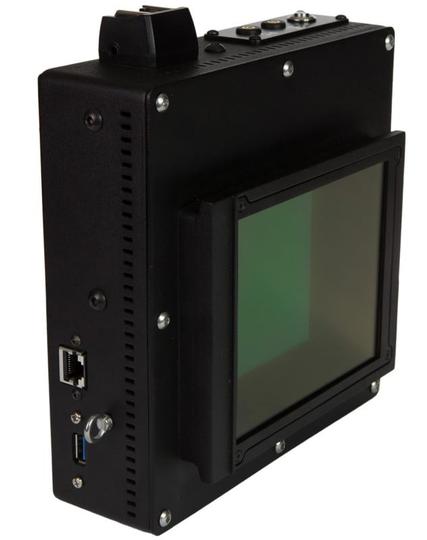
LargeSense has announced the first commercially available 4×5 digital back: the LS45. It can create true, large-format images in a medium other than film and is designed for the Graflok or International standard, can capture both RAW photos and videos, and costs $26,000.
The 4×5 monochrome digital back follows LargeSense's much heavier 9×11-inch monochrome back that it launched in 2018. In a recent hands-on with the camera, the company noted that future models would be "significantly lighter," and the launch of the LS45 4×5 back meets that promise.
"I noticed I was getting older so I decided to make a list of what I wanted to get done in my life," LargeSense's founder Bill Charbonnet says. The entire LargeSense company appears to be one big passion project for him.
"One of the possible projects I could do was make a large format digital camera. I had tried auto panos, handheld panos, recording a large format projected image, medium format, and so on. Nothing really is as nice as an actual digital large format with a big sensor."
The LS45 camera is a single-shot 140x120mm 14-bit monochrome CMOS sensor that features an ISO sensitivity of 250 to 2000. LargeSense says that it has 12.2 stops of dynamic range at the low end and 11.65 stops at the maximum ISO. The sensor itself, while massive compared to conventional 35mm sensors, doesn't have a lot of resolution: it is only 6.7-megapixels, and each pixel is 50-microns in size. For reference, the iPhone X has a 1.4-micron pixel size and the Fujifilm GFX 50S has 5.3-micron pixels. The company says that the large pixel size was chosen because it brings out the "magical 3D quality" of images taken with the camera, and better tones.
While 6.7-megapixels is a relatively low resolution by modern standards, especially considering the size of the sensor, Charbonnet has created a solution. He has developed custom software that uses a "deep learning neural network" can enlarge the photo up to four times, and Charbonnet says the result is as visually good as the native resolution.
LS45 with a Schneider Kreuznach G-Claron 9/305 | Schott BG 38 filter |
Copyright LargeSense, LLC
"Included in our software is a deep learning enlarger which works great. Images are around four times the pixels and it looks as good visually as a native capture. The enlarger can make use of Nvidia GPUs for faster operation. If you are processing thousands of frames you would want to speed up the process. For video, it is great since you have oversampled 4K video which is the minimum now."
The camera shoots in DNG RAW as well as what is called LSR1, which Charbonnet says is a full RAW format. It can shoot lossless RAW video to "near 30 frames per second" to internal storage, CF cards, or an external USB 3.1 drive.
LS45 with a Schneider Kreuznach G-Claron 9/305 | Schott BG 38 filter |
Copyright LargeSense, LLC
"LSR1 has the raw sensor readout, the defect map, a dark noise image, a flat field, and our EXIF information. We have advanced flat field corrections, such as our dust removal. We have our own Windows-based software for processing LSR1 files," he says.
Charbonnet says the camera takes about one minute to boot up from fully off, and the battery lasts for about two hours of usage. Additionally, the sensor has passive cooling which LargeSense says should not allow it to damage itself from too much heat in most shooting circumstances.
LS45 with a Schneider Kreuznach G-Claron 9/305 | Schott BG 38 filter |
Copyright LargeSense, LLC
"The noise increases as heat increases," Charbonnet says. "The key would be outside to keep sun from heating it up, you may need to cover with a shade. I notice black aluminum heats up quickly in the sun to the point where it is too hot to touch. The system has been used at 100 degrees Fahrenheit (37 degrees Celcius) without a problem. There are parts of the earth such as Death Valley in summer which can get very hot, and we have not tested it there, but just use common sense."
LS45 with a Schneider Kreuznach G-Claron 9/305 | Schott BG 38 filter |
Copyright LargeSense, LLC
The LS45 retails for $26,000 for the monochrome sensor, but LargeSense intends to produce a color sensor version that will cost close to $30,000. The camera does not ship with a lens, but comes with a back, base, cables, dark frame cloth, dark frame box, LED light panel with a diffuser, and a filter glass for visible light.
It does not include a lens, but has multiple mounting options, all of which can be found on the company's website.
#equipment #news #digital #digitallargeformat #largeformat #largeformatcamera #largeformatphotography #largesense #largesensels45 #ls45 #newcamera
LargeSense LS911 Hands-On: The First Digital Large Format Camera
The LargeSense LS911 is definitely a camera that is not for everyone. It is well-suited to individuals who want to thoroughly explore large format photography or who already have experience working with large format camera systems. Either way, the venture depends on having a large budget.
That said, what it lacks in portability and cost, it more than makes up for in sharpness, clarity, and razor-thin depth of field capabilities. Images pop off the screen and the pixel peepers will see tack-sharp edges, flawless bokeh, and smooth noise that looks more like film grain than digital noise.
The founder of LargeSense, Bill Charbonnet, describes the camera and his work as such:
“Building a company to make a camera which has never been built before, for a market that has not existed before. Organizing a diverse group of people to work together to build these special new cameras on a tight budget.”
Why carve out a new market of people who don’t know they want a product produced under tight design constraints and on an extremely narrow profit margin? Why isn’t this an unreasonable risk?
Simple: Size matters! Especially in digital photography.
1/30 sec, ISO 2100, Kodak Aero Ektar 305mm f/2.5 at f/2.5 | Flag colors added in post | Link to original file here
If the technical and financial caveats haven’t scared you away, strap in. Our experience with the LS911 and the end product has been unlike anything in the photography world.
The video above was captured at 1/30 sec, ISO 2100, reduced to 50% speed, and shot with a Kodak Aero Ektar 305mm at f/2.5. Link to a single RAW frame from the videohere.
We were able to connect with Charbonnet when we picked up the camera directly from LargeSense in Santa Clara, California. He’s a quirky, tech-savvy guy who offered whatever personal support we needed to get up and going. We drove the camera up to our studio in Seattle and got to work.
The video above was captured at 1/30 sec, ISO 2100, reduced to 50% speed, and shot with a Kodak Aero Ektar 305mm at f/2.5. Link to the uncorrected 8-bit video can be foundhere.
Resolution test: 1/30 sec, ISO 2100, JML Optical 305mm f/9 at f/16 | Link to original file here.
LargeSense LS911's Notable Specifications:
Since Nick has a background in large format photography, we were able to adapt his lenses and slide-mount assembly for use with the LS911. Because of our custom setup, it was easier to mount the unit upside down on the slide.
The camera itself is heavy and has a good clean build quality. All the buttons are sleek and the interface is intuitive.
There are significant features that other (even traditional) camera systems lack, like on-chip pixel binning and the ability to capture dark frames and flat fields for extremely clean images. Shutter speed, iso, image size, image format, the total number of exposures (for video), and a few other settings are available all on the main screen.
The histogram is configurable and the image preview can be adjusted for contrast and brightness. You can optionally connect a tablet or mobile device to control the camera. The controls on the app are thru a sort of web interface but function well and have the same capabilities as the screen on the camera. It was nice to be able to add notes, focal length, etc. to the metadata while shooting. We would like the option to zoom while shooting video for doing critical focus work and have faster shutter speeds than 1/30 of a second. LargeSense says these features are coming in the newer firmware, so we’ll see how they perform when they get released.
The LS911 has a CF card slot, a thumb drive USB port, and an internal one terabyte SSD capable of shooting at full 30 frames per second until you run out of space, though we only tested this out to about a minute. An important note is that the on-screen preview only updates two or three times a second so you don’t get a live 30 frames per second video preview on the camera.
The camera does require a 120v power source, so you’ll need an extension cord, inverter, or the like. The camera itself pulls about 300 watts when running and we were able to run it for an hour or so on a small 12v with an inverter.
The camera ships with an option for an on-chip IR cut filter or plain glass if you want the ability to shoot in infrared. We simply went with plain glass as we have pretty good stack of filters for shooting in different light spectra from UV through infrared.
The sensor itself measures 9×11 inches which is assembled in four pieces. According to LargeSense the software interpolates one row and column of pixels in between the four smaller sensors. It’s hard to tell by looking at the files but you can see the stitch line in certain situations if you look closely. Pixel peeping also reveals occasional faint horizontal lines when shooting high-contrast subjects. The phenomenon doesn’t seem to be consistent, and it also isn’t noticeable at full size.
The flash sync works well for triggering a flash via hot shoe or sync cable and syncs all the way up to 1/30 sec.
We took the LS911 out to do some night photography and we were very impressed. When we set up it was pitch black with no moon. We were excited to see clean images with short exposure times. You can even see the live view clearly at night which we’ve never been able to do with other camera systems without long test exposures.
2 seconds, ISO 6400, Kodak Aero Ektar 305mm at f/2.5 | Link to original RAW here.
We have used many camera systems, and our consensus is the cleanliness and clarity of the RAW files from night shots is hard to stop staring at. It’s almost dreamy. Additionally, there doesn’t seem to be a maximum exposure time. There is the expected minor salt and pepper noise with long exposures but it seems significantly better than smaller camera systems with similar exposure times.
You can also stack images in-camera, so you get one final long exposure from many short exposures. We did some tinkering to see if there was any gap between shots, but it appears to be completely seamless so you won’t get any dotted lines on moving objects.
2 minutes with in camera gapless stack (60 frames), ISO 6400, Kodak Aero Ektar 305mm at f/2.5 | Link to original RAW here. 1/30 sec, ISO 2100, Kodak Aero Ektar 305mm at f/2.5 | Link to original RAW here.
Charbonnet was very tight-lipped concerning testing and what is coming down the pipeline from LargeSense, but we know the following:
Future LS911 models will be "significantly lighter" and LargeSense is currently testing a color sensor that uses a unique color filter design that doesn’t use dyes for the color pixels. Charbonnet wouldn’t say if it was three layers like the Foveon or something else, but he did say they are testing out the color 4×5 now. LargeSense also has a monochrome 4×5 camera for purchase as well as, of course, the 9×11.
Pros:
Cons:
Overall, the LS911 is big and bulky to be expected but functions well and produces beautiful RAW files. It is exciting to shoot with and we haven’t felt limited as on some other camera systems. Everything fits together nicely even without our modifications and the interface is intuitive.
If you have experience shooting with large format or have always wanted to and have a decent budget, this camera is definitely for you. We wouldn’t be surprised if we start seeing this used for high-end cinematography. With a 9×11-inch mirrorless sensor available to consumers, we may see bellows and vintage glass parading in parks and cities around the world very soon!
_About the authors: Richard Brown is an American Photographer whose roots are steeped in film. In his early childhood, Richard lived in Chinhae, South Korea near a US Navy base. His first camera was a 35mm point-and-shoot which he used to capture one of the 88′ Olympic torchbearers. In high school, Richard was placed on yearbook staff and worked in the darkroom. He was gifted a briefcase Russian enlarger which he used frequently in his free time. In 1995 on a UK trip, Richard challenged himself to use an Argus brick the entire trip. He also traveled and photographed in Kuwait, Bahrain, Saudi Arabia, and across the United States. Richard then became a cast member at Walt Disney as a Photographer. Richard continued with his photography passion as a manager of a photo lab at Eckerd during the film SLR changeover. Richard has used many camera formats over the years. Richard continues his journey through the many changes that technology brings and considers himself an Apprentice of the Arts. Richard enjoys traveling with his gigapan and capturing the natural beauty of the PNW.
Nick Spiker is an American professional landscape photographer best known for incorporating invisible portions of the electromagnetic spectrum into his work. Nick’s passion for photography began as a child as he accompanied his father on various photography expeditions, including many shoots for National Geographic Adventurer. His mother cultivated this passion by providing Nick with access to the first editions of Adobe Photoshop. He dissected photography—both analog and digital—to its basic roots, becoming a master of light and color dynamics, optics, perspective, and perception. Nick uses his creations to reveal a world filled with beauty and clarity by using a precise balance of contrast and color in his images that can only be achieved by carefully selecting various spectral filters. Nick captures near-infinitesimal detail in his images and reveals the unviewable by translating infrared and ultraviolet channels to the visible spectrum. Nick will traverse any terrain in any weather at any time to capture the perfect image. Hiking 40 miles in subzero weather under the night sky with custom camera equipment is when Nick feels the most alive and inspired._
Cup of Joe Photography is a Seattle-based partnership that focuses on unique capture methods and special effects. Cup of Joe proudly supports the LGBTQIA community. Richard and Nick enjoy tinkering with anything photography-related. Richard and Nick are very serious when it comes to coffee -- both Richard and Nick roast their own beans every morning.
#equipment #reviews #8x10 #camera #cupofjoephotography #digitallargeformat #giantsensor #handson #largeformat #largeformatdigital #largesense #largesensels911 #nickspiker #review #richardbrown #singleshot #worldsfirst