 Raniere Silva
On board of the ICE train 🚄 to Stuttgart for the #deRSE26 conference. I'm looking forward to catching up with people and finding out what's been happening in the world of #RSE and #Jupyter. If you are interested in last week #JupyterHub roadmap workshop, send me a message.
 Frederik Elwert
Oh, that’s great! The #JupyterHubNRW service now integrates an #OpenRefine extension for #JupyterHub, enabling students to use OpenRefine without having to install it locally. That lifts a serious barrier some students faced in my course this semester.
 FDM Thüringen
Wir sind ja leider wirklich nicht gerade "quicklebendig auf Dauer-Broadcast", aber hin & wieder muss es einfach mal wieder eine Notiz an Euch sein.
Anlass wie so gerne: es ist wieder ☕ #TKFDMCoffeeLectures-Mittwoch.
Diesmal geht's um den #JupyterHub der @nfdi4ing :
Anett Seeland (@Uni_Stuttgart) stellt uns @jupyter4nfdi vor - incl. Blick auf Rechenressourcen, Vorteile und Unterstützungsmöglichkeiten für Euer
#FDM
🗓️ 28.01.2026, 14h, online mit Lieblingsgetränk -
https://t1p.de/vv9pr
 NFDI4ING
TKFDM Coffee Lecture | Online
On January 28th, 2:00–2:30 PM (CET), Jupyter@NFDI4ING will be presenting the NFDI4ING JupyterHub as part of the TKFDM Coffee Lecture series.
In this short and focused talk, you’ll get an overview of how the NFDI4ING JupyterHub supports research and engineering workflows and enables collaborative, reproducible work with Jupyter.
👉 Join us online and take a break with insights into research infrastructure: https://t1p.de/vv9pr
 Ztarbug
For anyone looking for a #Nextcloud installation on #Kubernetes, here is a Helmfile to do just that. It also shows, how to use Nextcloud as an #IdP and installs #JupyterHub using Nextclouds user identities.
Feedback, comments and bug reports are very much appreciated!
#FOSS rulez!

 OpenTech(AUC)
For several weeks we have been proudly supporting experiments with a self-hosted instance of #JupyterHub in the new programming course offered by Amsterdam University College #AUC called “Programming in Digital Societies” (PIDS).
OpenTech(AUC) is happy to see that with courses like PIDS, the university is (again) becoming a place where in-house technical experimenting can meet critical political reflection.
More info: https://opentech-auc.org/posts/2025-12-02-jupyter-hub/
Digital Sovereignty in the classroom
Throughout this semester, OpenTech(AUC) has been proudly supporting experiments with Jupyter Hub in the new programming course offered by Amsterdam University College (AUC), called “Programming in Digital Societies” (PIDS). In a nutshell, for many weeks now, students are building, running and sharing their Jupyter Notebooks in an environment that is fully owned and controlled by the PIDS lecturing team. This environment is running on a VPS that OpenTech(AUC) is renting on https://gandi.net (V-R16, 8CPU’s, 16GB RAM, 30 GB storage). The VPS runs Ubuntu, and on top of that an installation of JupyterHub (following the steps of this manual).
 Habr
HabrЕдиный вход для ML-стека на примере Keycloak
Привет! Я Саша Абакумов, DevOps-инженер в KTS . Нашей команде часто приходится поднимать инфраструктуру под ML-проекты. Со временем число ML-инженеров и разработчиков на таких проектах росло, и логиниться в каждый по отдельности становилось все больнее. Чтобы упростить коллегам жизнь, мы интегрировали Single Sign-On (SSO) в стек одного из наших проектов, состоящий из JupyterHub, Airflow и MLflow. SSO позволяет единообразно аутентифицироваться во всех инструментах под одной учетной записью. Помимо очевидного удобства, нам это также дало возможность централизованно управлять доступом и внедрить RBAC — сопоставление ролей в инструментах с группами или ролями в IdP. В качестве инструмента для реализации SSO я использовал OIDC-провайдер Keycloak, наверняка многим хорошо знакомый. Ниже я расскажу о том, как с его помощью настроить SSO для JupyterHub, MLflow и Airflow (все компоненты разворачиваются с помощью Helm-чартов).
https://habr.com/ru/companies/kts/articles/971982/
#ml #mlflow #sso #sso_аутентификация #jupyterhub #airflow #keycloak

 MetaDocencia
👏 Felicitamos a #UNCSupercómputo: con apoyo del Proyecto #Catalyst incorporaron nuevo hardware para una instalación escalable de #JupyterHub.
El equipo permitirá validar despliegues locales comparables a los de nubes públicas, fortaleciendo la soberanía tecnológica y la infraestructura abierta en la región: https://supercomputo.unc.edu.ar/2025/09/02/colgando-a-boogie/ supercomputo.unc.edu.ar
🍎 Desde MetaDocencia celebramos este paso e invitamos a conocer más sobre lo que fue el Proyecto Catalyst: https://catalystproject.cloud/
 de.NBI & ELIXIR Germany
🧬👩💻 Calling bioinformaticians, data scientists, trainers & cloud enthusiasts!
Join de.KCD & the 8th de.NBI Cloud User Meeting in Berlin, Sep 30–Oct 2, 2025.
🎓 Free hands-on tutorials: #SimpleVM, #Kubernetes, #Ansible, #OpenStack, #CWL, #Snakemake, #LLM, #RDM, #JupyterHub
🤝 Network with experts & peers
🗣️ Health-data keynotes (BIH/Charité)
⏳ Register by Sep 19!
🔗 Sign up now! https://www.denbi.de/training-courses-2025/1903-8th-de-nbi-cloud-user-meeting
Join de.KCD & the 8th de.NBI Cloud User Meeting in Berlin, Sep 30–Oct 2, 2025.
🎓 Free hands-on tutorials: #SimpleVM, #Kubernetes, #Ansible, #OpenStack, #CWL, #Snakemake, #LLM, #RDM, #JupyterHub
🤝 Network with experts & peers
🗣️ Health-data keynotes (BIH/Charité)
⏳ Register by Sep 19!
🔗 Sign up now! https://www.denbi.de/training-courses-2025/1903-8th-de-nbi-cloud-user-meeting

 James Balamuta
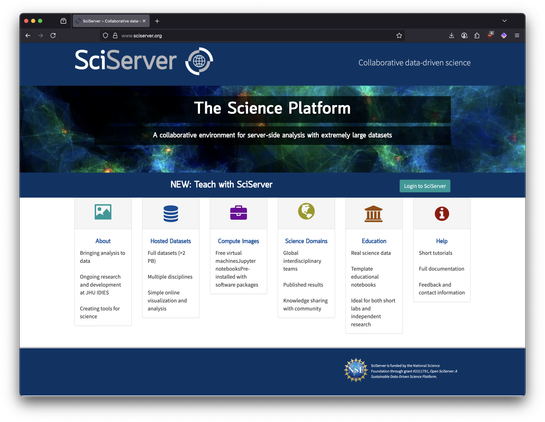
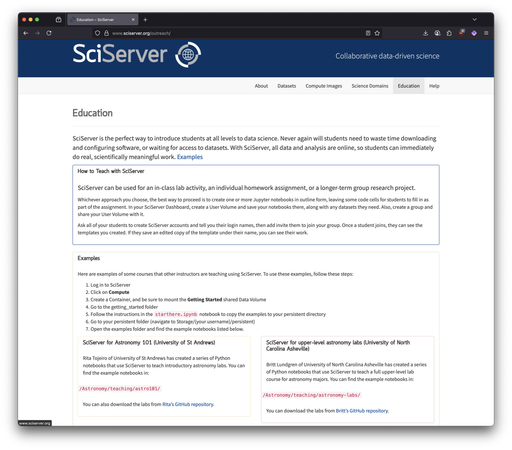
TIL about SciServer.org: Free scientific computing platform with persistent accounts (#NSF-funded). All the power of #JupyterHub without the setup hassle. Focus on building great teaching + research notebooks, not infrastructure! #OpenScience