
Raniere Silva

483 Followers
350 Following
345 Posts
PhD candidate @cityuhongk; Former Executive Council member of @thecarpentries; Former Community Officer at @SoftwareSaved. #OpenScience #Python #RStats

After 10 years, Arfon Smith is stepping down as Editor-in-Chief of @joss

A few thoughts from him on the decade: https://www.arfon.org/stepping-down-as-editor-in-chief-of-joss

The call for a new EiC: https://blog.joss.theoj.org/2026/05/call-for-editor-in-chief
#opensource #openscience

Stepping down as Editor-in-Chief of JOSS | Arfon Smith

After 10 years, reflecting on launching the Journal of Open Source Software and what comes next.

At #FOR2026 yesterday, I learned from Carole Goble that

Trust (in another person or organization) can be defined as their:

(Credibility + Reliability + Intimacy) / Self-Orientation

which is from Cathrin Stöver - Chief Communications Officer GÉANT (and in turn, is from Charles H. Green)

Lima et al 2026: "Beyond Code, We Are People: A Systematic Mapping of 25 Years of Literature on Soft Skills in Agile Development Teams" https://arxiv.org/abs/2604.28101
Beyond Code, We Are People: A Systematic Mapping of 25 Years of Literature on Soft Skills in Agile Development Teams

Software development is a sociotechnical and human-centered endeavor in which human factors directly influence quality, productivity, and innovation capacity. In this context, career development in computing goes beyond technical mastery, requiring competencies that enable professionals to deal with continuous change and collaborative demands. Among these, non-technical skills (soft skills) stand out, encompassing social, emotional, and communicational dimensions essential to team effectiveness and the success of software projects. Despite their recognized importance, there is still a need for a systematic mapping of the most relevant soft skills over the past 25 years, a period marked by the adoption of agile approaches in industry. This gap limits the integration of human and technical aspects in software development. This study presents a systematic mapping of the literature, analyzing 97 studies published between January 2000 and May 2025 across major scientific databases. The results identify recurring competencies such as communication, adaptability, teamwork, and leadership, as well as their association with different roles in agile contexts. The main agile approaches adopted, particularly Scrum, are also identified, along with key gaps in the literature, such as the lack of studies on role specific soft skills. The findings can support researchers, educators, and practitioners in designing curricula, training strategies, and organizational practices aligned with human factors, reinforcing the importance of integrating social and technical dimensions in the development of collaborative and innovative professionals.

arXiv.org
Hoshikawa et al 2026: "A Longitudinal Analysis of Good First Issue Practices and Newcomer Pull Requests in Popular OSS Projects" https://arxiv.org/abs/2604.27532 "…the proportion of issues with GFI labels…underwent a statistically significant decline beginning in January 2024 [and] the merge rate of newcomer GFI pull requests declined from 61.9% to 42.2%"
A Longitudinal Analysis of Good First Issue Practices and Newcomer Pull Requests in Popular OSS Projects

Open-source software (OSS) projects rely on effective newcomer onboarding to sustain their communities. OSS projects widely adopt "good first issue" (GFI) labels to highlight beginner-friendly tasks. As development practices continue to evolve, understanding how these onboarding mechanisms change over time is important for both maintainers and researchers. This study analyzes 406,826 issues and 1,117 newcomer GFI pull requests across 37 popular GitHub repositories (30 of which use GFI labels) over a four-year period from July 2021 to June 2025. We find that while the proportion of issues with GFI labels remained stable during the first three years, it underwent a statistically significant decline beginning in January 2024, with substantial variation across projects not explained by repository age or programming language. Despite this supply-side decline, newcomer engagement with GFI issues remains stable at approximately 27%, suggesting that GFI labels maintain consistent attractiveness. Examining the outcomes of this engagement, we find that the merge rate of newcomer GFI pull requests declined from 61.9% to 42.2%. Initial pull request characteristics such as description length and code size show no significant association with merge outcomes, indicating that success is not predicted by the quantitative characteristics of the initial submission alone. Together, these findings reveal a widening gap between stable newcomer interest in GFIs and the declining availability and success of GFI-based onboarding, underscoring the need for maintainers to sustain both GFI labeling and review support.

arXiv.org
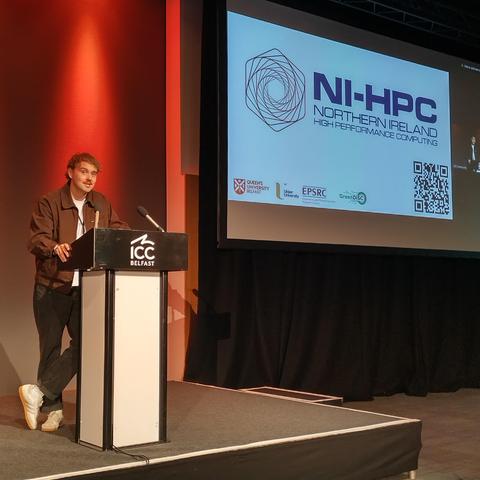
James McGroarty talked about the high performance computing (HPC) facility in North Ireland. #collabw26
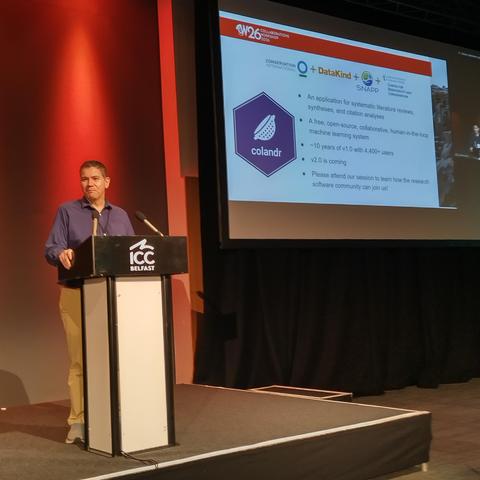
Check out the #Rstats package colandr when you have to do systematic literature review. Big thanks to Galvin Fulner and DataKind for sponsoring #collabw26.
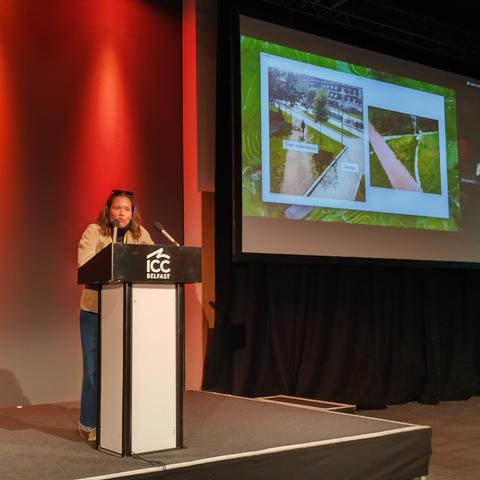
I loved the photo used by Anne Lee Steele in the #collabw26 lightning talk. System should adapt to their users.
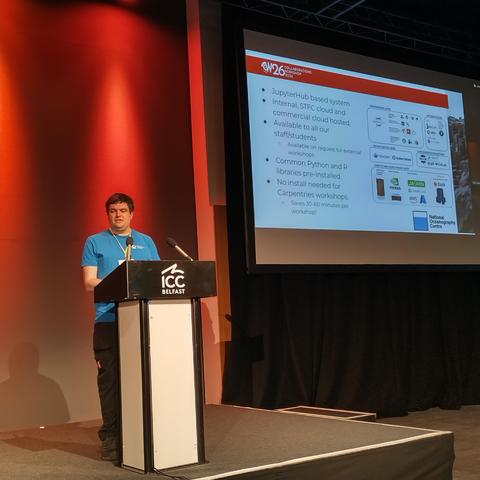
Colin Sauze promoted #JupyterHub on the new server used by the (UK) National Oceanography Centre. 🥳
#collabw26
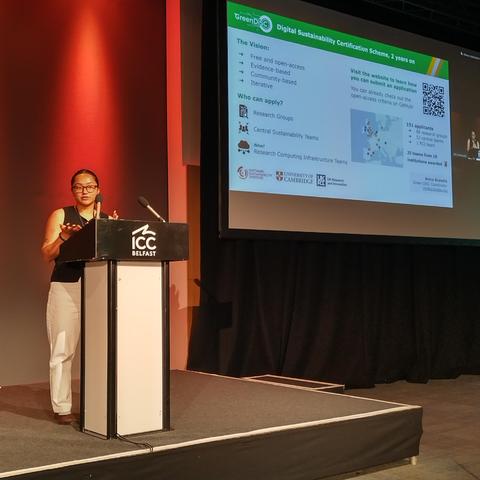
Check out Green DiSC if you are interested in sustainability certification. Or talk with Anita Araneta at #collabw26.
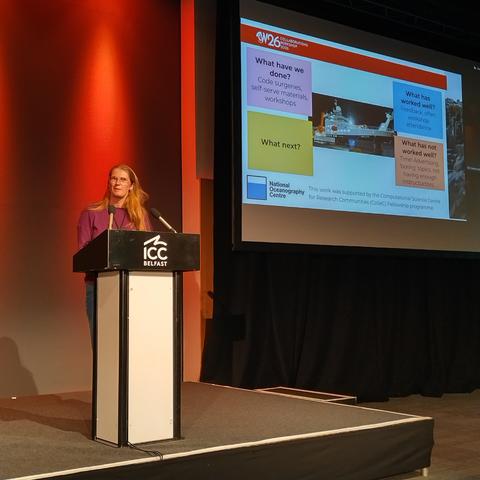
More about training. This time from Esther Turner's experience with oceanography community.
#collabw26