💧🌏 Greg Cocks
NASA's Parker Solar Probe Flew In And Out Of The Solar Corona And Found A Source Of High-Energy Particles That No Existing Model Had Predicted
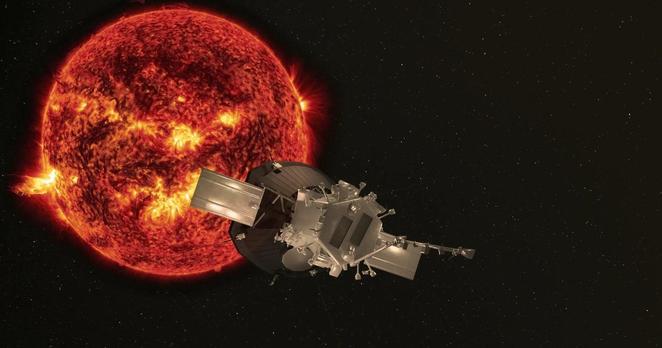
(When NASA's Parker Solar Probe passed through the solar corona during perihelion encounters at the heliospheric current sheet, its instruments recorded energetic protons at energies far above what existing models of particle acceleration at that location could account for.)
--
https://spacedaily.com/n-nasas-parker-solar-probe-flew-in-and-out-of-the-solar-corona-and-found-a-source-of-high-energy-particles-that-no-existing-model-had-predicted/ <-- shared technical article
--
https://doi.org/10.3847/2041-8213/ae3ca1 <-- shared paper
--
https://www.space.com/high-energy-particles-source-space-weather <-- shared technical article
--
https://youtu.be/Woo4yZby4BU?si=rzzND3qJkubGKyTo <-- shared space weather overview effects video, #AIslop notwithstanding 🙃 🫠 😉
--
“… A team… at the Southwest Research Institute… and… the University of Maryland’s Institute for Research in Electronics and Applied Physics has published an analysis of those measurements [link above]…, identifying magnetic reconnection at the heliospheric current sheet as the mechanism responsible. The proton energies detected were, in the study’s framing, approximately a thousand times greater than the available magnetic energy per particle that models of this process had predicted.
The finding matters for two reasons: it identifies a source of energetic particles close to the Sun that was not anticipated, and it raises questions about how far the existing understanding of reconnection-driven particle acceleration extends…
The Parker measurements suggest that picture needs revision. The magnetic island merging mechanism [the authors] identif[ied] can evidently produce proton populations at energies that challenge the boundary between what reconnection does and what shock acceleration does. Whether this source can explain a significant fraction of observed near-Earth energetic particle events, or whether it contributes mainly at energies and scales that remain confined close to the Sun, is a question the paper does not yet resolve…
Solar Orbiter, the European Space Agency mission operating in coordination with Parker, offers complementary measurements at somewhat greater distances. Comparing what the two spacecraft measure of the same particle populations as they propagate outward from the Sun will help establish which features originate close to the source and which are modified by the intervening solar wind. The energetic particle observations that puzzled researchers in the pre-Parker era now have a candidate mechanism. Whether that mechanism accounts for a large or small fraction of what actually reaches Earth remains the open question…”
#sun #solar #solarsystem #heliosphere #Parker #SolarOrbiter #spacecraft #research #monitoring #instrumentatin #spaceweather #solarflare #coronalmassejection #CME #NASA #ESA #magnetism #geomagnetism #proton #energy #particleacceleration #measurement #solarwind #risk #hazard #impacts #corona #perihelion #model #modeling
@nasa @esa
(When NASA's Parker Solar Probe passed through the solar corona during perihelion encounters at the heliospheric current sheet, its instruments recorded energetic protons at energies far above what existing models of particle acceleration at that location could account for.)
--
https://spacedaily.com/n-nasas-parker-solar-probe-flew-in-and-out-of-the-solar-corona-and-found-a-source-of-high-energy-particles-that-no-existing-model-had-predicted/ <-- shared technical article
--
https://doi.org/10.3847/2041-8213/ae3ca1 <-- shared paper
--
https://www.space.com/high-energy-particles-source-space-weather <-- shared technical article
--
https://youtu.be/Woo4yZby4BU?si=rzzND3qJkubGKyTo <-- shared space weather overview effects video, #AIslop notwithstanding 🙃 🫠 😉
--
“… A team… at the Southwest Research Institute… and… the University of Maryland’s Institute for Research in Electronics and Applied Physics has published an analysis of those measurements [link above]…, identifying magnetic reconnection at the heliospheric current sheet as the mechanism responsible. The proton energies detected were, in the study’s framing, approximately a thousand times greater than the available magnetic energy per particle that models of this process had predicted.
The finding matters for two reasons: it identifies a source of energetic particles close to the Sun that was not anticipated, and it raises questions about how far the existing understanding of reconnection-driven particle acceleration extends…
The Parker measurements suggest that picture needs revision. The magnetic island merging mechanism [the authors] identif[ied] can evidently produce proton populations at energies that challenge the boundary between what reconnection does and what shock acceleration does. Whether this source can explain a significant fraction of observed near-Earth energetic particle events, or whether it contributes mainly at energies and scales that remain confined close to the Sun, is a question the paper does not yet resolve…
Solar Orbiter, the European Space Agency mission operating in coordination with Parker, offers complementary measurements at somewhat greater distances. Comparing what the two spacecraft measure of the same particle populations as they propagate outward from the Sun will help establish which features originate close to the source and which are modified by the intervening solar wind. The energetic particle observations that puzzled researchers in the pre-Parker era now have a candidate mechanism. Whether that mechanism accounts for a large or small fraction of what actually reaches Earth remains the open question…”
#sun #solar #solarsystem #heliosphere #Parker #SolarOrbiter #spacecraft #research #monitoring #instrumentatin #spaceweather #solarflare #coronalmassejection #CME #NASA #ESA #magnetism #geomagnetism #proton #energy #particleacceleration #measurement #solarwind #risk #hazard #impacts #corona #perihelion #model #modeling
@nasa @esa