 Hacker News
Why There's No Single Best Way to Store Information
https://www.quantamagazine.org/why-theres-no-single-best-way-to-store-information-20260116/
#HackerNews #informationstorage #dataanalysis #techinsights #knowledgeorganization #dataarchitecture
Why There's No Single Best Way to Store Information
https://www.quantamagazine.org/why-theres-no-single-best-way-to-store-information-20260116/
#HackerNews #informationstorage #dataanalysis #techinsights #knowledgeorganization #dataarchitecture
Biological camera that captures, stores images directly into DNA
https://www.nature.com/articles/s41467-023-38876-w
Discussion: https://news.ycombinator.com/item?id=36663498
Confusing title: it's not a single strand of DNA that gets the image information, it's a pool of DNA wh. collectively hold the images information
Each "pixel" is a well in a 96-well plate. Bacteria in these wells are exposed to different light, triggering the DNA transformation; DNA is then harvested f. the bacteria to get your image library
...
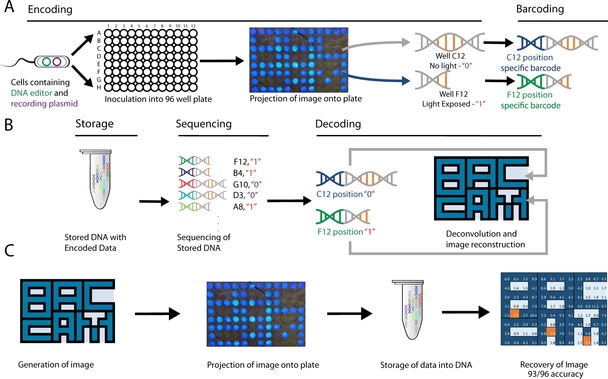

DNA data storage has gained recent interest due to the high information density of DNA. Here, the authors have developed a method to directly capture information in the form of light and encode it into DNA via bacteria, analogous to a digital camera.
The Neural Network Revolution: Why AI Will Make Traditional Databases Obsolete
https://rajiv.com/blog/2023/05/12/the-neural-network-revolution-why-ai-will-make-traditional-databases-obsolete/
#NeuralNetworks #DatabaseEvolution #InformationStorage #AI #DataManagement #NoSQL #RelationalDatabases #MindMapping #ProgrammingHistory #LargeLanguageModels #LLM
I wanted to share this wonderful thread, but I wanted to ALT it--to mention that the bookworm-eaten book looks as if an artist took an old book already damaged by water & the oil from fingertips, and carved into the open book with a U-shaped carving tool, at different depths. Not only worm trenches, but pieces of paper leaves, words out of place, layered, diagonal--it is still a work of art.
#History #InformationStorage #archive
https://raggedfeathers.com/@ryancordel[email protected]/109684445390472847

Attached: 1 image I need to share this interaction before it slips my mind—as I was looking at these materials yesterday with the iSchool’s facilities manager—side note: a person without whom the press or anything around it just wouldn’t exist—he observed about the bookworm-eaten book—“it’s like a computer virus. It slowly ate away at the information until it was completely inaccessible” & I will share that brilliant metaphor with students every time I show this book the rest of my career

 Victoria Stuart 🇨🇦 🏳️⚧️
 Rajiv Pant
 Kat Kimbriel