BeyondTheStats

Video: https://youtu.be/cQAClx0FoJw

Blogpost: https://blog.illestpreacha.com/mathober2024hypergeometric

#mathart #mathober #mathober2024 #mathober31 #lie #mathober12 #hypergeometric

Visuals coded in #python
Sound Coded in #sonicpi
Tweaked for Visuals

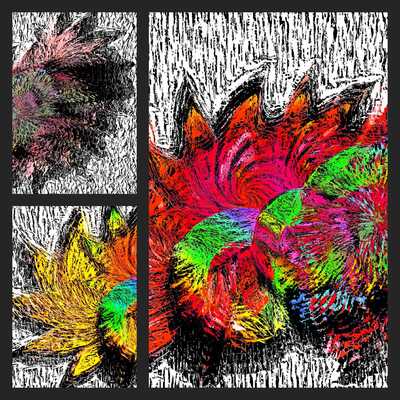
For the 23rd piece of Mathober2024,The prompts being used are the 12th prompt with Hypergeometric and the 31st Prompt with Lie. BeyondTheStats, takes the hypergeometric of fictional citizens of various planets with the mathematical fiction subgroup of shadow Math. Fiction can be consider a “lie”.

Poem

Energy is spending
Sending into all arrays
All aspects
But now at the intersect
We must decide which way
Will let our mind ease & flow
Glow and gleams
As it slow-ly let outs the steam

#creativecoding #coding #dataart #mathematical fiction
#newmedia #scifi #animation
#math #geometricart #geometry #graphs

Mathober Lie & HyperGeometric: BeyondTheStats

YouTube

@carter
#HyperGeometric
3. Can the equation provide a road map to \( _{p}F_{q}\left(\right)\)?
4. Is this whole process just a silly extension of DLMF 16.3.1 ?

5/\( \omega\) (?)

@carter
#HyperGeometric
Luke- Questions
1. Luke says that ν, μ, λ need to be positive integers. Can they be extended by fractional derivatives?
2. Can the equation be extended by the standard Analytic continued to the real line (except for poles and such) which Luke excludes; but provides guidance in other parts of the book? Of course, the extensions aren't identical to the original but satisfy the defining differential equation.

4/\( \omega\)

@carter
#HyperGeometric
\( _{2}F_{1}\left(1,1,2;-z\right)=z^{-1}\cdot ln(1+z) \)
Where I have kept Luke's notation since it is not too confusing.
Except that we need the conversion
\( _{2}F_{1}\left(1,1,2;z\right)=-z^{-1}\cdot ln(1-z)\)
per DLMF 15.4.1 (I didn't want to “into the weeds to early”)

3/ω

@carter
#HyperGeometric
1.1 As mentioned, here is the equation.
\[ _{2}F_{1}\left(\frac{\nu+1,\nu+\mu+1}{\nu+\mu+\lambda+2}|z\right)=\frac{\left(-1\right)^{\mu+1}\cdot\left(\nu+\mu+\lambda+1\right)!}{\lambda!\cdot\nu!\cdot\left(\nu+\mu\right)!\cdot\left(\mu+\lambda\right)!}\]
\[\cdot\frac{d^{\nu+\mu}}{dz^{\nu+\mu}}\left[\left(1-z\right)^{\mu+\lambda}\cdot\frac{d^{\lambda}}{dz^{\lambda}}\left\{ z^{-1}\cdot ln\left(1-z\right)\right\} \right] \]
and
2/\(\omega \)

@carter
#HyperGeometric
A note on Luke-3.4-15
Abstract.
This is just an exploration of Luke's “The Special Functions and Their Applications” Vol1, section 3.4 equation 15.
This a conversion of
Section 3.1 (15)
to a certain constrained set of \( _{2}F_{1}()\) to \( _{2}F_{1}\left(1,1,2;-z\right)=z^{-1}\cdot ln(1+z) \) .
The questions are about extending this in various ways.

Y. L. Luke,The Special Functions and Their Applications, Academic Press, New York (1969).
1/\( \omega\)

#introduction My name is Hector but I go by the handle hypergeometric2f1. I am from #Galicia in the northwest of #Spain. I love doing #physics, #math, #music, and #drawing. I have a love/hate relationship with #statistics. I am a big fun of #divergentseries, #summationmethods, and #hypergeometric and #meijerg functions. Have a PhD in physics, but I teach mathematics.
By the use of the #Gauss multiplication theorem the infinite series above may be broken up into a finite series of #hypergeometric functions
For a simple #random sample with replacement, the distribution is a binomial distribution. For a simple random sample without replacement, one obtains a #hypergeometric distribution.