Artificial intelligence, eye tracking, pet mode, follow focus. Yes, there’s no shortage of ‘magical’ autofocus aids for the modern photographer who needs to get images sharp in no time. When it comes to shooting street photography, I prefer to make it even easier and even faster. The solution is hyperfocal distance.

Hyperfocal distance – faster than the world’s fastest autofocus

#autofocus #hyperfocalDistance #photography

Hyperfocal distance – faster than the world’s fastest autofocus

Artificial intelligence, eye tracking, pet mode, follow focus. Yes, there's no shortage of ‘magical’ autofocus aids for the modern photographer who needs to get images sharp in no time. When it comes to shooting street photography, I prefer to make it even easier and even faster. The solution is hyperfocal distance.

Sivert Almvik Photography

Seven Recommended Rangefinder Focusing Techniques

Many photographers struggle with focusing rangefinder cameras. Some photographers, unfortunately, tend to shoot only wider/slower lenses or give up on rangefinders entirely for this reason. But I don't think photography should always be easy and by learning to use simpler cameras, we can internalize concepts and develop instincts and reflexes that apply to any type of camera.

I think that peoples' trouble with rangefinders begins with SLRs. This may sound funny but what I mean to say is that, when we pick up our first rangefinder, we often try to use it like an SLR. I did that for years myself, and remember the frustration.

But I found that it takes more of a photographer to use less of a camera. And have no doubt about it, a rangefinder does less for you than an SLR and needs to be approached this way.

Leica M6 TTL 0.85 | Leitz 5cm 1.5 Summarit | Kodak Tri-X 400 | Kodak HC110b

By allowing us to focus through the taking lens itself, SLR's alleviate the need to adopt habits that rangefinders encourage and, I think, make us stronger photographers as a whole.

With an SLR, we tend to live inside the viewfinder.

By living inside the viewfinder, I mean that we tend to treat SLR finders like magic boxes that we look inside of to see the future; our images almost exactly as they will eventually appear on film.

When we look into a rangefinder we are immediately struck with how rudimentary the viewfinder is, and the fact that we are most definitely, not peering into a magic box. With a rangefinder, I think the photographer sheds any illusion that they are looking into something more than some of panes of glass. And thus one must accept more agency for the images that one wants to create.

I imagine that many photographers carry their live-inside-the-viewfinder method of focusing into their use of rangefinders. And this may be fine with conservative use. But why spend the money and time on any camera and not push the system to its limits as well as become a more effective shooter?

Below are seven techniques that I find are important to embrace in order to focus rangefinder cameras more quickly and more accurately. You'll notice that each technique involves and relies on the others to work and make sense. I may have even overlapped some of them too much in trying to describe what I do. But like everything with photography, all the elements affect one another. None are fully isolated. And therefore, you will find yourself employing different techniques and combinations of techniques for different subjects and scenes.

Before we get going, I also want to point out that while analog Leica cameras and lenses are my personal rangefinder preference, I also use Voigtlander and some Japanese fixed lens rangefinders too. Regardless of your brand preference or model, a rangefinder is a rangefinder and this advice should apply.

Technique One: Service Your Rangefinder

It's not a focusing technique per se, but I can't say it enough. Service your rangefinder.

Even a cheap, fixed lens RF like an Olympus XA will benefit from professional service. Will service cost more than the camera? Maybe. But so will the cost of film and processing over a short period of time. Why not make those shots count? And certainly if you purchase a costly interchangeable lens rangefinder camera and lenses, you owe it to yourself for them to be working properly!

Nikon FM2n | Nikkor 55mm 2.8 Micro AIS | Kodak TMAX 100 | Kodak HC110b |

Send out both the body and your fastest/longest lenses to be calibrated for one another, together. Specific bodies need to be set up with specific lenses in order to maximize focusing accuracy.

This is not SLR World where we just throw any old lens on any old camera then go shoot a portrait session at full aperture. The faster and longer a rangefinder lens is, the more carefully it must be calibrated for your camera and your camera for it. (Also, be sure that the rangefinder you're using has a long enough effective baselength to accurately focus the lens you've mounted to it!) Rangefinder windows can also become dim with age and require either interior cleaning or full out replacement of the beamsplitter. Be certain that your rangefinder is serviced and in top mechanical and optical condition before demanding perfect focus from it.

Failing to do this first will make all other efforts moot.

Technique Two: Pre-set Your Focus

Most of us probably learn to manually focus cameras by looking into the viewfinder and jockeying the focus ring back and forth until the image looks as it should. This is a bad habit encouraged by the SLR and it's the first step we take before falling into helpless dependency on our viewfinder. Remember, don't live inside your viewfinder - look at your surroundings! Be aware of what you're shooting.

There are a couple ways to pre-set your focus, including hyper focal distance and simply guessing distance.

1930 Leica III | Leitz 5cm f3.5 Nickel Elmar | Kodak Tri-X 400 | Kodak HC110b

Street photographers know to use hyperfocal distance to pre-set their focus and avoid looking into their viewfinders too often or unnecessarily. This is good practice for all of us, no matter what type of camera we're using or genre we're shooting.

Hyper focal distance can be set using the distance and depth of field scales on your lens. The technique works works best with wider lenses and apertures like f8 or smaller. Set the infinity mark of your distance scale on the f8 that appears right of center on your depth of field scale. Consult the number of feet indicated by the same aperture (f8 in this example) left of center. In the case of my Voigtlander 40mm 1.4 Nokton, using these settings puts everything from seven feet to infinity, in focus. Find a subject that's more than seven feet away and they will now be in focus. Your viewfinder is only for composition now.

Practice hyperfocal distance but also, in tandem, practice guessing distance.

Infinity is easy. If you're shooting landscapes or any subject on the horizon, there's no need to use your camera to focus at all, rotate the lens to infinity. There. You're in focus.

1930 Leica III | Leitz 9cm f4 Elmar | Kodak Tri-X 400 | Kodak HC110b

When I took fireworks photos with my 1930 Leica, for example, this is all that I did. I set the lens to infinity and then forgot about focus for the remainder of my shoot.

Focusing on infinity and using hyperfocal distance alleviates the need to depend on your rangefinder for focus at all. But when you're focusing a longer/faster lens at a wider aperture and closer distances, out of necessity or just because you want to blur the background, another technique must be employed.

Before even lifting your camera to your eye, guess the focus. Just take a guess and set it on your lens. The idea is to get the focus distance in the ballpark and to use the rangefinder simply to verify and refine your guess, not to do all of the work. At dimly light wedding receptions, I set my focus for five or six feet and walk towards and away from people to bring them within distance. Sometimes your subject will move into the frame and literally focus themselves!

Leica M6 TTL 0.85 | Leitz 5cm 1.5 Summarit | Ilford Delta 3200 @ 6400 | Kodak HC110b

I started out by learning what my minimum distance of three feet looked like, my middle distances of about ten feet and infinity. Three feet is a little further than the length of my arm and the closest that most rangefinder lenses can focus. I taught my daughter to extend her arm to subjects with her Instax viewfinder cameras. If she can touch the subject with the tips of her fingers, she's too close to it so she needs to take a couple steps backwards. This ensures that she is not too close to the subject for it to be in focus. Six feet is good to recognize for social distancing! Find some distances that you like to frame subjects at, then remember what those distances look like. Quiz yourself by guessing then focusing with your camera and checking the distance. Do this often, in different spaces and you'll pick it up quickly!

If you get into a grove with pre-focusing, you'll probably find that you don't need to jockey the focus ring back and forth so much, if at all. If you pre-focus AND use the rangefinder to focus, it's like a two factor authentication for focus; more accurate than using the rangefinder alone.

Technique Three: Know Your Depth of Field

Everyone loves lenses. We probably own many more lenses than we really need. And that's fun. But the problem is that it can be difficult to learn a particular lenses' depth of field on an instinctual level if we don't use a particular lens regularly enough.

Leica M6 TTL 0.85 | Leitz 90mm f2 Summicron E55 Pre-ASPH | Kodak Tri-X 400 | Kodak HC110b

A large part of the disconnect that one may feel when looking through a rangefinder is that they unapologetically offer no visual sense of depth of field. Alarming to some, liberating to others, no matter how you see it, this is another reason that you have to be more of a photographer to use less of a camera.

Zone focusing is a technique that is closely related to hyperfocal distance and guessing. Viewfinder-type cameras (such as Fuji Instax) sometimes employ zone focus marks such as a mountain symbol for infinity (a far away subject), two people symbol for middle distance (a subject 7-10 feet away) and a single person for close distance (a subject 3-5 feet way). I didn't discuss zone focusing with pre-setting focus because I recommend using it at an instinctual level that is rooted in ones understanding of depth of field.

Take some time to study the depth of field scale marked on your rangefinder lens. Gain an understanding of the relationship between focus distance and aperture of a particular lens. Most everyone knows that the smaller your aperture, the more depth of field you have. But notice that the further away your subject, the more depth of field also. For whatever reason, distance to subject is often forgotten about as an influencing factor on depth of field. Translate this knowledge into habits. You're more likely to miss focus on closer subjects than further ones, so spend more time focusing on the closer subjects.

1930 Leica III | Leitz 5cm f2 Nickel Summar | Kodak Tri-X 400 | Kodak HC110b

If a subject is ten feet away and you're stopped down, you might be able to snag the shot before or without even using the rangefinder to focus at all. If you're in a situation where action is unfolding quickly, stand further away and stop down. Regardless of if you use your rangefinder or not in a scene like this, you are increasing your chances for good focus.

However, if your subject is 3 feet away and you're wide open, guess and pre-set your focus then use your rangefinder to hone it in. Don't try to guess or zone focus this scene 100%, use guessing/zone merely as guides. Understanding the depth of field scale of your lens is not zone focusing alone, it's understanding when to and NOT to zone focus. So this is what I mean about learning particular lenses and being instinctual.

Very few modern SLR lenses even feature these scales anymore. But as a rangefinder photographer, you're concerned with doing things yourself and having a full sense of your surroundings so as to take the best photos that you can as quickly and as effectively as possible.

Leitz 5cm f2 Summitar as photographed with Olympus OM-1n | Zuiko 55mm 3.5 Macro | Kodak TMAX P3200 @ 1600 | Kodak HC110b

When you internalize a particular lenses' depth of field scale, you learn not only to control the DoF and lens performance more accurately, but you can use DoF as a focus aid. The smaller your aperture and wider your lens, the more sloppy your distance guessing from Technique Two can be and still work -because you're relying on depth of field to cover the inaccuracy of your guess.

Leica M6 TTL 0.85 | Leitz 5cm f2 Summitar | Kodak TMAX P3200 @ 6400 | Kodak HC110b

But knowing depth of field is not just for guessing focus. When focusing through the rangefinder window, you must place your subject in the center of the viewfinder where the focus patch is. Next you must re-compose. If your DoF is very shallow or your subject is not perfectly parallel to your lens as you re-compose, your focus may become inaccurate when using a longer lens and/or wider aperture. But if you re-compose and know that you have ample depth of field, you will know that your subject will be in focus, despite the slight move. And if you don't have enough DoF to cover a potential error, maybe you decide not to recompose or simply take a centered and off centered version of the shot to cover yourself.

So understanding depth of field also helps achieve accurately focused rangefinder photos.

Technique Four: Look For Lines

With standard matt screen focusing on SLR's, you many not have trained your eye to look for lines. Since rangefinders work by splitting the image and aligning it laterally to focus, a good habit is to look for vertical lines on your subject to verify focus.

Leica M6 TTL 0.85 | Voigtlander 40mm 1.4 Nokton | Kodak TMAX P3200 @ 6400 | Kodak HC110b

Eyes, of course, contain concentric circles that, like straight lines, are perfect to focus on when shooting people. This is where an accurately calibrated lens and rangefinder count. In this photo of fellow Leica enthusiast, Ben Eisendrath, I could focus perfectly on his eye at full aperture thanks to the clear line of contrast between his iris and the white of his eye. Notice that depth of field is so shallow and focus falls out from the center so quickly that only Ben's left eye is in focus. I'll admit to doing some focus jockeying on this one!

However, in less than perfect lighting conditions you may see that peoples' eyes are in shadow and difficult to find the lines in. In those instances, the vertical line of the bridge of the nose works nicely to focus on also, or eyeglasses if they wear them, presuming you have enough depth of field to cover the eye beyond the nose or glasses.

Leica M6 TTL 0.85 | Leitz 5cm 1.5 Summarit | Ilford Delta 3200 @ 6400 | Kodak HC110b

I took the image above of local burlesque performer, Lipstick Lamarr. Profile poses like this can be very fast to focus because the subject's nose contrasted sharply against the shadow that she cast on the wall behind her. Step-by-step; I guessed my distance from Lamarr and set my lens for that distance (I think it was about 3 feet). Next, I put her nose in the center of the viewfinder, in the rangefinder patch since the light was speckled and her eyes were in shadow. I set focus for the bridge of her nose and then recomposed, knowing that at f2.8 at 3 feet (guessing settings based on vague memory and the look of the image) I'd have pretty shallow DoF but enough to cover moving the lens. I recomposed now that focus was done and took the shot.

Leica M6 TTL 0.85 | Leitz 5cm 1.5 Summarit | Kodak TMAX 100 | Kodak HC110b

Speaking of lines, invariably you're going to get into a situation where the subject is covered in repeating lines such as shadows from window blinds or a fence, or some other pattern. But you don't have to panic because you've already pre-focused. And instead of jockeying back and forth hopelessly, unable to discern one line from the other, you'll very quickly see the correct alignment of the pattern with a single flick of the focus ring to one side or the other.

Another reason to look for lines in a scene, aside from aiding focus, is that they can be used to help level your photograph using the framelines in your viewfinder. Sure, this can be done with an SLR but for me, personally, I just feel it works more easily with RF framelines.

Like the awareness of space that depth of field and pre-focusing brings, looking for lines is another example of how being aware of your surroundings leads to holistic improvement in ones work, whereas using auto focus can completely deaden the senses.

**Technique Five: Wait For Your Subject **

SLR and particularly digital, auto-everything photographers tend to equate shooting fast with spraying and praying. But shooting with speed, also means setting up quickly so that you're ready when the time is right to shoot.

Effective rangefinder focusing is often about anticipation. Anticipate the future position of a subject and simply wait for them to come into focus, or make the moment you want.

Leica M6 TTL 0.85 | Voigtlander 40mm 1.4 Nokton | Kodak Tri-X 400 | Kodak HC110b

Jellyfish are slow-moving, unpredictable creatures. So I found vertical lines (tentacles) to focus on, understood I'd have enough depth of field regardless of how near or far they moved. And then I waited. I watched and waited for the jellies to get into a position that I found balanced and appealing. I stopped thinking about focus, and I just watched my subjects. Then I snapped. I did not keep jockeying my focus in a frenzy as the jellies floated about.

Leica M6 TTL 0.85 | Leitz 5cm 1.5 Summarit | Kodak TMAX P3200 @ 6400 | Kodak HC110b

When shooting live concerts, I will sometimes focus on the stationary mic or mic stand (Look For Lines), expecting the singer to get closer to it again, and then… snap. I did not follow the singer with my camera, focusing and refocusing as she moved up and down the stage.

The jellyfish and the singer came to my point of focus. I controlled the scene, not the subject.

If shooting a woman drinking wine, I might focus on her face when she's not taking a sip, shoot that and then shoot again when the glass is on her lips without changing focus. When she places the glass on the bar, I could get a close-up of the glass. I'd focus on the glass and shoot it without her hand, wait and then get a shot of her hand on the glass as she lifts it to her mouth again.

Leica M6 TTL 0.85 | Leitz 90mm f2 Summicron E55 Pre-ASPH | Kodak TMAX 100 | Kodak HC110b

This technique can be a way to grab different versions of a scene without refocusing over and over. Awareness of focus brings awareness of a scene and vice versa. This is how you get perfectly timed and composed moments. Not scrambling focus in and out as the scene changes. Not by chasing subjects. But watching movements and behaviors, anticipating moves and working smarter, not harder.

Technique Six: Focus On What You Can Focus On

Turn something difficult into an asset. Get creative. Don't rule out a scene because you can't focus on what you initially wanted to focus on. Don't throw up your hands and buy an auto-focus, mirrorless wonder! Don't blame the tools! Find something that you can focus on.

1930 Leica III | Leitz 5cm f2 Summar | Kodak TMAX 100 | Kodak HC110b

If your depth of field is too shallow or subject too close for hyperfocal distance, focus on something stationary and/or further away. I've gotten into the habit of doing this mostly when photographing kids because they are often just moving too damn fast to follow them! I can't tell you how many new parents I've talked to who've given up on taking family snapshots with their 35mm film rangefinders, and even SLR's, in favor of autofocus digitals, simply because they couldn't keep up with their kids.

Can't remember what camera/lens I took this with but it was on Kodak TMAX P3200 @ 6400 with Kodak HC110b

But we are not focus automatons! We are not dumb auto focus motors chasing movement. There's no need to live in the viewfinder. Find something stationary and make that your subject instead of fighting with your fast-moving subject. Listen to what the scene tells you. Cover the scene as the scene wants to be covered.

And this leads me to the final technique that I will recommend for focusing with a rangefinder camera… ****

Technique Seven: Accept Inaccurate Focus

We all know the famous Henri Cartier-Bresson quote - "sharpness is a bourgeois concept." Yet we often cast this lesson from the rangefinder master aside and obsess over which lens to buy or kick ourselves if focus is slightly off in a photo. So, if all else fails, just rock the soft focus!

Nikon FM2n | Nikkor 35mm 1.4 AIS | Ilford Delta 3200 @ 6400 | Kodak HC110b

Why do we obsess over sharp focus?

Many of the world's most celebrated and effective images are soft or completely out of focus.

What makes out of focus photographs great is that they are more than mere lens advertisements. They capture bare, unabashed emotion and make a clear, definitive statement - without being clear at all! Out of focus photographs can sometimes TRANSCEND FOCUS!

For me personally, I value shooting with all manual cameras because I believe that by doing so, one is not only rendering the scene but also documenting ones reaction to it. Missed focus can sometimes express excitement, chaos or simply cause the viewer to explore the other elements of design within an image.

I took the image above with an SLR, not a rangefinder and included it both to make a comment about how SLR focus isn't perfect either and also because I think it is a nice demonstration of how and why an out of focus image can still be successful. I always aim to nail focus but when it doesn't happen, as artists, we have to give up the dogma for a moment and be able to see things as they are.

So please folks, don't give up on your rangefinders! What they lack, you'll have to make up for with your own skill, talent and creativity! Are you up for the challenge?

Thanks for reading, happy shooting

_Follow, Favorite, Like, Add, Insult, ContactJohnny Martyr _

#filmphotography #leica #martyrmusings #tipstricksadvice #advice #anticipation #calibration #depthoffield #dof #focus #focusing #howtofocus #howtofocusarangefinder #hyperfocal #hyperfocaldistance #hyperfocaldistancescale #infinityfocus #kodak #learn #lines #motion #movement #moving #patience #presetfocus #predictfocus #rangefinder #rangefinderfocus #scalefocus #service #sharp #sharpnessisabourgeoisconcept #splitimage #stationary #technique #tips #wait

Seven Recommended Rangefinder Focusing Techniques

Johnny Martyr

Seven Recommended Rangefinder Focusing Techniques

Many photographers struggle with focusing rangefinder cameras. Some photographers, unfortunately, tend to shoot only wider/slower lenses or give up on rangefinders entirely for this reason. But I don't think photography should always be easy and by learning to use simpler cameras, we can internalize concepts and develop instincts and reflexes that apply to any type of camera.

I think that peoples' trouble with rangefinders begins with SLRs. This may sound funny but what I mean to say is that, when we pick up our first rangefinder, we often try to use it like an SLR. I did that for years myself, and remember the frustration.

But I found that it takes more of a photographer to use less of a camera. And have no doubt about it, a rangefinder does less for you than an SLR and needs to be approached this way.

Leica M6 TTL 0.85 | Leitz 5cm 1.5 Summarit | Kodak Tri-X 400 | Kodak HC110b

By allowing us to focus through the taking lens itself, SLR's alleviate the need to adopt habits that rangefinders encourage and, I think, make us stronger photographers as a whole.

With an SLR, we tend to live inside the viewfinder.

By living inside the viewfinder, I mean that we tend to treat SLR finders like magic boxes that we look inside of to see the future; our images almost exactly as they will eventually appear on film.

When we look into a rangefinder we are immediately struck with how rudimentary the viewfinder is, and the fact that we are most definitely, not peering into a magic box. With a rangefinder, I think the photographer sheds any illusion that they are looking into something more than some of panes of glass. And thus one must accept more agency for the images that one wants to create.

I imagine that many photographers carry their live-inside-the-viewfinder method of focusing into their use of rangefinders. And this may be fine with conservative use. But why spend the money and time on any camera and not push the system to its limits as well as become a more effective shooter?

Below are seven techniques that I find are important to embrace in order to focus rangefinder cameras more quickly and more accurately. You'll notice that each technique involves and relies on the others to work and make sense. I may have even overlapped some of them too much in trying to describe what I do. But like everything with photography, all the elements affect one another. None are fully isolated. And therefore, you will find yourself employing different techniques and combinations of techniques for different subjects and scenes.

Before we get going, I also want to point out that while analog Leica cameras and lenses are my personal rangefinder preference, I also use Voigtlander and some Japanese fixed lens rangefinders too. Regardless of your brand preference or model, a rangefinder is a rangefinder and this advice should apply.

Technique One: Service Your Rangefinder

It's not a focusing technique per se, but I can't say it enough. Service your rangefinder.

Even a cheap, fixed lens RF like an Olympus XA will benefit from professional service. Will service cost more than the camera? Maybe. But so will the cost of film and processing over a short period of time. Why not make those shots count? And certainly if you purchase a costly interchangeable lens rangefinder camera and lenses, you owe it to yourself for them to be working properly!

Nikon FM2n | Nikkor 55mm 2.8 Micro AIS | Kodak TMAX 100 | Kodak HC110b |

Send out both the body and your fastest/longest lenses to be calibrated for one another, together. Specific bodies need to be set up with specific lenses in order to maximize focusing accuracy.

This is not SLR World where we just throw any old lens on any old camera then go shoot a portrait session at full aperture. The faster and longer a rangefinder lens is, the more carefully it must be calibrated for your camera and your camera for it. (Also, be sure that the rangefinder you're using has a long enough effective baselength to accurately focus the lens you've mounted to it!) Rangefinder windows can also become dim with age and require either interior cleaning or full out replacement of the beamsplitter. Be certain that your rangefinder is serviced and in top mechanical and optical condition before demanding perfect focus from it.

Failing to do this first will make all other efforts moot.

Technique Two: Pre-set Your Focus

Most of us probably learn to manually focus cameras by looking into the viewfinder and jockeying the focus ring back and forth until the image looks as it should. This is a bad habit encouraged by the SLR and it's the first step we take before falling into helpless dependency on our viewfinder. Remember, don't live inside your viewfinder - look at your surroundings! Be aware of what you're shooting.

There are a couple ways to pre-set your focus, including hyper focal distance and simply guessing distance.

1930 Leica III | Leitz 5cm f3.5 Nickel Elmar | Kodak Tri-X 400 | Kodak HC110b

Street photographers know to use hyperfocal distance to pre-set their focus and avoid looking into their viewfinders too often or unnecessarily. This is good practice for all of us, no matter what type of camera we're using or genre we're shooting.

Hyper focal distance can be set using the distance and depth of field scales on your lens. The technique works works best with wider lenses and apertures like f8 or smaller. Set the infinity mark of your distance scale on the f8 that appears right of center on your depth of field scale. Consult the number of feet indicated by the same aperture (f8 in this example) left of center. In the case of my Voigtlander 40mm 1.4 Nokton, using these settings puts everything from seven feet to infinity, in focus. Find a subject that's more than seven feet away and they will now be in focus. Your viewfinder is only for composition now.

Practice hyperfocal distance but also, in tandem, practice guessing distance.

Infinity is easy. If you're shooting landscapes or any subject on the horizon, there's no need to use your camera to focus at all, rotate the lens to infinity. There. You're in focus.

1930 Leica III | Leitz 9cm f4 Elmar | Kodak Tri-X 400 | Kodak HC110b

When I took fireworks photos with my 1930 Leica, for example, this is all that I did. I set the lens to infinity and then forgot about focus for the remainder of my shoot.

Focusing on infinity and using hyperfocal distance alleviates the need to depend on your rangefinder for focus at all. But when you're focusing a longer/faster lens at a wider aperture and closer distances, out of necessity or just because you want to blur the background, another technique must be employed.

Before even lifting your camera to your eye, guess the focus. Just take a guess and set it on your lens. The idea is to get the focus distance in the ballpark and to use the rangefinder simply to verify and refine your guess, not to do all of the work. At dimly light wedding receptions, I set my focus for five or six feet and walk towards and away from people to bring them within distance. Sometimes your subject will move into the frame and literally focus themselves!

Leica M6 TTL 0.85 | Leitz 5cm 1.5 Summarit | Ilford Delta 3200 @ 6400 | Kodak HC110b

I started out by learning what my minimum distance of three feet looked like, my middle distances of about ten feet and infinity. Three feet is a little further than the length of my arm and the closest that most rangefinder lenses can focus. I taught my daughter to extend her arm to subjects with her Instax viewfinder cameras. If she can touch the subject with the tips of her fingers, she's too close to it so she needs to take a couple steps backwards. This ensures that she is not too close to the subject for it to be in focus. Six feet is good to recognize for social distancing! Find some distances that you like to frame subjects at, then remember what those distances look like. Quiz yourself by guessing then focusing with your camera and checking the distance. Do this often, in different spaces and you'll pick it up quickly!

If you get into a grove with pre-focusing, you'll probably find that you don't need to jockey the focus ring back and forth so much, if at all. If you pre-focus AND use the rangefinder to focus, it's like a two factor authentication for focus; more accurate than using the rangefinder alone.

Technique Three: Know Your Depth of Field

Everyone loves lenses. We probably own many more lenses than we really need. And that's fun. But the problem is that it can be difficult to learn a particular lenses' depth of field on an instinctual level if we don't use a particular lens regularly enough.

Leica M6 TTL 0.85 | Leitz 90mm f2 Summicron E55 Pre-ASPH | Kodak Tri-X 400 | Kodak HC110b

A large part of the disconnect that one may feel when looking through a rangefinder is that they unapologetically offer no visual sense of depth of field. Alarming to some, liberating to others, no matter how you see it, this is another reason that you have to be more of a photographer to use less of a camera.

Zone focusing is a technique that is closely related to hyperfocal distance and guessing. Viewfinder-type cameras (such as Fuji Instax) sometimes employ zone focus marks such as a mountain symbol for infinity (a far away subject), two people symbol for middle distance (a subject 7-10 feet away) and a single person for close distance (a subject 3-5 feet way). I didn't discuss zone focusing with pre-setting focus because I recommend using it at an instinctual level that is rooted in ones understanding of depth of field.

Take some time to study the depth of field scale marked on your rangefinder lens. Gain an understanding of the relationship between focus distance and aperture of a particular lens. Most everyone knows that the smaller your aperture, the more depth of field you have. But notice that the further away your subject, the more depth of field also. For whatever reason, distance to subject is often forgotten about as an influencing factor on depth of field. Translate this knowledge into habits. You're more likely to miss focus on closer subjects than further ones, so spend more time focusing on the closer subjects.

1930 Leica III | Leitz 5cm f2 Nickel Summar | Kodak Tri-X 400 | Kodak HC110b

If a subject is ten feet away and you're stopped down, you might be able to snag the shot before or without even using the rangefinder to focus at all. If you're in a situation where action is unfolding quickly, stand further away and stop down. Regardless of if you use your rangefinder or not in a scene like this, you are increasing your chances for good focus.

However, if your subject is 3 feet away and you're wide open, guess and pre-set your focus then use your rangefinder to hone it in. Don't try to guess or zone focus this scene 100%, use guessing/zone merely as guides. Understanding the depth of field scale of your lens is not zone focusing alone, it's understanding when to and NOT to zone focus. So this is what I mean about learning particular lenses and being instinctual.

Very few modern SLR lenses even feature these scales anymore. But as a rangefinder photographer, you're concerned with doing things yourself and having a full sense of your surroundings so as to take the best photos that you can as quickly and as effectively as possible.

Leitz 5cm f2 Summitar as photographed with Olympus OM-1n | Zuiko 55mm 3.5 Macro | Kodak TMAX P3200 @ 1600 | Kodak HC110b

When you internalize a particular lenses' depth of field scale, you learn not only to control the DoF and lens performance more accurately, but you can use DoF as a focus aid. The smaller your aperture and wider your lens, the more sloppy your distance guessing from Technique Two can be and still work -because you're relying on depth of field to cover the inaccuracy of your guess.

Leica M6 TTL 0.85 | Leitz 5cm f2 Summitar | Kodak TMAX P3200 @ 6400 | Kodak HC110b

But knowing depth of field is not just for guessing focus. When focusing through the rangefinder window, you must place your subject in the center of the viewfinder where the focus patch is. Next you must re-compose. If your DoF is very shallow or your subject is not perfectly parallel to your lens as you re-compose, your focus may become inaccurate when using a longer lens and/or wider aperture. But if you re-compose and know that you have ample depth of field, you will know that your subject will be in focus, despite the slight move. And if you don't have enough DoF to cover a potential error, maybe you decide not to recompose or simply take a centered and off centered version of the shot to cover yourself.

So understanding depth of field also helps achieve accurately focused rangefinder photos.

Technique Four: Look For Lines

With standard matt screen focusing on SLR's, you many not have trained your eye to look for lines. Since rangefinders work by splitting the image and aligning it laterally to focus, a good habit is to look for vertical lines on your subject to verify focus.

Leica M6 TTL 0.85 | Voigtlander 40mm 1.4 Nokton | Kodak TMAX P3200 @ 6400 | Kodak HC110b

Eyes, of course, contain concentric circles that, like straight lines, are perfect to focus on when shooting people. This is where an accurately calibrated lens and rangefinder count. In this photo of fellow Leica enthusiast, Ben Eisendrath, I could focus perfectly on his eye at full aperture thanks to the clear line of contrast between his iris and the white of his eye. Notice that depth of field is so shallow and focus falls out from the center so quickly that only Ben's left eye is in focus. I'll admit to doing some focus jockeying on this one!

However, in less than perfect lighting conditions you may see that peoples' eyes are in shadow and difficult to find the lines in. In those instances, the vertical line of the bridge of the nose works nicely to focus on also, or eyeglasses if they wear them, presuming you have enough depth of field to cover the eye beyond the nose or glasses.

Leica M6 TTL 0.85 | Leitz 5cm 1.5 Summarit | Ilford Delta 3200 @ 6400 | Kodak HC110b

I took the image above of local burlesque performer, Lipstick Lamarr. Profile poses like this can be very fast to focus because the subject's nose contrasted sharply against the shadow that she cast on the wall behind her. Step-by-step; I guessed my distance from Lamarr and set my lens for that distance (I think it was about 3 feet). Next, I put her nose in the center of the viewfinder, in the rangefinder patch since the light was speckled and her eyes were in shadow. I set focus for the bridge of her nose and then recomposed, knowing that at f2.8 at 3 feet (guessing settings based on vague memory and the look of the image) I'd have pretty shallow DoF but enough to cover moving the lens. I recomposed now that focus was done and took the shot.

Leica M6 TTL 0.85 | Leitz 5cm 1.5 Summarit | Kodak TMAX 100 | Kodak HC110b

Speaking of lines, invariably you're going to get into a situation where the subject is covered in repeating lines such as shadows from window blinds or a fence, or some other pattern. But you don't have to panic because you've already pre-focused. And instead of jockeying back and forth hopelessly, unable to discern one line from the other, you'll very quickly see the correct alignment of the pattern with a single flick of the focus ring to one side or the other.

Another reason to look for lines in a scene, aside from aiding focus, is that they can be used to help level your photograph using the framelines in your viewfinder. Sure, this can be done with an SLR but for me, personally, I just feel it works more easily with RF framelines.

Like the awareness of space that depth of field and pre-focusing brings, looking for lines is another example of how being aware of your surroundings leads to holistic improvement in ones work, whereas using auto focus can completely deaden the senses.

**Technique Five: Wait For Your Subject **

SLR and particularly digital, auto-everything photographers tend to equate shooting fast with spraying and praying. But shooting with speed, also means setting up quickly so that you're ready when the time is right to shoot.

Effective rangefinder focusing is often about anticipation. Anticipate the future position of a subject and simply wait for them to come into focus, or make the moment you want.

Leica M6 TTL 0.85 | Voigtlander 40mm 1.4 Nokton | Kodak Tri-X 400 | Kodak HC110b

Jellyfish are slow-moving, unpredictable creatures. So I found vertical lines (tentacles) to focus on, understood I'd have enough depth of field regardless of how near or far they moved. And then I waited. I watched and waited for the jellies to get into a position that I found balanced and appealing. I stopped thinking about focus, and I just watched my subjects. Then I snapped. I did not keep jockeying my focus in a frenzy as the jellies floated about.

Leica M6 TTL 0.85 | Leitz 5cm 1.5 Summarit | Kodak TMAX P3200 @ 6400 | Kodak HC110b

When shooting live concerts, I will sometimes focus on the stationary mic or mic stand (Look For Lines), expecting the singer to get closer to it again, and then… snap. I did not follow the singer with my camera, focusing and refocusing as she moved up and down the stage.

The jellyfish and the singer came to my point of focus. I controlled the scene, not the subject.

If shooting a woman drinking wine, I might focus on her face when she's not taking a sip, shoot that and then shoot again when the glass is on her lips without changing focus. When she places the glass on the bar, I could get a close-up of the glass. I'd focus on the glass and shoot it without her hand, wait and then get a shot of her hand on the glass as she lifts it to her mouth again.

Leica M6 TTL 0.85 | Leitz 90mm f2 Summicron E55 Pre-ASPH | Kodak TMAX 100 | Kodak HC110b

This technique can be a way to grab different versions of a scene without refocusing over and over. Awareness of focus brings awareness of a scene and vice versa. This is how you get perfectly timed and composed moments. Not scrambling focus in and out as the scene changes. Not by chasing subjects. But watching movements and behaviors, anticipating moves and working smarter, not harder.

Technique Six: Focus On What You Can Focus On

Turn something difficult into an asset. Get creative. Don't rule out a scene because you can't focus on what you initially wanted to focus on. Don't throw up your hands and buy an auto-focus, mirrorless wonder! Don't blame the tools! Find something that you can focus on.

1930 Leica III | Leitz 5cm f2 Summar | Kodak TMAX 100 | Kodak HC110b

If your depth of field is too shallow or subject too close for hyperfocal distance, focus on something stationary and/or further away. I've gotten into the habit of doing this mostly when photographing kids because they are often just moving too damn fast to follow them! I can't tell you how many new parents I've talked to who've given up on taking family snapshots with their 35mm film rangefinders, and even SLR's, in favor of autofocus digitals, simply because they couldn't keep up with their kids.

Can't remember what camera/lens I took this with but it was on Kodak TMAX P3200 @ 6400 with Kodak HC110b

But we are not focus automatons! We are not dumb auto focus motors chasing movement. There's no need to live in the viewfinder. Find something stationary and make that your subject instead of fighting with your fast-moving subject. Listen to what the scene tells you. Cover the scene as the scene wants to be covered.

And this leads me to the final technique that I will recommend for focusing with a rangefinder camera… ****

Technique Seven: Accept Inaccurate Focus

We all know the famous Henri Cartier-Bresson quote - "sharpness is a bourgeois concept." Yet we often cast this lesson from the rangefinder master aside and obsess over which lens to buy or kick ourselves if focus is slightly off in a photo. So, if all else fails, just rock the soft focus!

Nikon FM2n | Nikkor 35mm 1.4 AIS | Ilford Delta 3200 @ 6400 | Kodak HC110b

Why do we obsess over sharp focus?

Many of the world's most celebrated and effective images are soft or completely out of focus.

What makes out of focus photographs great is that they are more than mere lens advertisements. They capture bare, unabashed emotion and make a clear, definitive statement - without being clear at all! Out of focus photographs can sometimes TRANSCEND FOCUS!

For me personally, I value shooting with all manual cameras because I believe that by doing so, one is not only rendering the scene but also documenting ones reaction to it. Missed focus can sometimes express excitement, chaos or simply cause the viewer to explore the other elements of design within an image.

I took the image above with an SLR, not a rangefinder and included it both to make a comment about how SLR focus isn't perfect either and also because I think it is a nice demonstration of how and why an out of focus image can still be successful. I always aim to nail focus but when it doesn't happen, as artists, we have to give up the dogma for a moment and be able to see things as they are.

So please folks, don't give up on your rangefinders! What they lack, you'll have to make up for with your own skill, talent and creativity! Are you up for the challenge?

Thanks for reading, happy shooting

_Follow, Favorite, Like, Add, Insult, ContactJohnny Martyr _

#filmphotography #leica #martyrmusings #tipstricksadvice #advice #anticipation #calibration #depthoffield #dof #focus #focusing #howtofocus #howtofocusarangefinder #hyperfocal #hyperfocaldistance #hyperfocaldistancescale #infinityfocus #kodak #learn #lines #motion #movement #moving #patience #presetfocus #predictfocus #rangefinder #rangefinderfocus #scalefocus #service #sharp #sharpnessisabourgeoisconcept #splitimage #stationary #technique #tips #wait

Seven Recommended Rangefinder Focusing Techniques

Johnny Martyr

What is Hyperfocal Distance and How Do You Find It?

One of the more complex technical topics in photography is something called hyperfocal distance. At first glance, the basic definition of hyperfocal distance seems pretty straightforward: It’s the distance at which you focus your camera lens to get as much of your shot in focus as possible, from the foreground to the horizon.

Things start to get complicated when you try to narrow down that definition, and even more difficult when you start to get into the specifics of how to calculate the hyperfocal distance for various different lenses and shooting situations. Let’s dive into the mechanics of hyperfocal distance and see if we can’t bring some clarity to what can be a murky and confusing topic.

For the purposes of this article, we’re going to assume that you are familiar with the basics of technical photography, so you know about things like aperture, focal length, depth of field, and prime vs. zoom lenses. If any of those terms are new to you, you may want to check out some of our other articles on those topics and then circle back to this one when you’re ready.

A Practical Example

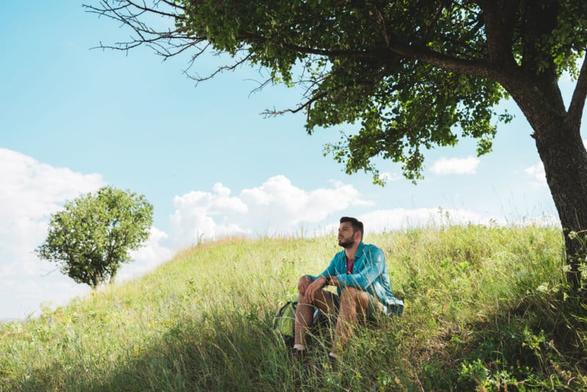
Let’s consider a pretty common scenario: You are taking a landscape photograph of a field on a sunny day, and you have a person in the foreground, a tree in the middle ground, and then some awesome swirly clouds in the deep background. Here’s your problem: What lens do you use, at what aperture, set to what focal point, so that all three major elements -- the person, the tree, and the clouds -- are in focus and sharp enough?

If you focus on the person, the tree is out of focus. If you focus on the clouds, the person is blurry. If you focus on the tree -- well, maybe that could work, or maybe the tree will be nice and sharp but the person and the clouds will both be out of focus. But let’s say you fiddle around a bit with your focus and find a “sweet spot” at 55 feet away, with your 85mm lens set to f/16, that puts all the important elements of the shot in focus. That “sweet spot” is your hyperfocal distance. Just write down your lens settings in your photography notebook -- 85mm, f/16, 55’ -- and now you know what your hyperfocal distance is!

Simple, right? Except that that’s only the hyperfocal distance for that field, with that person and that tree and those clouds. If the person isn’t exactly the same distance away the next time, you can’t use 55’ as your hyperfocal distance. Surely there must be a better way to calculate hyperfocal distance other than just guessing and checking for every element in every shot?

There is, as long as we set some ground rules. Let’s say that hyperfocal distance is the minimum focusing distance necessary, with a given lens, to get objects at infinity in focus. By “infinity”, we mean objects on the visible horizon like clouds or stars or distant mountains.

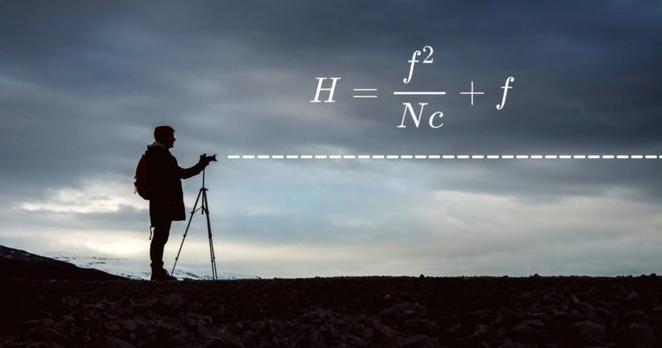
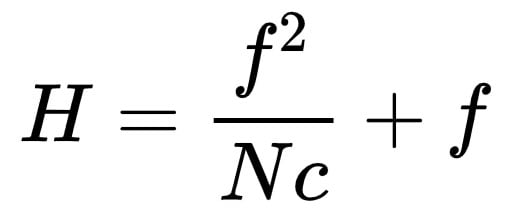
With that definition in mind, there is a complicated mathematical formula that will let you calculate the hyperfocal distance of any given lens… but it’s going to be completely useless to you in the field. In the field, you’re going to have to wing it.

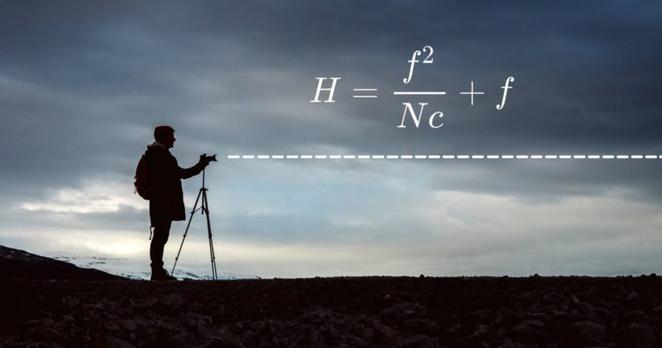
If you’re curious, the formula looks like this:

f is your focal length, N is your aperture, and c is your maximum circle of confusion, which is a way of measuring acceptable sharpness.

Here is where we run into our big problem: what counts as “in focus” is a subjective judgment. In our example, our goal was getting the background clouds and foreground person to be sharp enough. The problem is, there isn’t a universal definition of “sharp enough”. Maybe I want to see every eyelash on that person’s face, but you are OK with a little artistic blur. So how can we calculate the hyperfocal distance to get a shot “in focus” when there’s no way to nail down what “in focus” really means?

I bet that you thought that I was going to have an answer to that question. Unfortunately, I don’t, and this is the heart of what makes calculating hyperfocal distance so difficult. Even though you can mathematically define how sharp or fuzzy an image is, everyone has a different preference of how sharp something needs to be for it to be considered sharp “enough”.

The Subjective Route

One way to go is to embrace this subjectivity. Some people will tell you the best way to figure out hyperfocal distance is to set your desired aperture, then focus up until infinity is "perfectly sharp," and then zoom (using your lens with a zoom lens or your feet with a prime lens) to get your foreground in focus, adjusting as you go to make sure the background stays sharp.

Using this method, your hyperfocal distance will vary with your aperture setting. This is a subjective method for determining hyperfocal distance because where you focus will vary based on when you think the foreground elements are sharp enough.

The Objective Route

Others will say that the best way is to define hyperfocal distance is the objective method. With this technique, start with a lower aperture, compose your shot, and find the focal point in which infinity is equally as blurry as your foreground element. Remember, “equally sharp” and “equally blurry” mean the same thing. Then, without changing your focal point or your zoom, you can adjust your aperture until both foreground and background are acceptably sharp. (If they never get acceptably sharp no matter how high your aperture goes, that means that your equipment isn’t up to the job.)

Using this method, your hyperfocal distance is the same no matter what your aperture is, since you’re not finding your focus based on a subjective judgment of what is or isn’t sharp “enough”. Instead, you are finding your focus on where the background and foreground are equally sharp, which is an objective measure, and then adjusting only your aperture.

The “objective” method is sometimes called the “double distance” method because your focal point is going to be about double the distance from you to the closest foreground element. In our example of person, tree, and clouds, if the person is roughly 30 feet away from you, then your hyperfocal distance is going to be roughly 60 feet away. If you’re really good at estimating distances (or you have a laser rangefinder), you can use this shortcut to save yourself a lot of time by focusing at 60 feet, to begin with, and adjusting aperture from there.

Pros and Cons

Both of these techniques have their advantages. The subjective method involves keeping your background in perfect focus while doing the best you can to capture the foreground. This is obviously better when your background elements are the most important thing in the shot, like if you’re shooting starscapes. It also tends to save you frustration if your lens is shorter, or limited in terms of aperture settings.

The objective method works well if the entire composition has equal priority, in other words, if the horizon isn’t more important than your foreground. It also has the advantage of always being the same relative to your foreground elements. With any given lens and camera, as long as you know how far away your foreground is, your hyperfocal distance will not change. Finally, at least in my opinion, it makes for cleaner compositions, and overall it’s a lot less work.

Shortcuts

Now, all that being said, are there any shortcuts we can use? What about hyperfocal distance tables, or apps, or the focusing scale on the side of a lens? Well, the problem with tables and apps is that firstly, they prioritize background elements, so your foreground might come out blurry. Secondly, most of them use a formula optimized for 35mm film cameras and standard-sized physical prints. If you have a full-frame camera and if your photographs are destined to become 8x10s hanging in a gallery somewhere, then tables and apps might be fine. Otherwise, you’re going to get suboptimal results.

On the other hand, the focusing scales you find on the sides of lenses can actually work really well for finding hyperfocal distance -- if you know how to use them, and if your lens has one at all.

To find your hyperfocal distance, line up the infinity mark over your current aperture and note the distance that then appears right above the center index line of your depth-of-field scale.

In this example, the aperture is set at f/11, so the focus ring is turned until the infinity symbols are lined up with the f/11 mark to the right of the center index line. The resulting hyperfocal distance (seen above the center line) is a little past 10 feet or 3 meters. To the left of the center line, the other f/11 mark indicates the distance at which acceptable sharpness begins, which, in this case, is a little past 5 feet and 1.5 meters.

Most focusing scales nowadays only appear on professional-grade manual-focus prime lenses. Consumer-grade autofocus prime lenses only sometimes have scales, and even when they do, they can be pretty imprecise. As far as zoom lenses go, the only ones that have useful focus scales on them are push-pull zooms, and those went out of style in the mid-1980s. While you may occasionally find rudimentary focus scales on contemporary zooms, they’re not really good for much. Lastly, some older fixed-lens cameras may have a red dot on their focus dial. That red dot indicates the hyperfocal distance for that camera.

In Summary

So, to review: The hyperfocal distance in your shot is the minimum distance at which you can focus to get sharp focus on objects at infinity. You can find it in the field in two ways, either by focusing up to infinity then zooming to get the foreground in focus or by finding the point at which background and foreground are equally out-of-focus, then adjusting your aperture upwards until they’re in focus. Finally, you can sometimes use tables, apps, or scales as a shortcut, but they only work well in specific circumstances.’

If you’ve stuck with us this far, congratulations. There aren’t many technical topics in photography more complicated than hyperfocal distance. If you understand it, you’ve earned a pat on the back. The next time you’re out in the field with a manual lens and a few minutes to kill, why not try using one of our two methods? Once you get some practice at figuring it out on the fly, finding your hyperfocal distance becomes second nature.

Image credits: Stock photos licensed from Depositphotos. Illustration created with images (1, 2, 3, 4, 5) licensed under CC BY 3.0.

#educational #guides #tutorials #explainer #explanation #focus #guide #hyperfocal #hyperfocaldistance #technical

What is Hyperfocal Distance and How Do You Find It?

An explanation of what hyperfocal distance in photography is and how you can find it for your camera, lens, and scenario.