 New Lands RP
#HPG 💯 🔥
While over 93% of #HPG's revenue is still derived from steel, the company is also active in agriculture, logistics, and real estate

Visual Efficiency for Intel’s GPUs At Intel, we are reimagining the future of graphics—making it more nimble, accessible, and power-efficient. As the landscape of GPU technology rapidly evolves, we’re leading the charge to making premium visual experiences available on more GPUs, including low-po...
HPG: One Soldier Killed, Two Others Injured as Turkish Attacks Against Guerrilla Areas Continue
The Press Office of the People’s Defense Forces (HPG) reported that the Turkish army carried out 691 attacks on the guerrilla-held Medya Defense Zones in southern Kurdistan (northern Iraq) between April 21 and 23. Legitimate self-defense by the guerrillas left one soldier dead and two others injured.
According to the HPG statement on Thursday, details of the latest attacks by the Turkish army and interventions by the guerrillas are as follows:
Attacks by warplanes
On April 22, Turkish warplanes bombed the Girgaşê and Girê Kun areas in Garê region three times, the Girê Bahar Resistance Area in Şehîd Delîl Western Zap region once and the Sipîndarê area in Garê region twice.
On April 23, warplanes bombed the Sipîndarê and Girgaşê areas in Garê region four times, and the Girê Bahar Resistance Area in Şehîd Delîl Western Zap region once.
Attacks with heavy weapons, artillery and howitzers
On April 21, 22, 23 and 24, the Turkish army carried out 680 attacks with heavy weapons, artillery and howitzers, targeting the areas of Şehîd Kawa and Berê Zînê in Xakurkê region three times; the areas of Mijê, Dêreşê, Sipîndarê, Girgaşê and Girê Kun in Garê region 102 times; the areas of Şêlazê and Bêşîlî in Metîna region 160 times; the areas of Girê Amediyê and Girê Bahar in Şehîd Delîl Western Zap region 415 times.
Interventions by our forces
On April 19, guerrillas struck a container belonging to the invaders who were in an attack position in Girê Bahar Resistance Area in Şehîd Delîl Batı Zap region.
On April 22, a surveillance camera system used by the invading Turkish army to spy on our war tunnels in Girê Amediyê Resistance Area in Şehîd Delîl Western Zap region was hit and destroyed by our YJA Star (Free Women’s Troops) forces.
On April 22, the positions of the invaders who were in an attack position in the Girê Çarçel area in Metîna region were struck by our Şehîd Axîn Mûş Unit with a kamikaze drone. One soldier was confirmed killed and two others injured.
On April 22, a position of the invaders in the Girê Bahar Resistance Area in Şehîd Delîl Western Zap region was hit and damaged by our forces.
Warning to the people
HPG said they received information that money was being demanded in the name of their organization in the regions of Botan, Batman, and Çiyayêmazî and Derik in Mardin, particularly from businesspeople and some community circles. HPG made it clear that none of their units was tasked with such a mission, saying: “Collecting money from the people in this way is prohibited by our movement. Those who demand money in these places are likely to be rent-seeking gangs or agents organized by the enemy. Our people and patriotic-democratic organizations should pay attention to this matter and be sensitive to such agents-gangs and should not give money under the name of aid.”
https://abolitionmedia.noblogs.org/?p=18671
#guerrilla #hpg #kurdistan #pkk #resistance #turkey #westAsia
In Kurdistan, Resistance is Life
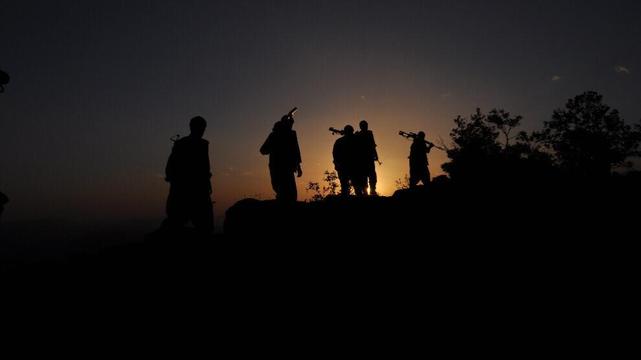
A historic resistance is taking place in the war tunnels in the Şehîd Munzur area in Zap region. This resistance has left three years behind. The occupying Turkish army tried to break this resistance by using all its means with all kinds of attacks and banned weapons, it ended up fruitless and helpless against the guerrillas because these valiant, selfless and courageous guerrillas, the defenders of the mountains of Kurdistan, are heroes like Gabar Botan, Xebat Tîrêj, Şervan Guerrilla, Çiyager Dîcle, Erdal Reşo and Munzur Serhed who sacrificed their lives for the sake of victory. That is why the resistance positions in the mountains of Kurdistan will never fall and the spirit of resistance will never disappear. The books of Kurdish and Kurdistan history are written with epics of resistance, because the Kurdish people have always managed to preserve their existence, culture and identity through great and unique resistance. For this reason, the people have a deep-rooted heritage of resistance.
This legacy was passed on from old to young, from parents to children. Today, this legacy of resistance is still growing in the hearts of the people and their children. If the Kurds had not resisted, they would have been shattered by many plans and agreements such as Qasr-e Shirin, Sykes-Picot and Lausanne. Neither their language, identity nor existence would have survived. If they had not resisted, systems like the Baathist regime, Iran’s extermination policy, and the fascist, racist and cruel mentality of the Turkish state would have destroyed even the name of the Kurds. These hegemonic systems would have used to sacrifice Kurds for their own interests, turning them into instruments of their interests. Yet, Kurds have always resisted, and this resistance still continues. With the philosophy of Leader Öcalan, this culture of resistance has gone beyond the understanding of patriotism based only on emotions; it has moved to a more conscious, organized and determined stage. Now the resistance in Kurdistan has become the voice and color of life. Today, in the mountains of Kurdistan, this voice echoes in the hearts of the guerrillas. This echo shakes and breaks down all the walls built by fascism and occupation.
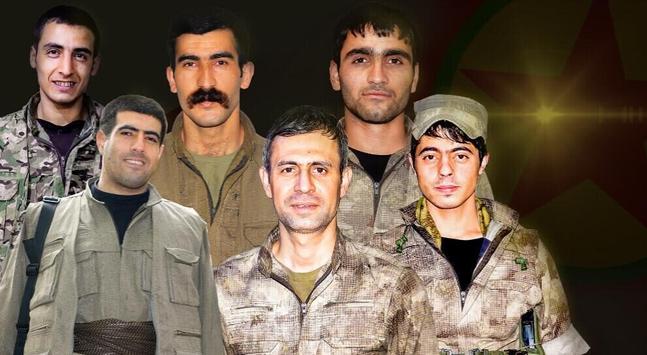
Commander Gabar Botan, guerrilla Şervan Guerrilla from Aleppo, Xebat Tîrêj from Eruh, the resistance fighter Çiyager Dîcle from Kobanê, Erdal Reşo from Nusaybin and the brave commander Munzur Serhed from Van contributed to the growth of this resistance with their lives. These six heroes became immortalized in different periods, inscribing their names in the most glorious epics of Kurdistan’s resistance history. They are the heroes immortalized in the Şehîd Munzur war tunnels.
The Şehîd Munzur Hill, west of Zap, was one of the first fronts to respond to the attacks by the occupying Turkish state in 2022. In 2021, before the invasion operations began in the areas of Avashîn and Zap, the heroes on Şehîd Munzur Hill underwent difficult preparations to resist the occupation. They were fedayeen who represented the resolute will of the people of Kurdistan; they had a conscious stance that knew the enemy very well and knew in advance how to respond. That is why they had prepared their plans for victory before the war began. That’s why they were very careful. Each of them had his weapon ready, waiting for the invading soldiers to make a mistake and get caught. When that moment came, the Apoist guerrillas were ready to write an epic of resistance and heroism. From the first arrival of the enemy until the day they were fully entrenched in the region, the guerrillas resisted with the same assertion, belief and determination. They fought to raise the hope of freedom of the people of Kurdistan.
These heroic guerrillas bore a spirit that was steeped in freedom, believed in victory and sacrificed themselves on Şehîd Munzur Hill to build an honorable life. That position was defended with such conviction that NATO’s second-largest army could not overcome those guerrillas despite mobilizing all their means, all their technology and the use of all kinds of banned weapons. When the occupying troops tried to enter the area, when they made great efforts to capture it, commander Gabar Botan and his comrades knew very well how to respond to the enemy. With tactics appropriate to the war conditions of the time, they came out of the tunnels, attacked like hawks and retreated again. They made plans against the enemy in their own positions in every way and implemented these plans with a sacrificial spirit.
For three years, with the enthusiasm of comradeship, they resisted against all odds. Even in the most difficult emplacements, they believed in the possibility of victory, strengthening each other with a determination mixed with hope and love. For three years, the occupying army tried all means at the door of the tunnels to crush their hopes and then to destroy them, but they failed. Chemical weapons, phosphorus bombs, nuclear tactics, tank and artillery shelling hundreds of times a day, warplanes and drones were used. The natural structure of the Şehîd Munzur Hill was changed, but the spirit shaped by heroes like Gabar, Erdal, Çiyager, Xebat, Şervan and Munzur, never changed. On the contrary, the bond between them grew stronger.
In the cold days of winter, the guerrillas stood guard at their positions for long hours, shouldered the burden of military discipline and remained alert at all times. With limited means, each one thought of the other and gave their food to their comrades. When they were wounded, they bandaged each other’s wounds with the warmth of the PKK comradeship. Even in the most difficult moments, they sang uplifting songs to each other, strengthened each other with enthusiasm and spirituality, and made everyone wish with hope to be in their positions. For more than 1095 days, each day with resistance stronger than the last, they did not allow a moment of indecision in their hearts. Lack of sleep, limited water and food, the cold of winter and the scorching heat of summer never became exhaustion or obstacles for them. Under all circumstances and conditions, they organized themselves with the power of Apoist ideology, united their minds and strength to defend each other against all kinds of attacks. With their intelligence and skills in military fields, they transformed their tunnels into action headquarters.
They were masters of sabotage and infiltration tactics in guerrilla warfare. They ambushed invading soldiers, pulled in the corpses of enemies who tried to descend into their tunnels and taught them unforgettable lessons. In the tunnels, they lived together a life with meaning in every aspect. They knew very well that with this resistance they represented the will of the people. They were aware that they were fighting for peoples who had been oppressed for centuries. For this reason, they knew the value of time and space, correctly understood the role and mission that history had placed on their shoulders and fought with this consciousness. Erdal, who commanded from Cizîra Botan to Gabar focused on victory; Xebat, who gave support and strength to his comrades; Çiyager from Kobanê, who glorified the Apoist revolutionary line; Şervan, who carried the enthusiasm of youth, and Munzur from Serhed, who engraved the belief of victory in the hearts of his comrades; each of them was like a vast ocean. They were true fighters of the Apoist line with their patience, faith, devotion and sacrifice.
For three years, these brave men and women resisted non-stop. Every day, at a distance of 10-20 meters, they fought against an enemy who knew no rules of war. Despite the attacks by an enemy that does not recognize moral values, their comrades now continue to walk in their footsteps. For three years, they neutralized NATO’s second-largest army at the door of the tunnels, leaving them helpless. They wrote a new book in the history of Kurdish resistance. The heroism on Şehîd Munzur Hill is engraved in history. Today, in the footsteps of these immortal heroes, the spirit of resistance in ŞehîdMunzur is spreading to the area of Şehîd Delîl Zagros as well. With the same determination, their comrades continue to defend the sacred lands of Kurdistan with their blood and sacrifice.
https://abolitionmedia.noblogs.org/?p=18610
#guerrilla #hpg #kurdistan #pkk #resistance #turkey #westAsia
A Three-Year Epic of Resistance: Girê Fm War Tunnels
Writing about them cannot be done in a few days or a few weeks. Of course, the details of a war that lasted three years, every day of which was epic, cannot be described in a single article.
Because, resisting in that tunnel was neither striking the enemy in a sudden random encounter nor going against the invaders with an ordinary action. Fighting in that position, in the Girê FM- Şehîd Munzur war tunnels was not like that.
It was not one-time patience; it was a will of steel, a bullet-proof perseverance against the faces of Nimrod, Pharaoh and Dehak in the 21st century… It was not a zeal that fit into time or seasons, but a century of zeal, a century of stubbornness in the hearts of Gabar, Şervan and Xebat.
For them, resistance was not an inclination or a whim. It was a way of life, even life itself. Like breathing in and out… Resistance and victory were more necessary and more essential than bread and water…
Every day of their resistance from May 2022 until the winter of 2025 was centered on the same goal. They melted their lives every moment of every day for three years so that they could be remembered in the pages of history as victorious, and they did not say “we surrender”.
Because, inside their minds were not the betrayers who raised the white flag and waited hand and foot at the door of a tunnel; in their utopia of the future were proud and bolt-upright revolutionaries celebrating the glory days of the war with their red flags in their hands.
Gabar, Xebat and Şervan were meant to be the revolutionaries of that great day. So, it was not in vain. Resistance was not a memory of a bygone time whose time had passed and whose name was no longer remembered…
The longest lasting tunnel resistance
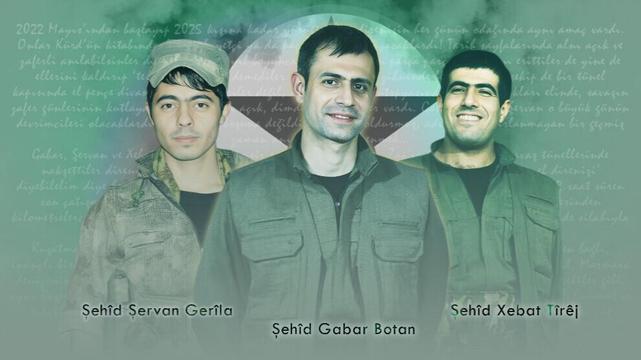
Gabar, Şervan and Xebat engraved their resistance in Zap’s Şehîd Munzur war tunnels, built with the endless labor of the guerrillas, each carrying a piece of resilient spirit. Today, they struck the enemy every day with their hands on the trigger, so that we could say “the longest lasting tunnel resistance in the history of guerrilla struggle”.
Commander Gabar Botan was the victor of the last 12-hour battle. While the so-called war commanders of the Turkish army were “safe distance commanders” with binoculars in their hands, kilometers away from the fighting positions, Commander Gabar was a provincial commander who shot down invaders and enemy positions with his weapon in his hand.
Even in the midst of the sieges, in a dog-eat-dog world, they continued to fight as committed, selfless devotees of Rêber Apo [Leader Abdullah Öcalan]. Like their predecessors, like the Bager Gevers, they lived in the moment and place where they felt closest to the Leader. This was precisely the source of their endurance and strength. Otherwise, what resource, what power, what willpower could resist for three years against savage barbarians who had equipped themselves with the weapons of the modern age?
They were not the ones who suffocated under chemical gas bombardments. They were the ones who repelled the enemy from the front of the tunnels in breathtaking clashes even under those bombardments. They were the ones who rained guerrilla wrath under tank and artillery strikes; they were the ones who emerged victorious from the battle of wills, not the ones whose will was broken in every call for surrender!
Commanders Gabar, Şervan and Xebat…They will live free in the hearts of guerrillas for hundreds, thousands of years. They became the authors of a three-year epic with the philosophy of ‘a morsel and a cardigan’.
source: ANF English
https://abolitionmedia.noblogs.org/?p=18544
#guerrilla #hpg #kurdistan #pkk #resistance #turkey #westAsia
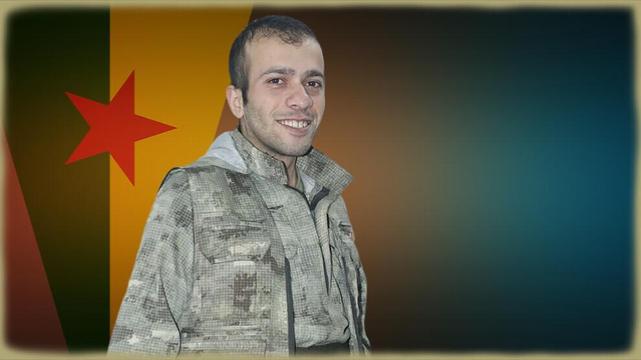
HPG Pays Tribute to Guerrilla Dilmaf Efrîn
Guerrilla Dilmaf Efrîn fell as a martyr in February in South Kurdistan’s Gare region following a tragic accident and an ensuing explosion. The People’s Defense Forces (HPG) issued a statement to pay tribute to the martyr and said that “with his passing, the Kurdish guerrilla movement has lost a determined and highly respected fighter who dedicated his life to the struggle for Kurdistan’s freedom.” The HPG shared the following details about the guerrilla:
Codename: Dilmaf Efrîn
Full name: Xelîl Cuma
Place of birth: Efrîn
Parents’ names: Nura – Reşîd
Date and place of death: 6 February 2025, Gare
Dilmaf was born in Afrin (Efrîn), Rojava, a region known for its deep ties to the Kurdish freedom movement. From a young age, he was exposed to the political reality of Kurdistan. Stories of guerrilla fighters, the resistance against assimilation, and state repression left a lasting mark on him. The sense of alienation he experienced in state-run schools, where he couldn’t freely speak his mother tongue, further fueled his desire for a different life.
He worked from a young age to support his family, developed a strong awareness of social inequality, and soon joined the Kurdish youth movement. Guided by a deep sense of justice, his path eventually led him to the guerrilla ranks, a conscious decision to opt for a life of simplicity, collectivity, and resistance.
In 2014, he officially joined the Kurdish movement. After a brief basic military training, guerrilla Dilmaf participated in numerous operations, as well as in the fight against the Islamic State (ISIS). His discipline, sense of responsibility, and political clarity quickly earned him the trust of his comrades.
His political thinking was especially influenced by the ideas of Abdullah Öcalan and the concept of Democratic Confederalism. Dilmaf was not only a fighter but also a learner: he immersed himself in political and ideological education, participated in specialized trainings, and became a seasoned guerrilla. Comrades described him as sincere, helpful, energetic, and deeply loyal to his ideals.
His final deployment was in a particularly strategic region, where he continued his work with great determination until his death.
The HPG wrote: “Dilmaf was more than a fighter. He was a role model. With his determination, sincere character, and deep dedication to the cause, he has secured a place in the collective memory of our movement. His death is a great loss, but his life remains a legacy. It is now the responsibility of the Kurdish freedom movement, his comrades, and the people of Afrin to carry forward his efforts until the dreams he died for become reality.”
HPG Pays Tribute to Guerrillas Doğa Şîn and Eylül Deniz Zagros
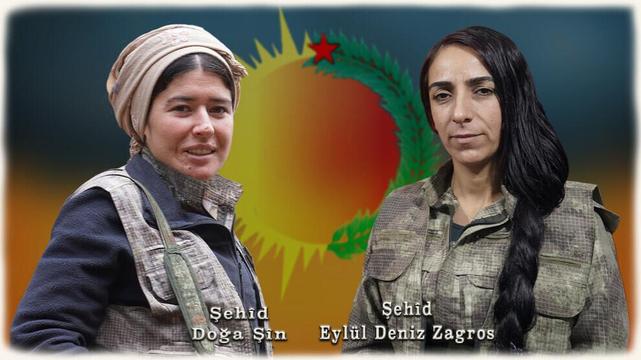
The People’s Defense Forces (HPG) paid tribute to Free Women’s Units (YJA Star) guerrillas Doğa Şîn and Eylül Deniz Zagros, who fell as martyrs in Turkish attacks on Gare.
According to the HPG, both fighters were involved in resistance in various regions of Kurdistan for years and sustained fatal injuries during two separate attacks in January and February. The HPG described them as “courageous and dedicated militants” who had devoted their lives to the struggle for Kurdish freedom.
The People’s Defense Forces expressed their condolences to the families of the two fallen fighters and emphasized in their obituary the emotional connection the women had with the ideals of the movement. They were honored as role models for the new generation of young activists. The loss, they said, is a heavy blow, but their legacy will live on, in political work, the fight for recognition and rights, and in the cultural memory of the Kurdish movement.
“Doğa and Eylül were not just militants; they were symbolic figures of a movement that stands against oppression and for a life of freedom,” the statement read. Their courage and determination made them role models beyond death. “We will continue their path with determination,” concluded the message.
Nom de Guerre: Doğa Şîn
Full name: Binevş Altay
Place of birth: Pirsûs
Mother and father’s names: Üveyş – Selami
Date and place of death: January 11, 2025 / Gare
Nom de Guerre: Eylül Deniz Zagros
Full name: Evin Işbilir
Place of birth: Gever
Mother and father’s names: Güzel – Halit
Date and place of death: February 1, 2025 / Gare
Doğa Şîn
Originally from the northern Kurdish town of Suruç (Pirsûs), Doğa Şîn grew up in a politicized environment and joined the guerrillas in 2014, amid the war against the Islamic State (ISIS). Her decision was made under the impression of the attack on the western Kurdish city of Kobanê, located directly across the border from Suruç. “She promised herself at that time to support the people who had lost their homes and to stand against what she saw as the cause of their suffering,” said the HPG.
Prior to that, Doğa Şîn had spent years searching for a way out of what she perceived as an alienating society. Her encounter with the ideology of Abdullah Öcalan, and especially his views on women and alternatives to the capitalist system, led her to the Kurdish freedom movement. After joining the guerrillas, she fought directly in areas where resistance against ISIS was taking place. Following an injury at the front and a lengthy recovery, she returned to active combat, this time in the mountains.
Despite coming from a flatland region, she quickly felt at home in the mountains. There, she was active in various organizational and military roles. With strong determination and tactical skill, she specialized in modern guerrilla warfare. Her comrades described her as a disciplined, creative, and reliable fighter who never shied away from challenges.
In one of her writings, Doğa Şîn described the mountains as motherly and protective, a metaphor for her journey of self-discovery. In her military operations, she reportedly stood out for her precision and dedication.
Eylül Deniz Zagros
Eylül Deniz Zagros was born in Yüksekova (Gever), in the northern Kurdish province of Hakkari (Colemêrg), a region known for its deeply rooted spirit of resistance. Her family had already been active in the Kurdish liberation struggle in previous years, which had a profound influence on her. As a teenager, she was involved in political activism, and from around 2009, she participated in organizing community self-defense. In 2012, she left university and joined the guerrillas in the Zagros Mountains.
She viewed her political and ideological training as the foundation for her later military education. According to her own accounts, her motivation was closely tied to the violent deaths of her brother and a paternal cousin in 2013 in Yüksekova. Both men were shot dead by snipers from a Turkish police special unit during a protest against the desecration of a guerrilla cemetery.
Her path in the guerrilla eventually led her into the fight against ISIS, including in the Yazidi region of Shengal, where a genocide occurred in 2014 and Yazidi women were systematically kidnapped and abused. She considered the suffering of Yazidi women as symbolic of patriarchal violence, which motivated her to resist with determination.
After several injuries, Eylül Deniz Zagros returned to the Medya Defense Areas, continued her training, and contributed to the development of new guerrilla tactics. According to the obituary, she placed great emphasis on collective responsibility, humility, and gender equality within the movement. She became a role model for many young women through her determination.
The Name of Kurdish Women Will Always be Remembered in the Epics of Resistance
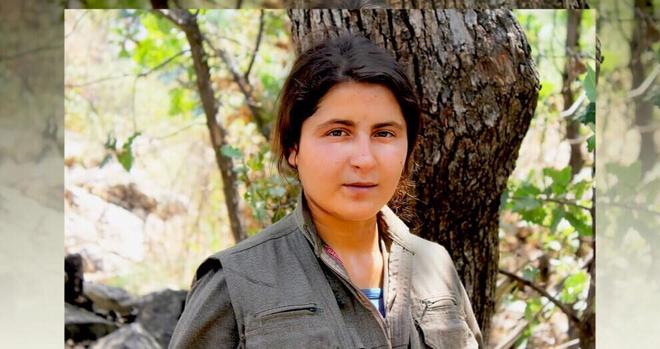
From the land of Derwêş and Edûlê, a young woman with a pure heart joined the struggle for freedom. Cîhan Hîvron (Lînda Xeyrî Hecî) became a fighter for her country, a resister for women’s freedom, a seeker of truth for a right and meaningful life.
Cîhan Hîvron, who was born in Shengal (Sinjar) into a patriotic Kurdish family committed to Yazidi values, got to know the PKK (Kurdistan Workers’ Party) more closely with the Kurdistan Freedom Guerrillas who ran to the help of the Yazidi community during the ISIS onslaught in 2014. Having witnessed the massacre and abduction of thousands of people and the migration of hundreds of thousands during the ISIS attack, Hîvron joined the resistance units in 2016 to avenge Yazidi women. She contributed to the cleansing of Shengal from the mercenaries, and after the withdrawal of the guerrillas from Shengal in 2018, she took to the mountains of Kurdistan.
Cîhan Hîvron received the first basic education at the Martyr Rojîn Gewda Academy, and better understood and deepened on the thoughts of Leader Apo [Abdullah Öcalan]. She set an example for her comrades with her deep devotion to the land of Kurdistan. With the strength of her love for her country, she took part in the forefront of every work and quickly adapted to the guerrilla life. Throughout her education, she learned with great curiosity and participated in discussions clearly and radically. She constantly read and improved herself in order to understand Leader Apo’s style, manner and pace. She attached as much importance to improving herself in the military field as she did to organisation and ideological development. For this reason, she participated in every military training and lesson on weapons and tactics with great enthusiasm. As a Yazidi woman, she wanted to be a strong example for all young girls in her community.
The guerrilla fighter Cîhan, who deeply felt the pain caused by the massacres committed against her people, the enslavement and sale of women, and leaving children without language, identity and culture, took Leader Apo’s ideas as a guide and moved towards her goal. After completing her academy education, she participated in practical work. With the training she received and the faith her comrades had in her, she participated in the struggle more actively. Guerrilla Cîhan was devoted to comradeship, her country and her people with an endless love. For the sake of this devotion, she did not spare any labour and sacrifice. She never closed her ears to the cries of the children of her country. She did not remain indifferent to the lamentations of the mothers of martyrs.
On the peaks of the mountains of Shengal, even in the most difficult moments of the war, she could see the light of hope on the faces of her people and continued her struggle every day with vows to realise this hope. She was a source of inspiration for all her comrades; with her positive energy she would add the colour of hope to their hearts, and with determination in her eyes she would tell them ‘Victory is ours, comrade’. Cîhan’s face was recorded in the hearts of her comrades and in the memory of her people with the most beautiful colours. As a guerrilla fighter who set an example to her comrades with her struggle, courage, resistance and sacrifice, she played a pioneering role in the freedom struggle of her people and did not succumb to any difficulties.
On 25 May 2019, during an enemy attack on the Medya Defence Zones, she was martyred together with a group of her comrades, becoming an example for young Kurdish women and especially for Yazidi women. She did not accept an aimless life; she had great goals and she continued her life in line with these goals. She took brave steps, struggled and never backed down. That is why guerrilla Cîhan will never be forgotten; her name will be remembered with great honour in the resistance epics of Kurdish women, among the heroes of the freedom struggle.
https://abolitionmedia.noblogs.org/?p=17935
#guerrilla #hpg #iraq #kurdistan #pkk #resistance #turkey #westAsia
 Vietnam Insider
 kaplanyan
 abolitionmedia
 ASX Mkt. Sensitive