 BastilleBSD
More IDN homograph detection research today. This screenshot is a bit horrifying considering how nearly identical many of the invalid entries visually match the valid entry (top).
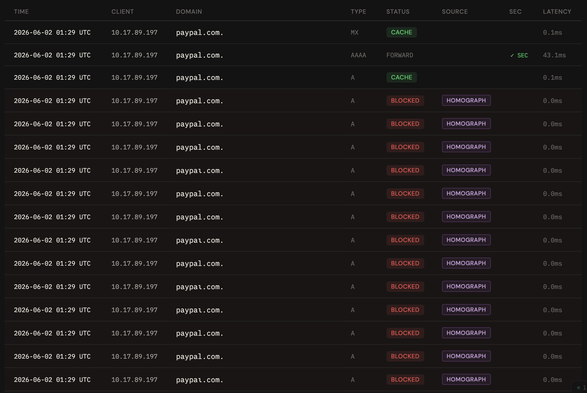
More IDN homograph detection research today. This screenshot is a bit horrifying considering how nearly identical many of the invalid entries visually match the valid entry (top).
Screenshot from my custom (Rust) DNS filtering-forwarder with new experimental runtime IDN homograph detection against a predefined protected domain list.
Screenshot results reflect these punycodes:
xn--ggle-55da.com google.com BLOCK
xn--pypl-53dc.com paypal.com BLOCK
xn--pple-43d.com apple.com BLOCK
xn--fiq228c5hs.cn chinese ALLOW

Today I fell down the rabbit hole of detecting and blocking IDN homograph attacks at the DNS level. Some of the homograph domains are clever!
How do homograph attacks deceive even the most cautious users?
Homograph attacks are a growing threat in the world of cybersecurity. These attacks use characters from different alphabets that look similar to create deceptive domain names, tricking users into visiting fake websites and potentially compromising sensitive information.
🔗 All you need to know about homograph attacks https://outpost24.com/blog/homograph-attacks-how-hackers-exploit-look-alike-domains/
Welcome to the #Promptodon #WritingPrompt also today's #Haiku
Today's Prompt (Jan 5):
Caterwaul, my cat,
I'll cater for y'all when you
Clau up that nice waul.

There are many sectarian divides in computer. "Little-Endians" and "Big-Endians" wage bitter war against each other over the order of bits. Should line in text files end with \r\n or just \n? And both vi and emacs users fight betwixt themselves while ignoring the superior foe - nano. Perhaps the most contentious of these is the battle between URI and URL. Should we refer to links on the web…
It is spelled "URl"
https://shkspr.mobi/blog/2020/03/it-is-spelled-url/
There are many sectarian divides in computer.
\r\n or just \n?vi and emacs users fight betwixt themselves while ignoring the superior foe - nano.Perhaps the most contentious of these is the battle between URI and URL. Should we refer to links on the web as Uniform Resource Identifiers or Locators? Obviously there is a correct answer - and anyone who disagrees is a heretic.
So, I've come up with a compromise guaranteed to annoy satisfy everyone - URl.
That's upper-case U, upper-case R, lower case L.
Perfect!
There are many sectarian divides in computer. "Little-Endians" and "Big-Endians" wage bitter war against each other over the order of bits. Should line in text files end with \r\n or just \n? And both vi and emacs users fight betwixt themselves while ignoring the superior foe - nano. Perhaps the most contentious of these is the battle between URI and URL. Should we refer to links on the web…
 Martin Schäfer
 Outpost24
 Renaud Lifchitz

 Jocelyn Sordoni
 Nathan Wasson 🇺🇦
 Terence Eden
 Terence Eden’s Blog