The special issue on time-geography & mobility analytics includes a number of super interesting studies [ahem ahem!] including this paper showing how to explore the time-geography of public transport networks with the {gtfs2gps} package #rstats https://www.urbandemographics.org/publication/2022_jgs_time_geography_gtfs2gps/ #gtfs2gps
Exploring the time geography of public transport networks with the gtfs2gps package | Urban Demographics

Urban Demographics

2. We're now using #gtfs2gps to estimate public transport emissions with the new #gtfs2emis package in #rstats.
📦Package: https://ipeagit.github.io/gtfs2emis/
🔖Paper preprint: https://osf.io/8m2cy/
🌐Blog post: https://transportpolicymatters.org/2022/12/12/measuring-public-transport-emissions/

What applications could gtfs2gps help you with?

Estimating Public Transport Emissions from General Transit Feed Specification (GTFS) Data

A bottom up model to estimate the emission levels of public transport systems based on General Transit Feed Specification (GTFS) data. The package requires two main inputs: i) Public transport data in the GTFS standard format; and ii) Some basic information on fleet characteristics such as fleet age, technology, fuel and Euro stage. As it stands, the package estimates several pollutants at high spatial and temporal resolutions. Pollution levels can be calculated for specific transport routes, trips, time of the day or for the transport system as a whole. The output with emission estimates can be extracted in different formats, supporting analysis on how emission levels vary across space, time and by fleet characteristics. A full description of the methods used in the gtfs2emis model is presented in Vieira, J. P. B.; Pereira, R. H. M.; Andrade, P. R. (2022) <doi:10.31219/osf.io/8m2cy>.

Key message: #gtfs2gps outputs general purpose trajectory data that can be used for several applications:
1. Lewis Lehe et al have used #gtfs2gps to analyze bus stop spacings in the US, which can importantly influence service coverage & accessibility https://findingspress.org/article/27373-distributions-of-bus-stop-spacings-in-the-united-states
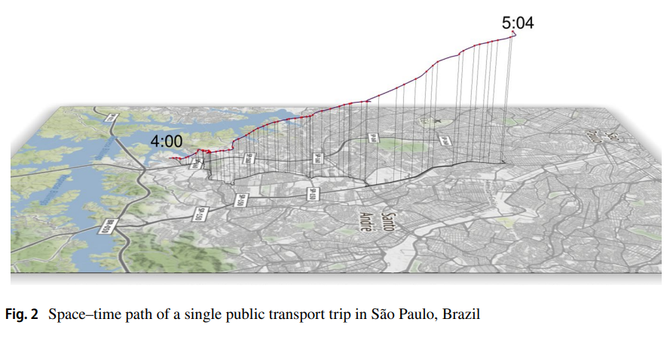
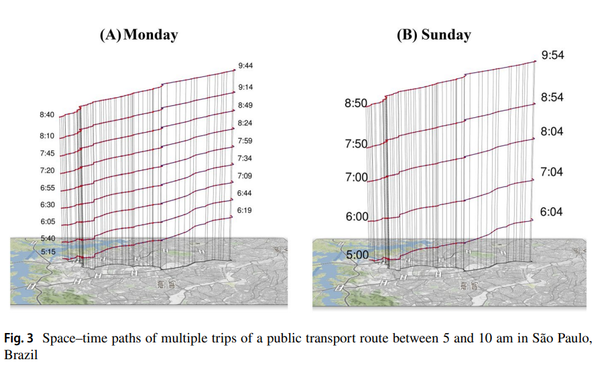
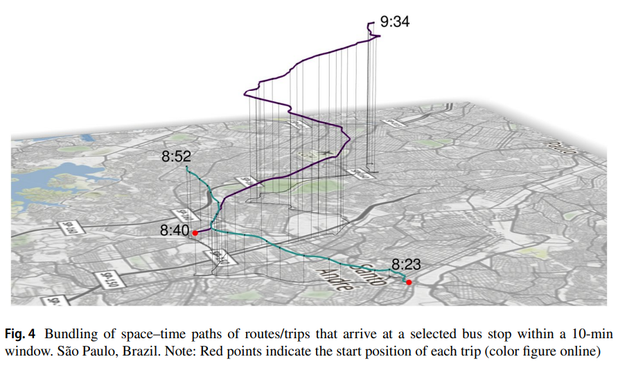
First, we explain the package methods and demonstrate how #gtfs2gps can be used to articulate key concepts in #TimeGeography to explore and visualize the spatial and temporal patterns of public transport networks. Figures show the space-time paths and Bundling of trips #rayshader
#gtfs2gps reports the space-time trajectories of public transport vehicles at fine spatial & temporal resolutions, which could be useful for several applications. We demonstrate the package in the paper in two ways:
In this paper,
@joaopbazzo
, P.Andrade (
@dsrinpe
) and I introduce #gtfs2gps, an #rstats package that converts public transport data in #GTFS format to a trajectory data table format, similar to GPS records showing the timestamps of vehicles in every trip +
Very glad to share that our paper introducing the #gtfs2gps package in #rstats has been accepted for publication in a special issue on #TimeGeography edited by @paezha in @JGeoSys.
Here's the:
- preprint https://osf.io/preprints/socarxiv/qydr6/
- 📦 https://ipeagit.github.io/gtfs2gps/
---
RT @UrbanDemog
New preprint where we explaing the methods behind the #gtfs2gps R package and show how it can help us understand and visualize the #Tim
https://twitter.com/UrbanDemog/status/1523733938753404928